
Surgical Instruments Types: Complete Guide | Reto Surgical
Surgical Instruments Types: A Reto Surgical Overview
Surgical instruments are essential tools used by healthcare professionals to perform procedures with precision, control, and safety. From basic tissue handling and cutting to complex surgical procedures, the right instrument can make a significant difference in clinical performance and efficiency.
With decades of experience in manufacturing and supplying medical and dental instruments, Reto Surgical provides a wide range of precision surgical instruments designed to meet the requirements of healthcare professionals, distributors, importers, and OEM customers worldwide.
In this guide, we explore the major types of surgical instruments, their common applications, important design features, and considerations when selecting quality surgical instruments.
What Are Surgical Instruments?
Surgical instruments are specially designed medical devices used by surgeons, dentists, and other healthcare professionals during surgical or clinical procedures. Depending on their intended function, instruments may be used for cutting, grasping, holding, retracting, dissecting, suturing, or manipulating tissues and other materials.
Surgical instruments are manufactured in different shapes, sizes, configurations, and materials to suit specific procedures. Stainless steel is one of the most commonly used materials because of its strength, corrosion resistance, durability, and suitability for cleaning and sterilization.
The performance of an instrument depends not only on its design but also on material quality, manufacturing precision, finishing, hardness, surface treatment, and quality control.
Major Types of Surgical Instruments
Surgical instruments can be categorized according to their function. Although there are many specialized instruments available, the following categories cover some of the most commonly used surgical instrument types.
- Cutting and Dissecting Instruments
Cutting instruments are designed to cut tissues, sutures, dressings, and other materials during medical procedures.
Common examples include:
- Surgical scissors
- Operating scissors
- Dissection scissors
- Tissue scissors
- Bandage scissors
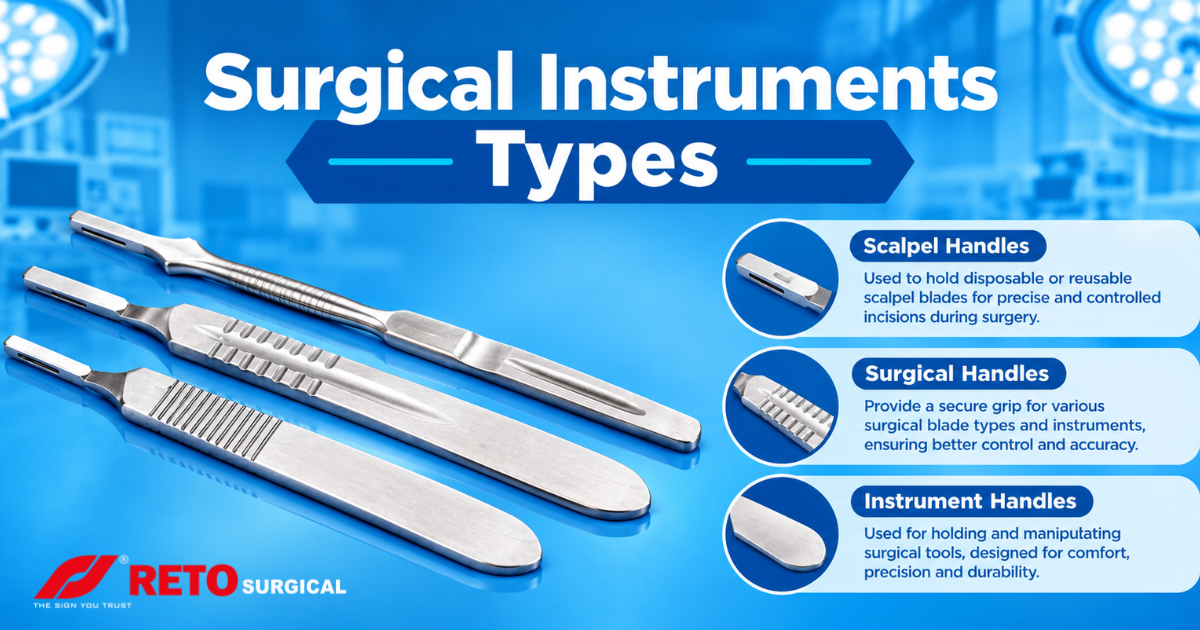
- Surgical blades and handles
- Bone-cutting instruments
Scissors are available in straight, curved, sharp/sharp, sharp/blunt, and other configurations. The appropriate design depends on the procedure and the material being cut.
Precision is particularly important for cutting instruments because sharp and accurately aligned cutting edges can help provide controlled performance.
- Grasping and Holding Instruments
Grasping instruments are used to securely hold tissues, materials, or surgical components during procedures. Their jaws may be smooth, serrated, toothed, or specially shaped depending on the intended application.
Examples include:
- Tissue forceps
- Dressing forceps
- Dissecting forceps
- Adson forceps
- Allis tissue forceps
- Babcock forceps
- Thumb forceps
Different jaw patterns provide different levels of grip and tissue handling. For delicate tissues, atraumatic designs may be preferred, while toothed configurations can provide a stronger grip when required.
- Hemostatic and Clamping Instruments
Hemostatic instruments are used primarily to control bleeding by clamping blood vessels or tissues. They are an important part of many surgical instrument sets.
Common examples include:
- Mosquito hemostatic forceps
- Kelly forceps
- Crile forceps
- Rochester forceps
- Artery forceps
- Vascular clamps
- Surgical clamps
Many hemostatic instruments incorporate a ratchet mechanism that allows the user to maintain controlled pressure without continuously holding the handles together.
The correct combination of jaw design, serration pattern, locking mechanism, and instrument size is important for effective performance.
- Retractors
Retractors are designed to hold tissues or organs away from the surgical site, helping provide better visibility and access to the area being treated.
Retractors may be:
- Hand-held retractors
- Self-retaining retractors
- Single-ended retractors
- Double-ended retractors
- Specialized surgical retractors
Examples include Army-Navy retractors, Langenbeck retractors, Richardson retractors, Deaver retractors, and specialized retractors for particular surgical procedures.
Retractor design can vary significantly depending on the surgical specialty and anatomical area involved.
- Needle Holders
Needle holders, also known as needle drivers, are used to hold and manipulate surgical needles during suturing.
They generally feature:
- A locking ratchet
- Textured or serrated jaws
- Ergonomic finger rings
- Different jaw lengths and configurations
Common types include Mayo-Hegar needle holders and specialized needle holders designed for delicate or microsurgical procedures.
A properly manufactured needle holder should provide a secure grip while allowing the surgeon precise control over the needle.
- Surgical Suction Instruments
Suction instruments are used to remove blood, fluids, irrigation solutions, and other materials from the surgical field.
Common examples include:
- Yankauer suction tips
- Frazier suction cannulas
- Poole suction instruments
- Surgical suction tubes
The diameter, tip configuration, and overall length can vary according to the procedure and required level of suction.
- Probes and Exploratory Instruments
Probes are used to examine, locate, or explore anatomical structures, cavities, wounds, and other areas during clinical procedures.
Examples include:
- Surgical probes
- Sinus probes
- Fistula probes
- Dental probes
- Double-ended probes
These instruments are commonly manufactured with smooth, carefully finished working ends to support controlled examination.
- Dilators and Retractors
Dilators are used to gradually enlarge or maintain an opening, while specialized retracting instruments provide access to specific surgical areas.
Their applications can vary across general surgery, gynecology, urology, ENT, dental surgery, and other specialties.
Because these instruments may come into contact with delicate tissues, appropriate dimensions, surface finishing, and smooth working surfaces are important considerations.
- Suturing Instruments
Suturing instruments support the process of closing surgical wounds and securing tissues.
This category includes:
- Needle holders
- Suture scissors
- Tissue forceps
- Suture forceps
- Specialized suturing instruments
Suturing sets are often selected according to the type of procedure, tissue involved, and surgeon preference.
Materials Used in Surgical Instruments
Material selection is an important part of surgical instrument manufacturing. Stainless steel is widely used because it offers a combination of strength, durability, corrosion resistance, and suitability for repeated processing.
Different grades of stainless steel may be selected according to the intended application. Common examples used in medical instrument manufacturing include AISI 410, AISI 420, and AISI 304, depending on the instrument and its functional requirements.
The manufacturing process can also include precision machining, forging, heat treatment, grinding, polishing, passivation, laser marking, and other finishing processes.
At Reto Surgical, attention to material specifications and manufacturing processes supports consistent instrument quality and traceability.
What Makes a Quality Surgical Instrument?
Choosing surgical instruments should involve more than simply comparing appearance or price. Important factors include:
Material quality: The instrument should be manufactured from suitable materials for its intended application.
Precision: Working ends, jaws, cutting edges, hinges, and locking mechanisms should be accurately manufactured.
Surface finishing: A smooth and appropriate finish can support cleaning, durability, and corrosion resistance.
Ergonomics: Handles and finger rings should provide comfortable and controlled operation.
Durability: Reusable instruments should be capable of performing reliably through their intended service life when properly maintained.
Traceability: Product identification and batch/lot traceability can help support quality management and supply-chain control.
Quality management: A structured quality management system is important for consistent manufacturing and documentation.
Reto Surgical: Surgical Instrument Manufacturing and OEM Solutions
Reto Surgical is a manufacturer and exporter of surgical and dental instruments, serving customers and business partners in international markets.
Our product capabilities cover a broad range of surgical instruments, dental instruments, dental implants and implant accessories, as well as customized and OEM manufacturing solutions.
We work with importers, distributors, healthcare businesses, and professional partners who require reliable manufacturing, consistent quality, and flexible product development.
Reto Surgical can also support customers requiring custom instrument patterns, specific dimensions, customized designs, laser marking, and product identification solutions.
For suitable products, customers can discuss their requirements with our technical and manufacturing team to determine the appropriate material, design, finishing, packaging, and production specifications.
Choosing the Right Surgical Instrument Supplier
For distributors and importers, selecting the right manufacturing partner is an important business decision. A reliable supplier should be able to provide consistent product quality, appropriate documentation, dependable communication, and production capacity.
Before placing an order, customers may wish to evaluate:
- Product range and manufacturing capabilities
- Material specifications
- Quality control procedures
- Documentation and traceability
- Custom manufacturing capabilities
- Packaging options
- Export experience
- Production capacity
- Sample and evaluation procedures
- Long-term supply capabilities
Samples can also be useful for evaluating instrument design, finishing, functionality, and overall manufacturing quality before moving to larger orders.
Conclusion
Surgical instruments are fundamental to modern healthcare, with each instrument designed to perform a specific function. From cutting and grasping instruments to clamps, retractors, probes, needle holders, and specialized surgical tools, selecting the correct instrument is essential for controlled and efficient procedures.
For manufacturers, precision engineering, appropriate materials, careful finishing, quality control, and traceability are all important elements in producing dependable surgical instruments.
Reto Surgical combines manufacturing experience with a broad product range and OEM capabilities to support distributors, importers, healthcare businesses, and international customers looking for surgical and dental instrument solutions.
Whether you require standard surgical instruments, customized designs, or products developed according to your specifications, Reto Surgical can work with you to explore suitable manufacturing solutions.
Frequently Asked Questions
- What are surgical instruments?
Surgical instruments are specialized medical tools used by surgeons and healthcare professionals for cutting, grasping, dissecting, retracting, suturing, holding, and manipulating tissues during surgical procedures. - What are the main types of surgical instruments?
Common categories include cutting instruments, grasping and holding instruments, dissecting instruments, retractors, clamping and occluding instruments, suturing instruments, suction instruments, and specialized surgical tools. - What are cutting surgical instruments?
Cutting instruments are designed to cut tissue, sutures, or other materials. Examples include surgical scissors, scalpels, and various specialized cutting instruments. - What are grasping and holding instruments?
These instruments are used to securely hold tissues, materials, or other instruments during procedures. Examples include tissue forceps, dressing forceps, and specialized surgical graspers. - What are surgical forceps used for?
Surgical forceps are commonly used for grasping, holding, manipulating, or positioning tissue and surgical materials. Different jaw designs are available for different applications. - What are surgical scissors used for?
Surgical scissors are used for cutting tissues, sutures, dressings, and other materials. Their blade shape, length, and tip design vary according to their intended application. - What are retractors in surgery?
Retractors are instruments used to hold tissues or organs away from the surgical field, helping provide better visibility and access during a procedure. - What are surgical clamps used for?
Surgical clamps are designed to grasp, compress, hold, or temporarily occlude tissues, vessels, tubing, or other materials during surgical procedures. - What are dissecting instruments?
Dissecting instruments are used to separate, manipulate, or carefully expose tissues. Their design allows surgeons to perform controlled tissue dissection. - What materials are commonly used to manufacture surgical instruments?
High-quality surgical instruments are commonly manufactured from stainless steels such as martensitic or austenitic grades, selected according to the instrument’s required strength, corrosion resistance, hardness, and application. - Why is stainless steel widely used for surgical instruments?
Stainless steel provides a useful combination of strength, corrosion resistance, durability, cleanability, and resistance to repeated processing when the appropriate grade and manufacturing process are used. - What makes a high-quality surgical instrument?
Important characteristics include accurate dimensions, appropriate material selection, precise manufacturing, smooth finishing, reliable function, corrosion resistance, ergonomic handling, and consistent quality control. - Are surgical instruments reusable?
Some surgical instruments are designed as reusable devices and can undergo appropriate cleaning, disinfection, and sterilization processes according to the manufacturer’s instructions. Others are designed for single use. - How should reusable surgical instruments be maintained?
Reusable instruments should be cleaned and processed according to their manufacturer’s validated instructions. Proper handling, inspection, cleaning, drying, sterilization, and storage help maintain their performance and service life. - What is the importance of instrument ergonomics?
Ergonomic design can provide a comfortable and secure grip, allowing healthcare professionals to achieve better control and precision while handling an instrument. - Can surgical instruments be customized?
Yes. Depending on the manufacturer and project requirements, surgical instruments can be developed or customized according to specified dimensions, patterns, materials, finishes, markings, and functional requirements. - Can Reto Surgical manufacture customized surgical instruments?
Reto Surgical can support custom instrument development according to customer requirements, including specific designs, dimensions, patterns, and marking requirements, subject to technical and manufacturing feasibility. - What quality standards are important for surgical instrument manufacturers?
Medical-device manufacturers may operate under quality-management systems such as ISO 13485, while applicable product requirements and regulatory obligations depend on the instrument, intended use, market, and classification. - How do I choose the right surgical instrument?
Selection should consider the intended procedure, tissue or material being handled, required level of precision, instrument dimensions, jaw or tip configuration, ergonomics, material, cleaning/sterilization requirements, and applicable regulatory requirements. - Where can I source surgical instruments from Reto Surgical?
Reto Surgical is a manufacturer and exporter of surgical and dental instruments based in Sialkot, Pakistan, offering standard and customized instrument solutions for international distributors, importers, and healthcare markets.