
Dental Surgical Instruments: Types, Uses & Manufacturing
Dental Surgical Instruments: Instrument List, Applications, Manufacturing and Certifications
Introduction
Dental surgery requires precision, control, and instruments that dentists and oral surgeons can rely on throughout a procedure. Whether the treatment involves a routine tooth extraction, removal of impacted teeth, periodontal surgery, implant placement, or minor oral and maxillofacial procedures, the quality and design of the instruments can directly influence efficiency and handling.
Dental Surgical Instruments are specially designed tools used to cut, separate, grasp, remove, manipulate, and protect tissues and bone during dental surgical procedures. Unlike general dental instruments, surgical instruments must provide excellent control, appropriate strength, ergonomic handling, and reliable resistance to repeated sterilization.
For a dental professional, choosing the right instrument is about more than simply having a complete tray. The instrument should match the procedure, provide the required level of precision, and maintain its performance after repeated cleaning and sterilization.
This guide explores the most commonly used dental surgical instruments, their applications, how quality instruments are manufactured, and the certifications that buyers should consider when sourcing them.
Dental Surgical Instrument List: Essential Instruments for Oral Surgery
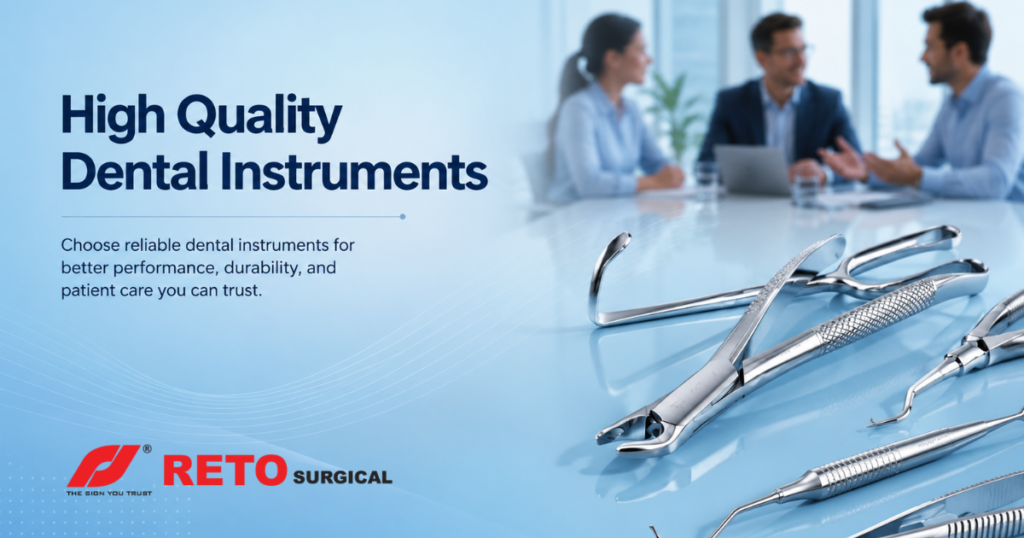
A well-organized surgical tray normally contains several different types of instruments, with each serving a specific purpose. Although the exact selection depends on the procedure, the following instruments are widely used in dental and oral surgery.
- Extraction Forceps
Extraction Forceps are among the most recognizable instruments in dental surgery. They are designed to grasp and remove teeth while allowing the clinician to apply controlled movements.
Different forceps patterns are manufactured for different teeth and clinical situations. Variations can include upper and lower jaw designs, anterior and posterior patterns, and specialized forceps for particular root or tooth shapes.
A properly designed forceps should provide a secure grip without unnecessarily damaging surrounding tissues.
- Periosteal Elevators
Periosteal Elevators are used to separate and elevate the periosteum from the underlying bone. They are particularly useful when a surgical flap needs to be raised during procedures such as tooth extraction, implant surgery, periodontal treatment, or bone surgery.
The working end may have a sharp, rounded, or specially contoured profile depending on the intended application. Ergonomic handle design is also important because controlled pressure is required during tissue elevation.
- Luxators
Luxators are slender instruments used to assist with tooth extraction by entering the periodontal ligament space. Their narrow working ends allow the clinician to carefully work around the tooth before extraction.
Luxators are available in different sizes and shapes, making them useful in situations where conventional extraction techniques may require additional support. Because their working edges can be delicate, appropriate handling and maintenance are essential.
- Surgical Curettes
Surgical Curettes are commonly used for removing unwanted tissue, debris, granulation tissue, or material from a surgical site. They can be particularly useful during procedures involving extraction sockets, periodontal defects, and other areas requiring careful tissue cleaning.
The shape and size of the curette should correspond to the area being treated. A well-finished working end helps the clinician achieve controlled manipulation without unnecessary trauma.
- Tissue Forceps
Tissue Forceps are designed for grasping and handling soft tissue during surgery. Depending on their design, they may feature smooth or toothed tips.
Tissue forceps need to provide sufficient grip while allowing the surgeon to maintain control. The correct pattern is selected according to the type of tissue and the procedure being performed.
- Surgical Scissors
Surgical Scissors are used for cutting soft tissue, sutures, membranes, and other materials encountered during dental surgery. They are available in straight and curved configurations and may have different tip profiles.
Sharp, accurately aligned blades are essential for smooth cutting. Poorly manufactured or damaged scissors can make procedures less efficient and may compromise control.
- Needle Holders
Needle Holders are essential during wound closure and suturing. They hold the surgical needle securely and allow the clinician to guide it through tissue with controlled movements.
A reliable locking mechanism and properly aligned jaws are particularly important. The handle should also provide comfortable control, especially during procedures involving multiple sutures.
- Bone Rongeurs
Bone Rongeurs are heavy-duty instruments designed for cutting or removing small sections of bone. They may be used during oral surgery and other procedures where controlled bone removal is necessary.
Their jaws need to be strong enough for the intended application while maintaining precise movement. Different jaw configurations allow clinicians to select an instrument appropriate for the surgical site.
- Dental Surgical Instrument Sets
Instead of purchasing individual instruments, many clinics and distributors choose Dental Surgical Instrument Sets. A set can contain a carefully selected combination of instruments required for a particular procedure or group of procedures.
For example, an extraction set may contain extraction forceps, elevators, luxators, curettes, tissue forceps, scissors, and other supporting instruments. Procedure-specific sets can improve organization, reduce preparation time, and help standardize surgical workflows.
Applications of Dental Surgical Instruments
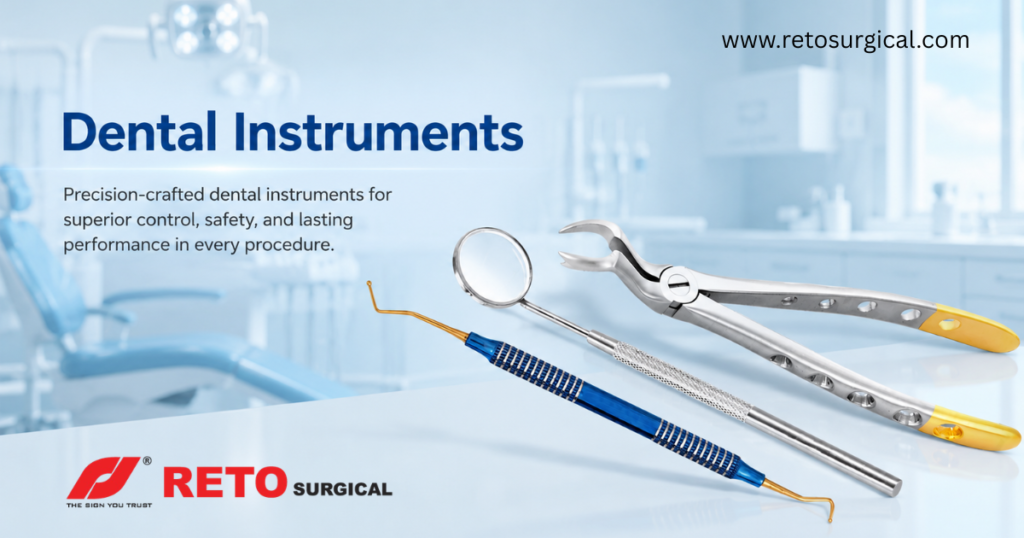
The applications of dental surgical instruments extend far beyond simple tooth extraction. Modern oral surgery involves a wide variety of procedures, each requiring instruments with different mechanical and ergonomic characteristics.
Tooth Extraction and Oral Surgery
One of the most common applications is tooth extraction. Forceps, luxators, elevators, curettes, and tissue-handling instruments may be used at different stages of the procedure.
For example, a clinician may use a luxator to assist with periodontal ligament separation, followed by an extraction forceps to remove the tooth. A surgical curette can then be used where appropriate to clean the extraction site.
Dental Implant Procedures
Dental implant surgery requires precise tissue and bone management. Periosteal elevators, surgical scissors, tissue forceps, and other instruments may be included in implant surgery trays.
The instruments used should provide reliable handling because implant procedures often involve delicate soft-tissue management and controlled surgical techniques.
Periodontal Surgery
Periodontal procedures may require instruments for tissue elevation, tissue handling, cutting, and site preparation. Periosteal elevators, curettes, tissue forceps, and surgical scissors can all play important roles depending on the procedure.
In this environment, instrument design is particularly important because clinicians need controlled movements around delicate oral tissues.
Bone and Surgical Procedures
Bone rongeurs and other surgical instruments are used when controlled bone removal or modification is required. Strong construction, accurate jaw alignment, and appropriate surface finishing are important characteristics for these applications.
The choice of instrument should always be based on the intended clinical procedure and the manufacturer’s recommended use.
Suturing and Wound Closure
Following surgery, wound closure may require needle holders, tissue forceps, and surgical scissors. These instruments work together to provide the control needed for positioning tissue, guiding the needle, and trimming sutures.
A balanced surgical set therefore does more than provide individual tools—it creates a complete workflow from surgical access through to closure.
Manufacturing of High-Quality Dental Surgical Instruments
Manufacturing quality is one of the most important considerations when purchasing dental surgical instruments. A professional instrument should not only look polished when new; it should be engineered to perform consistently over its service life.
Many reusable instruments are manufactured from medical-grade stainless steel selected for properties such as strength, corrosion resistance, hardness, and suitability for repeated sterilization.
The manufacturing process can include precision forging or machining, grinding, forming, heat treatment, polishing, passivation, assembly, and final inspection. The exact process depends on the instrument design.
For example, a delicate tissue instrument requires different dimensional and finishing considerations from a heavy-duty bone rongeur. Similarly, scissors require accurate blade alignment and cutting performance, while needle holders require properly matched jaws and a reliable locking mechanism.
Precision and Surface Finishing
Precision manufacturing is especially important for instruments with moving parts or finely shaped working ends. Even small dimensional variations can affect handling and performance.
Surface finishing also plays an important role. A smooth, properly finished surface can make instruments easier to clean and helps provide resistance against staining and corrosion when the instrument is correctly maintained.
Manufacturers may use processes such as polishing and passivation to improve the surface condition of stainless-steel instruments.
Quality Control
Professional manufacturers normally use quality-control procedures throughout production rather than relying only on a final visual inspection.
Depending on the product, inspection can include:
- Dimensional checks
- Surface inspection
- Jaw alignment testing
- Cutting performance testing
- Locking mechanism inspection
- Corrosion-resistance evaluation
- Hardness testing
- Functional testing
- Packaging inspection
- Final batch verification
This approach helps ensure that instruments meet defined specifications before they are supplied to customers.
Certifications and Compliance: What Buyers Should Look For
Certifications and regulatory compliance are particularly important when purchasing dental surgical instruments for professional use or international distribution.
A manufacturer should be able to provide appropriate documentation for the markets in which its products are supplied. The exact regulatory requirements depend on the instrument classification, intended use, market, and applicable legislation.
ISO 13485 is one of the most important quality-management standards associated with medical devices. It focuses on quality-management systems for organizations involved in the design, manufacture, storage, distribution, installation, servicing, and related activities for medical devices.
When evaluating a manufacturer, buyers should check the scope and validity of the certificate rather than simply looking for an ISO logo.
ISO 9001 is a broader quality-management standard covering organizational quality processes and continual improvement. While it is not specifically a medical-device standard, it can provide additional information about a company’s quality-management practices.
CE Marking and Market Requirements
For products placed on applicable European markets, CE marking and the relevant medical-device regulatory requirements should be carefully assessed. Buyers should confirm that the product has the appropriate conformity documentation for its intended use and classification.
For the UK market, manufacturers and suppliers should also consider applicable UK medical-device requirements, including MHRA-related obligations where relevant.
Importers and distributors should request the appropriate technical and regulatory documentation before placing instruments on a market. This can include declarations of conformity, certificates, product specifications, labeling information, and other supporting documents depending on the product and jurisdiction.
Choosing the Right Dental Surgical Instruments
The best instrument is not necessarily the most expensive one. Instead, it should be appropriate for the intended procedure, manufactured to consistent specifications, comfortable to handle, and supported by reliable quality documentation.
When sourcing dental surgical instruments, consider:
- Material quality – Look for suitable medical-grade stainless steel and appropriate corrosion resistance.
- Instrument design – Working ends, handles, joints, and locking mechanisms should match the intended application.
- Manufacturing consistency – Ask about inspection and quality-control procedures.
- Sterilization suitability – Reusable instruments should be designed and maintained according to the manufacturer’s instructions for use.
- Regulatory documentation – Verify relevant certificates and conformity documents.
- Product range – A manufacturer offering individual instruments and procedure-specific sets can make sourcing easier.
- Customization – For distributors and healthcare organizations, private labeling, engraving, packaging, and customized instrument sets may be valuable.
- Supplier experience – Consider manufacturing experience, export markets, technical support, and after-sales service.
Conclusion
High-quality Dental Surgical Instruments are an essential part of safe, efficient, and controlled oral surgery. From Extraction Forceps, Periosteal Elevators, and Luxators to Surgical Curettes, Tissue Forceps, Surgical Scissors, Needle Holders, and Bone Rongeurs, every instrument has a specific role in the surgical workflow.
For clinics and distributors, Dental Surgical Instrument Sets can provide a practical way to organize procedure-specific tools while improving efficiency and consistency.
However, the quality of a surgical instrument goes beyond its appearance. Material selection, precision manufacturing, surface finishing, functional testing, quality management, and appropriate regulatory compliance all contribute to a dependable product.
If you are sourcing dental surgical instruments for a dental practice, hospital, distributor, or international market, choose a manufacturer that can demonstrate consistent production quality and provide the documentation required for your target market. The right combination of instrument design, manufacturing expertise, and quality assurance can make a meaningful difference in everyday surgical practice.
- What are dental surgical instruments?
Dental surgical instruments are specialized tools used by dentists, oral surgeons, and other dental professionals during surgical procedures. They are designed for tasks such as extracting teeth, cutting tissue, handling soft tissue, removing bone, and suturing.
- What are the most common dental surgical instruments?
Common instruments include Extraction Forceps, Periosteal Elevators, Luxators, Surgical Curettes, Tissue Forceps, Surgical Scissors, Needle Holders, Bone Rongeurs, and dental surgical instrument sets.
- What are extraction forceps used for?
Extraction forceps are designed to securely grasp and remove teeth during dental extraction procedures. Different patterns are available for different tooth types and locations.
- What is the purpose of a periosteal elevator?
A Periosteal Elevator is used to separate and lift the periosteum from the underlying bone. It is commonly used during tooth extraction, implant surgery, periodontal procedures, and other oral surgeries.
- What are dental luxators used for?
Luxators are narrow surgical instruments used to assist in tooth extraction by working carefully around the periodontal ligament space. They are available in various sizes and shapes.
- What are surgical curettes used for?
Surgical Curettes are used to remove unwanted tissue, debris, or granulation tissue from surgical sites. Their application depends on the specific procedure and instrument design.
- What are tissue forceps used for in dental surgery?
Tissue Forceps are used to grasp, hold, and manipulate soft tissue during surgical procedures. Different jaw patterns are available for different tissue-handling requirements.
- What are surgical scissors used for?
Surgical Scissors are used for cutting soft tissue, sutures, membranes, and other materials during dental and oral surgical procedures. They are available in straight and curved designs.
- What is a needle holder used for?
A Needle Holder securely holds a surgical needle during suturing. Its locking mechanism and jaw design provide the control needed for accurate needle placement.
- What are bone rongeurs used for?
Bone Rongeurs are heavy-duty instruments designed to cut or remove small sections of bone when required during oral and dental surgical procedures.
- What are dental surgical instrument sets?
Dental Surgical Instrument Sets are collections of instruments assembled for specific dental procedures. A set may include forceps, elevators, luxators, curettes, scissors, needle holders, and other surgical tools.
- What materials are dental surgical instruments made from?
Many reusable dental surgical instruments are manufactured from medical-grade stainless steel. Different stainless-steel grades may be selected according to the required hardness, strength, corrosion resistance, and application.
- Are dental surgical instruments reusable?
Many surgical instruments are reusable when they are specifically designed for reuse and are processed according to the manufacturer’s instructions for cleaning, disinfection, sterilization, inspection, and maintenance.
- How should dental surgical instruments be sterilized?
Reusable instruments should be cleaned and sterilized according to the manufacturer’s validated instructions for use and the requirements of the dental facility. Appropriate sterilization methods depend on the instrument and applicable regulations.
- How can corrosion of dental surgical instruments be prevented?
Proper cleaning, drying, sterilization, storage, and maintenance can help reduce corrosion. Instruments should also be protected from inappropriate chemicals and prolonged exposure to moisture.
- What should I look for when buying dental surgical instruments?
Consider material quality, precision of manufacture, ergonomic design, functional performance, corrosion resistance, sterilization compatibility, quality-control procedures, regulatory documentation, and supplier reliability.
- What is ISO 13485 for dental surgical instrument manufacturers?
ISO 13485 is an international quality-management standard specifically focused on organizations involved with medical devices. It provides a framework for maintaining consistent quality and regulatory processes.
- What is ISO 9001, and is it important for surgical instrument manufacturers?
ISO 9001 is a general quality-management standard. While it is not specific to medical devices, certification can demonstrate that an organization operates a structured quality-management system.
- What is CE marking for dental surgical instruments?
CE marking indicates that a product placed on applicable European markets has met the relevant EU requirements for that product. The specific conformity process depends on the product’s classification and applicable legislation.
- Can dental surgical instruments be customized?
Yes. Depending on the manufacturer, customization may include instrument dimensions, working-end designs, handles, surface finishes, engraving, branding, packaging, and procedure-specific instrument sets.
- How are dental surgical instruments manufactured?
Manufacturing may involve forging or machining, forming, heat treatment, grinding, polishing, passivation, assembly, functional testing, inspection, and packaging. The exact process depends on the instrument type.
- Why is stainless steel commonly used for dental surgical instruments?
Stainless steel can provide a useful combination of strength, hardness, corrosion resistance, durability, and suitability for repeated sterilization when the appropriate grade and manufacturing processes are used.
- What is the difference between luxators and extraction forceps?
Luxators are generally used to help separate or loosen the tooth within the periodontal ligament area, while extraction forceps are designed to grasp and remove the tooth. They can therefore serve different stages of an extraction procedure.
- Why is instrument quality important in dental surgery?
High-quality instruments can provide better control, consistent performance, durability, and appropriate handling. Precision in the working end and mechanism is particularly important for surgical procedures.
- Where can dental surgical instruments be used?
Dental surgical instruments are used in dental clinics, oral surgery practices, hospitals, implant procedures, periodontal surgery, tooth extraction, minor oral surgery, and other appropriate clinical applications.
- How should dental surgical instruments be stored?
Clean and properly sterilized instruments should be stored in a clean, dry environment using appropriate packaging or storage systems. They should be protected from contamination, moisture, and physical damage.
- Can manufacturers supply complete dental surgical instrument sets?
Yes. Many manufacturers can supply procedure-specific sets containing selected instruments for applications such as extraction, implant surgery, periodontal procedures, or general oral surgery.
- What certifications should I check when sourcing dental surgical instruments?
Depending on the target market and product classification, buyers may need to review documents such as ISO 13485 certification, applicable conformity documentation, declarations of conformity, product specifications, and relevant market-registration or regulatory documentation.
- How do I choose the right dental surgical instrument set?
Start by identifying the procedures for which the set will be used. Then select the required instrument types, sizes, working-end designs, materials, and quantities. For professional or commercial sourcing, also verify the manufacturer’s quality and regulatory documentation.
- Why should dental professionals buy instruments from an experienced manufacturer?
An experienced manufacturer is more likely to have established processes for material selection, precision manufacturing, quality control, testing, finishing, packaging, and regulatory documentation. This can make sourcing more reliable for both dental professionals and distributors.