
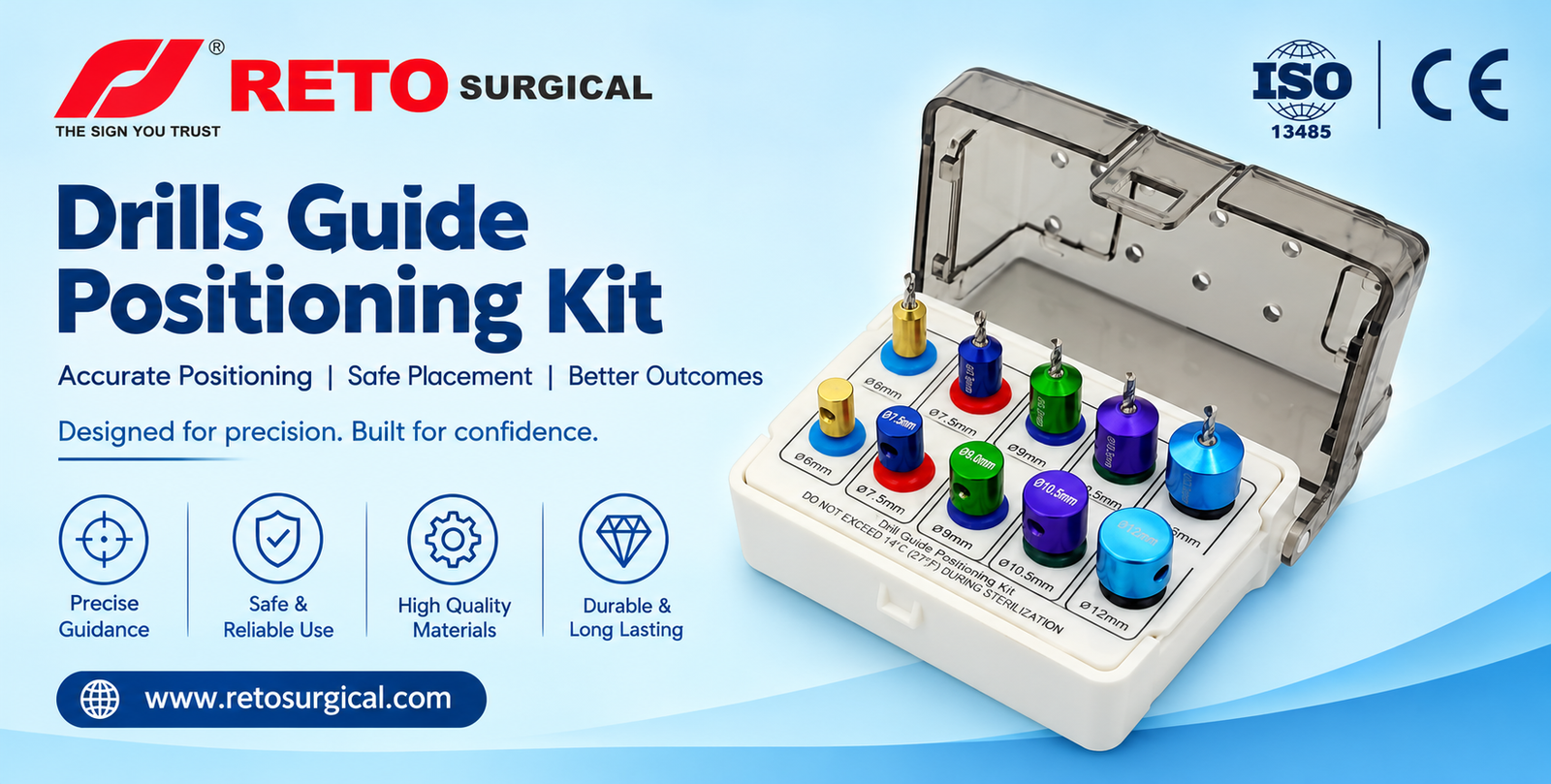
Drill Guide Positioning Kit for Dental Implants | Reto Surgical
Drill Guide Positioning Kit: A Complete Guide to Precision in Dental Implant Surgery
Successful dental implant placement requires careful planning, accurate drilling, and the correct selection of surgical instruments. Even small variations in drill angle, depth, or position can affect the implant’s final placement and the surrounding anatomical structures. This is why a Dental Implant Drill Guide Positioning Kit can be an important part of a guided implant surgery workflow.
Designed to support accurate drill positioning, a drill guide positioning kit helps clinicians follow a planned implant trajectory during osteotomy preparation. Depending on the system, the kit may include surgical drill guides, positioning components, sleeves, depth-control accessories, and compatible implant drills. These components work together to support a more controlled and reproducible surgical process.
For dental professionals, selecting the right kit involves more than comparing the number of instruments included. Compatibility with the implant system, drill dimensions, irrigation requirements, surgical workflow, and sterilisation instructions all deserve careful consideration.
Whether a clinic is expanding its implant dentistry services or a distributor is evaluating new products for its catalogue, understanding how a drill guide positioning kit works can help with informed purchasing decisions.
In this guide, we explore the main functions, components, benefits, and selection criteria for drill guide positioning kits, along with practical considerations for dental implant surgery.
What Is a Dental Implant Drill Guide Positioning Kit?
A Dental Implant Drill Guide Positioning Kit is a collection of instruments and accessories designed to help guide dental implant drills along a predetermined position and trajectory. It is commonly associated with guided implant surgery, where digital planning or another suitable planning method establishes the intended implant location before drilling begins.
The precise contents vary by manufacturer and system. Some kits focus on positioning a drill guide, while others form part of a broader guided surgical instrument set.
Understanding the role of a surgical drill guide
A Surgical Drill Guide for Dental Implants provides a guiding interface for compatible drills. Depending on its design, it may use metal sleeves, guide openings, or other positioning features to help control the direction of the drill.
For example, when a clinician plans an implant in a narrow space between adjacent teeth, maintaining the intended drill trajectory is particularly important. A compatible guide can help the clinician follow the planned direction while accounting for the available bone and surrounding anatomy.
However, a drill guide does not eliminate surgical judgement. The clinician must still assess bone quality, anatomical limitations, guide stability, access, and the suitability of the planned implant position.
Common components of a positioning kit
Depending on the system, a kit may contain:
- Drill guide positioning components
- Surgical guide sleeves or compatible guide inserts
- Implant drills in different diameters and lengths
- Depth-control components or drill stops
- Positioning pins or other alignment accessories
- Organising trays or instrument holders
Not every kit includes all these components. Some products are supplied as individual accessories intended to work with an existing guided surgery system.
Before purchasing, check the manufacturer’s product documentation to confirm the contents, compatible instruments, and intended clinical applications.
How it fits into guided implant workflows
A Guided Dental Implant Surgery Kit may be used as part of a workflow that begins with clinical assessment and treatment planning. The clinician evaluates the patient, plans the implant position, selects an appropriate guide, and prepares the osteotomy using compatible instruments.
The positioning kit supports the drilling stage of this process. Its effectiveness depends on the quality of the planning, the accuracy and stability of the guide, correct instrument selection, and the clinician’s ability to follow the manufacturer’s instructions.
Dental Implant Osteotomy Preparation and Drill Positioning
Dental Implant Osteotomy Preparation is the process of creating a prepared site in the jawbone for implant placement. It requires appropriate drill selection, controlled drilling, irrigation, and careful attention to the planned implant dimensions.
A drill guide positioning kit can support this process by helping the clinician maintain the intended drilling direction and alignment.
Why precision implant drill positioning matters
Precision Implant Drill Positioning is important because the implant site must be planned in relation to adjacent teeth, available bone, and relevant anatomical structures. An incorrectly positioned osteotomy can complicate implant placement and may compromise the intended restorative outcome.
Guided drilling can help clinicians reproduce a planned trajectory, but accuracy depends on several factors:
- Guide stability: The surgical guide must be seated and stabilised according to the manufacturer’s instructions.
- Drill compatibility: The drill diameter, guide sleeve, and any required inserts must match the selected system.
- Depth control: The clinician must follow the planned depth and the instrument’s specified limitations.
- Visibility and access: Adequate access is necessary to position instruments correctly and monitor the surgical site.
- Irrigation: Appropriate cooling must be maintained to help manage heat during bone preparation.
Consider a case involving a posterior implant site with limited access. The clinician may need to balance guide design, instrument length, visibility, and irrigation while maintaining the planned trajectory. Choosing a compatible positioning kit before surgery can help the team prepare the necessary instruments and identify potential access limitations.
The importance of irrigation during drilling
Bone preparation generates heat through friction between the drill and bone. Excessive heat can damage surrounding bone tissue, making appropriate drilling technique and cooling essential.
External irrigation systems deliver coolant toward the drilling area from outside the drill. Their effectiveness depends on the drill design, coolant delivery, access to the operative site, and the manufacturer’s recommended operating conditions.
External Irrigation Parallel Twisted Implant Drills are one type of instrument that may be considered when selecting drills for a particular implant system. Their geometry and irrigation configuration should be evaluated alongside diameter, length, cutting characteristics, and compatibility with the guide.
Clinicians should follow the drill manufacturer’s instructions for irrigation, speed, pressure, and use. A guided workflow should never be treated as a substitute for appropriate surgical technique or thermal management.
Understanding the Dental Implant Drill Sequence
The Dental Implant Drill Sequence refers to the prescribed order in which drills are used to prepare an osteotomy. The sequence varies according to the implant system, implant dimensions, bone conditions, and the manufacturer’s surgical protocol.
A drill guide positioning kit must be compatible with the intended sequence. Before surgery, clinicians should confirm that the selected drills and guide components can be used together as instructed.
How a typical drilling sequence works
Although individual systems differ, an implant drilling workflow may involve several stages.
Step 1: Initial positioning
The clinician confirms the surgical guide’s seating and stability and verifies the planned implant position. Initial drilling establishes the starting point and direction in accordance with the relevant surgical protocol.
Step 2: Pilot drilling
A pilot drill may be used to establish the initial osteotomy trajectory. Its diameter and working length must be suitable for the system and planned implant.
Step 3: Progressive osteotomy preparation
Additional drills may be used in a prescribed sequence to increase the osteotomy diameter. The sequence should be followed exactly as specified by the implant manufacturer rather than assuming that drills from different systems are interchangeable.
Step 4: Depth and dimensional verification
The clinician checks the prepared site against the planned dimensions and applicable clinical protocol. Any depth markings, stops, or other accessories must be interpreted according to their intended use.
Step 5: Implant placement
Once the osteotomy has been prepared and assessed, the clinician proceeds with implant placement in accordance with the selected system’s instructions and the patient’s clinical requirements.
This sequence is a general explanation, not a universal surgical protocol. Specific drill combinations, speeds, depths, and preparation steps must be determined from the relevant manufacturer’s instructions and the clinician’s treatment plan.
Where two-step coated dental implant drills fit in
Two-Step Coated Dental Implant Drills may be relevant when comparing drill designs and surface treatments available for implant dentistry. However, the term alone does not establish a universal drilling sequence or guarantee a particular clinical outcome.
When evaluating coated drills, consider the coating specification, substrate material, cutting geometry, wear characteristics, cleaning requirements, and validated reprocessing instructions. Any performance claims should be supported by appropriate manufacturer documentation or clinical evidence.
For distributors and procurement teams, it is useful to distinguish between the physical design of a drill and the clinical protocol in which it is intended to be used. The presence of a coating does not automatically make a drill suitable for every implant system or guided surgery application.
Types of Drills and Instruments to Consider
The performance of a drill guide positioning kit depends not only on the guide itself but also on the instruments used with it. Understanding the available drill types can help clinicians, purchasing teams, and dental distributors assess product suitability.
Small-diameter dental implant drills
Small-Diameter Dental Implant Drills are used in applications where a smaller initial or subsequent osteotomy diameter is required by the relevant surgical protocol.
Their selection depends on the intended implant system, drill sequence, bone conditions, and required preparation dimensions. Small-diameter drills may form part of an initial drilling stage, but their precise role must be confirmed in the manufacturer’s instructions.
When comparing these drills, review:
- Available diameters and working lengths
- Cutting geometry and material specifications
- Compatibility with the designated guide sleeves
- Drill markings and depth-control features
- Irrigation requirements
- Cleaning, sterilisation, and reuse instructions
Product descriptions should clearly distinguish between overall drill length and working length, as these measurements serve different purposes when assessing surgical access and drilling depth.
Parallel twisted implant drills
Parallel twisted drills are designed with a fluted geometry intended to support cutting and the removal of material during drilling. Specific designs differ in flute configuration, cutting edges, dimensions, and irrigation arrangements.
When evaluating External Irrigation Parallel Twisted Implant Drills, confirm that the external irrigation arrangement can deliver coolant appropriately under the intended clinical conditions.
It is also important to check whether the drill is designed for guided or freehand use, or for a particular combination of guide components. A drill that fits a handpiece is not necessarily compatible with a particular surgical guide.
Guided implant surgery instruments
Guided Implant Surgery Instruments include the tools and accessories used to implement a guided implant plan. Depending on the system, they may include drills, sleeves, guide keys, positioning accessories, depth-control components, and other specialised instruments.
For a coordinated surgical workflow, compatibility should be assessed across the entire instrument system rather than one component at a time.
A useful purchasing checklist includes:
- System compatibility: Are the instruments approved or specified for the intended implant and guide system?
- Dimensional accuracy: Are diameters, lengths, sleeve dimensions, and tolerances clearly documented?
- Material quality: Are material specifications and relevant manufacturing controls available?
- Traceability: Can products and batches be identified through appropriate labelling and records?
- Reprocessing: Are cleaning, disinfection, sterilisation, and reuse instructions provided where applicable?
- Documentation: Are intended use, limitations, and applicable regulatory information clearly stated?
For manufacturers and suppliers, complete technical documentation and consistent product identification can make it easier for dental distributors to evaluate products and maintain reliable purchasing records.
How to Choose the Right Drill Guide Positioning Kit
Selecting a suitable kit involves matching the product to the clinical workflow, implant system, and intended applications. A larger kit is not necessarily the best choice if it contains instruments that are incompatible with the clinician’s existing system.
Evaluate compatibility first
Start by identifying the implant system and guided surgery workflow for which the kit will be used. Confirm the required drill diameters, working lengths, guide sleeve dimensions, and positioning accessories.
Do not rely on appearance alone when comparing products. Two drills may look similar but have different dimensions, tolerances, or intended uses.
Consider manufacturing quality and consistency
Dental implant instruments must meet their specified dimensional and functional requirements. Manufacturers and suppliers should be able to provide relevant information about materials, manufacturing processes, inspection, and product traceability.
For B2B buyers, it is sensible to ask for technical specifications, available sizes, packaging details, and applicable quality and regulatory documentation before placing a commercial order.
Where reusable instruments are supplied, their validated reprocessing instructions and expected service limitations should also be reviewed.
Assess the complete cost of ownership
Purchase price is only one part of the decision. Availability of replacement drills, compatibility with existing equipment, instrument organisation, documentation, and after-sales support may all influence long-term value.
For dental distributors, a clearly organised product range with consistent specifications can simplify product selection and customer support. For clinical users, a well-documented kit can help the team prepare instruments efficiently and reduce confusion during setup.
Choose a supplier that understands your requirements
A reliable supplier should be able to answer practical questions about available sizes, manufacturing specifications, compatibility, customisation options, lead times, and documentation.
If you are sourcing a drill guide positioning kit for a clinic or distribution business, request the product catalogue and technical details before comparing quotations. This helps ensure that the products being compared have equivalent specifications and intended applications.
Conclusion
A Dental Implant Drill Guide Positioning Kit can play an important role in a guided implant surgery workflow by helping clinicians follow a planned drilling trajectory. Its value depends on the compatibility of the guide and instruments, accurate treatment planning, appropriate drill selection, irrigation, and adherence to the manufacturer’s instructions.
From Dental Implant Osteotomy Preparation and Precision Implant Drill Positioning to choosing the correct Dental Implant Drill Sequence, every stage requires careful attention to the intended clinical application. Small-diameter drills, coated drills, parallel twisted drills, and other guided implant surgery instruments should be selected according to their documented specifications rather than appearance or general product descriptions.
For dental professionals and distributors, the best approach is to evaluate the complete system, verify technical documentation, and select instruments that meet the requirements of the intended workflow.
Looking for dental implant drill guide positioning kits or compatible implant instruments? Explore the available product range, review the technical specifications, and contact a qualified manufacturer or supplier to discuss your requirements before purchasing.
Follow Us
Frequently Asked Questions (FAQs)
- What is a dental implant drill guide positioning kit?
A dental implant drill guide positioning kit is a collection of instruments and accessories designed to help guide dental drills along a planned trajectory during implant site preparation. Depending on the system, it may include drill guides, sleeves, positioning components, drills, and depth-control accessories.
- What is the purpose of a drill guide positioning kit?
Its purpose is to support accurate drill positioning during guided implant surgery. When used with a suitable surgical guide and compatible instruments, it helps the clinician follow the planned drilling direction and position.
- What is included in a dental implant drill guide kit?
The contents vary by manufacturer. A kit may include surgical drill guides, guide sleeves, implant drills, positioning pins, depth-control accessories, and an instrument tray. Always check the product specifications to confirm which components are supplied.
- How does a surgical drill guide for dental implants work?
A surgical drill guide provides a guiding interface for compatible drills. Its design helps maintain the intended drilling direction during osteotomy preparation. The clinician must ensure that the guide is stable and that the drills and sleeves are compatible.
- What is guided dental implant surgery?
Guided dental implant surgery uses a planned surgical guide to help transfer the intended implant position and trajectory to the surgical site. The guide may be designed using digital treatment planning and appropriate patient-specific information.
- Why is precision implant drill positioning important?
Precision implant drill positioning helps the clinician follow the planned implant trajectory while considering bone availability, adjacent teeth, and nearby anatomical structures. Proper planning, guide stability, and surgical technique remain essential.
- What is dental implant osteotomy preparation?
Dental implant osteotomy preparation is the process of preparing the site in the jawbone where an implant will be placed. It involves selecting appropriate drills, following the prescribed drilling sequence, managing irrigation, and preparing the site according to the implant system’s instructions.
- What is a dental implant drill sequence?
A dental implant drill sequence is the prescribed order in which drills are used to prepare an implant site. The sequence depends on the implant system, planned implant dimensions, bone conditions, and the manufacturer’s surgical protocol.
- Are all dental implant drills compatible with drill guide positioning kits?
No. Compatibility depends on drill dimensions, guide sleeve specifications, system design, and the manufacturer’s instructions. A drill that fits a surgical handpiece may not be suitable for every guided implant system.
- What are small-diameter dental implant drills used for?
Small-diameter dental implant drills are used when a smaller-diameter drilling stage is specified by the relevant surgical protocol. Their application depends on the implant system, planned osteotomy dimensions, and clinical requirements.
- What are external irrigation parallel twisted implant drills?
These are implant drills featuring a parallel twisted geometry and an external irrigation arrangement. They are designed for use in compatible systems where coolant is delivered externally. Their suitability depends on the drill’s specifications and the manufacturer’s instructions.
- What are two-step coated dental implant drills?
Two-step coated dental implant drills are a product category that may refer to drills featuring a particular coating and a two-stage design or process, depending on the manufacturer’s terminology. Buyers should verify the precise meaning, coating specification, and intended use in the product documentation.
- Why is irrigation important during dental implant drilling?
Irrigation helps manage heat generated during drilling and supports appropriate cooling of the surgical site. The irrigation method, flow, drill speed, and drilling technique should follow the relevant manufacturer’s instructions.
- How do I choose the right drill guide positioning kit?
Consider implant system compatibility, drill dimensions, guide sleeve specifications, positioning accessories, depth-control requirements, material quality, traceability, and reprocessing instructions. Confirm that the complete kit suits the intended surgical workflow.
- What is the difference between guided and conventional implant drilling?
Guided drilling uses a surgical guide to help direct compatible drills along a planned trajectory. Conventional freehand drilling relies more directly on the clinician’s visual assessment and manual control. The appropriate approach depends on the case, treatment plan, equipment, and clinical judgement.
- Can a drill guide positioning kit improve implant placement accuracy?
A compatible and properly used guided system can help transfer the planned drilling position to the surgical site. However, accuracy varies with planning quality, guide fit and stability, instrument tolerances, and surgical technique. A guide does not guarantee a particular outcome.
- How do I verify drill depth in a guided implant surgery system?
Depth verification depends on the system’s design. Clinicians may use documented drill markings, depth stops, or other approved components. The working length, guide dimensions, and manufacturer’s instructions must be considered to avoid incorrect depth assumptions.
- What materials are commonly used to manufacture dental implant drills?
Dental implant drills are commonly manufactured from suitable medical-grade metals, including specified stainless-steel alloys, depending on the intended application. Material selection, cutting geometry, surface treatment, and manufacturing controls should be confirmed through the manufacturer’s technical documentation.
- Are dental implant drill guide positioning kits reusable?
Some systems are designed for reuse, while others may have different use limitations. Reusable instruments must be processed according to validated cleaning, disinfection, sterilisation, inspection, and maintenance instructions. Never assume that a kit is reusable without checking its labelling.
- How should dental implant drills be cleaned and sterilised?
Follow the manufacturer’s validated reprocessing instructions for the specific instrument. These should specify the applicable cleaning method, inspection requirements, sterilisation parameters, and any restrictions on reuse.
- What should dental distributors check before purchasing a drill guide positioning kit?
Distributors should review the product range, technical specifications, compatibility, quality documentation, applicable regulatory information, packaging, traceability, minimum order quantities, lead times, and after-sales support. Samples and technical discussions may help clarify suitability before a larger order.
- Can dental implant drill guide positioning kits be customised?
Customisation may be available from some manufacturers, depending on their capabilities and the product’s intended use. Buyers should discuss required dimensions, instrument configurations, materials, compatibility, documentation, and any applicable validation or regulatory requirements before commissioning a customised product.
- What documentation should accompany a dental implant drill guide positioning kit?
Documentation depends on the product and applicable regulatory requirements. It may include technical specifications, intended-use information, material details, labelling, traceability information, and cleaning and sterilisation instructions for reusable instruments. Buyers should verify the documentation required for their market.
- How can I find a reliable dental implant instrument manufacturer?
Evaluate the manufacturer’s experience, quality management system, manufacturing capabilities, inspection processes, traceability, technical documentation, and ability to meet your specifications. Request relevant evidence and clarify regulatory responsibilities before placing an order.
- Where can I source dental implant drill guide positioning kits for wholesale or OEM supply?
Dental distributors and importers can contact specialist dental instrument manufacturers and suppliers to discuss available products, compatible instrument configurations, wholesale pricing, and OEM requirements. Before ordering, request product specifications, applicable compliance documentation, and confirmation of intended use.