
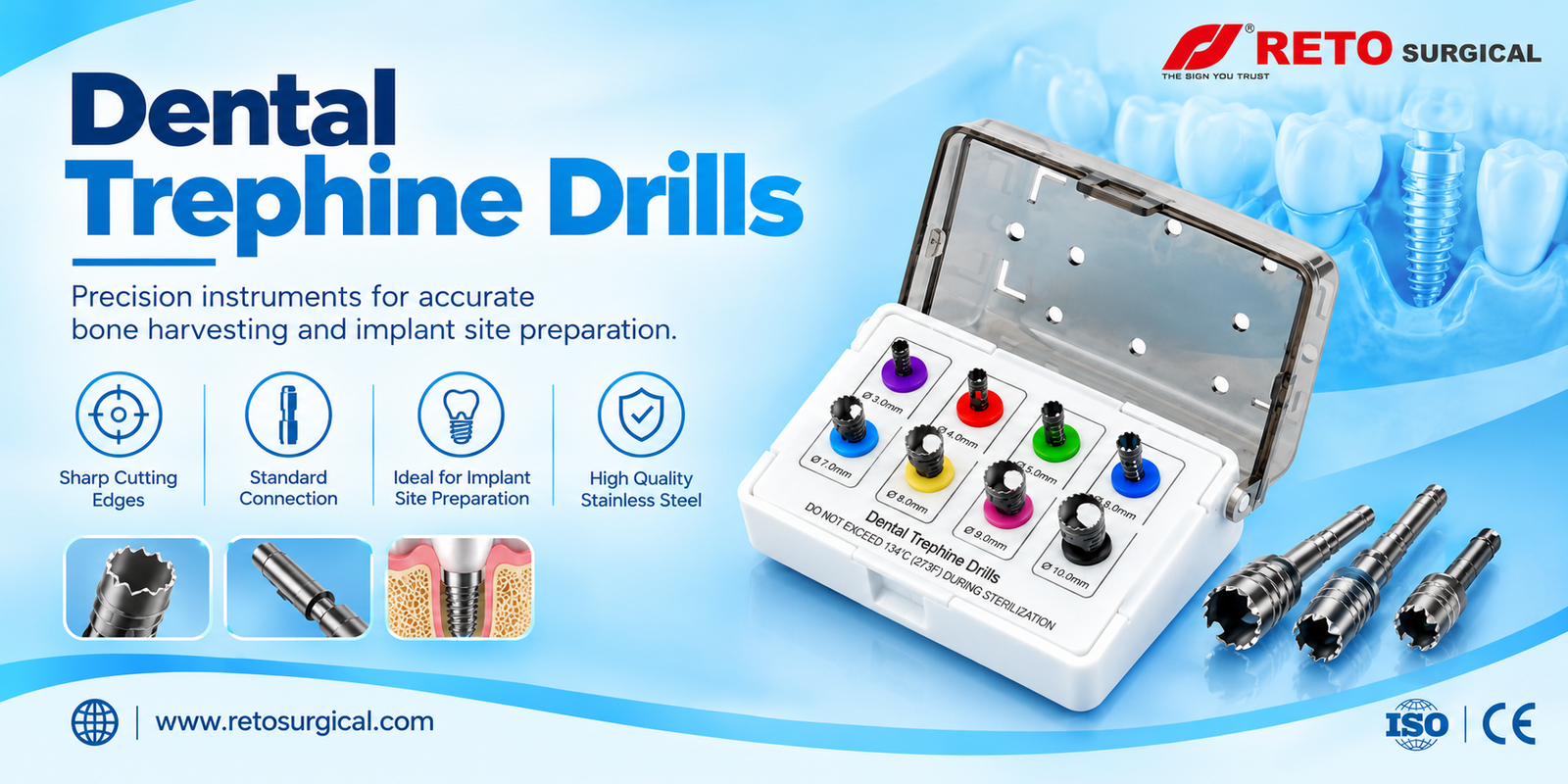
Dental Trephine Drills: Types, Sizes & Uses | Reto Surgical
Dental Trephine Drills: Types, Uses, Sizes, and How to Choose the Right Drill
Introduction
Dental implant treatment has transformed modern dentistry, providing patients with reliable solutions for replacing missing teeth. However, not every implant procedure follows the original plan. In certain clinical situations, a dental implant may need to be removed because of complications, implant failure, infection, or other treatment-related concerns. When removal is necessary, selecting the appropriate instruments is essential for maintaining precision and supporting the clinician’s treatment objectives.
Dental trephine drills are specialised rotary instruments designed to cut a circular channel through bone or surrounding tissue, depending on the instrument’s design and intended application. In implant dentistry and oral surgery, they may be used for selected implant retrieval procedures, bone removal, and other surgical applications where a cylindrical cutting action is required.
Unlike conventional dental burs, which are commonly used for preparing teeth or shaping hard tissues, trephine drills are designed with a hollow, cylindrical cutting profile. This construction allows the instrument to create a circular cut around a selected area. The exact application depends on its diameter, cutting geometry, compatibility with the surgical handpiece, and the manufacturer’s instructions.
For dental professionals, implant specialists, and surgical instrument distributors, understanding the differences between trephine drill designs can make instrument selection more straightforward. Factors such as diameter, material quality, cutting performance, cleaning requirements, and sterilisation compatibility all deserve attention.
In this guide, we explore the main applications of dental trephine drills, the different types available, commonly used sizes, material considerations, and practical points to consider when choosing a suitable instrument for professional dental use.
What Are Dental Trephine Drills and How Are They Used?
Dental trephine drills are specialised surgical instruments with a hollow, circular cutting head. Depending on their design, they can create a cylindrical opening or remove a circular section of bone. Their geometry makes them useful in selected procedures where a conventional round bur may not provide the required cutting profile.
In implant dentistry, clinicians may encounter situations where an implant must be removed from the surrounding bone. Some removal techniques involve specialised retrieval systems, while others may require controlled bone removal to gain access to the implant. The appropriate method depends on the implant system, the clinical condition, the available bone, and the treatment plan.
A Dental Implant Retrieval Trephine Drill is designed for applications involving the controlled removal of bone around an implant when indicated by the clinician. Its purpose is not simply to cut quickly but to provide a suitable cutting profile for the intended procedure.
Common applications of dental trephine drills
Depending on the product design and the manufacturer’s intended use, these instruments may be considered for:
- Selected dental implant removal procedures.
- Controlled removal of a cylindrical section of bone.
- Certain oral and maxillofacial surgical applications.
- Bone harvesting procedures where the instrument is specifically designed and indicated for that purpose.
- Selected surgical procedures requiring circular cutting geometry.
It is important to distinguish between instruments designed for implant retrieval and those intended for bone harvesting or other surgical procedures. Although their external appearance may be similar, their cutting geometry, dimensions, and intended applications may differ.
For example, a clinician managing a failed implant may need an instrument compatible with a particular retrieval protocol. Another clinician performing a bone-related procedure may require a trephine designed for a different purpose. In both situations, the correct choice depends on the manufacturer’s instructions and the clinical assessment.
How do trephine drills differ from conventional dental burs?
Conventional dental burs are available in many shapes, including round, pear-shaped, fissure, and tapered designs. They are commonly used for tooth preparation, cavity preparation, finishing, and other dental procedures.
Trephine drills, by comparison, use a hollow cylindrical cutting profile. This shape enables circular cutting rather than simply grinding or shaping a surface.
The difference matters because the instrument’s design influences how it interacts with bone and other hard tissues. Trephines must be selected according to their intended application, and clinicians should follow the recommended operating conditions, irrigation requirements, and surgical technique.
Types of Surgical Trephine Burs and Their Applications
Not all trephines are manufactured for the same purpose. Dental professionals should evaluate the intended application before comparing dimensions, cutting edges, or overall appearance.
Surgical Trephine Burs are used in selected dental and surgical procedures where a hollow cylindrical cutting action is required. Their construction and design can vary according to the manufacturer’s specifications and the procedure for which they are intended.
Understanding the main product categories helps dental clinics and distributors select instruments that meet their requirements.
Dental implant retrieval trephines
Implant retrieval trephines are intended for selected situations in which bone around a dental implant needs to be removed to facilitate retrieval. Their diameter and working length must be appropriate for the implant and the clinical circumstances.
A trephine that is too large may remove more bone than necessary, while an unsuitable diameter or working length may make access difficult. Consequently, compatibility with the implant system and the manufacturer’s guidance should be checked before use.
A Trephine Drill for Implant Removal should never be selected solely because its dimensions appear suitable. The clinician must also consider the implant’s position, surrounding anatomical structures, bone availability, and the risks associated with the planned procedure.
Bone trephine drills
Bone Trephine Drills are instruments designed for particular procedures involving circular bone cutting or harvesting, according to their intended use.
Some designs may be suitable for obtaining cylindrical bone specimens, while others are intended for controlled bone removal. These applications are not automatically interchangeable, so it is important to verify the product’s specifications and indications.
For example, a dental professional planning a bone-related procedure may need to consider the instrument’s internal and external diameters, cutting-edge design, working length, and compatibility with the surgical equipment.
Trephine drills within implant retrieval systems
Trephines may form part of a broader collection of Implant Retrieval Instruments. Depending on the system, other components may include specialised drivers, extraction tools, adapters, and accessories designed for a particular implant platform.
Using compatible components can help the clinician follow the intended procedure and reduce uncertainty when preparing for treatment.
When purchasing individual instruments, dental practices should confirm whether the trephine can be used independently or requires a compatible system. This is particularly important for distributors supplying products to clinics that use multiple implant brands.
Understanding Trephine Drill Sizes: 3.2 mm and 4.0 mm
Diameter is one of the most important specifications when evaluating a trephine drill. However, the correct size cannot be determined by diameter alone. Working length, cutting-head geometry, implant dimensions, and the intended procedure also influence instrument selection.
Trephine Drills 3.2 mm and 4.0 mm are examples of size-specific products that dental professionals may encounter when comparing trephine options.
These measurements should always be interpreted in the context of the manufacturer’s product description. Depending on the product, the stated measurement may refer to the cutting diameter or another defined dimension. Buyers should confirm the specification rather than assume all manufacturers use identical measurement conventions.
What should clinicians consider when selecting a diameter?
Several factors are relevant when assessing the suitability of a trephine drill.
- Intended clinical application
The instrument should be appropriate for the procedure being performed. A diameter suitable for one application may not be suitable for another.
- Implant dimensions and system compatibility
For implant retrieval, clinicians need to consider the implant’s dimensions and the particular retrieval technique. Product specifications and implant-system guidance should be consulted before choosing an instrument.
- Surrounding anatomical structures
Bone removal requires careful consideration of nearby anatomical structures. The selected instrument and technique should reflect the clinician’s assessment of the available space and potential risks.
- Working length
The cutting head’s diameter is only one part of the specification. The available working length must also be appropriate for access and the intended procedure.
- Handpiece compatibility
Connection type, operating requirements, and compatibility with the intended surgical handpiece must be verified. An instrument should only be used with equipment and operating parameters approved by its manufacturer.
Why size accuracy matters
Accurate specifications help dental practices select instruments consistently and allow distributors to provide clearer product information to their customers.
For manufacturers, clearly identifying diameter, working length, connection type, material, and intended use can also reduce confusion during purchasing.
A useful product listing should therefore include a detailed dimensional drawing or specification sheet wherever possible. Buyers should be able to distinguish between different sizes without relying solely on product photographs.
Stainless Steel Trephine Drills: Materials, Manufacturing, and Quality
Material selection plays an important role in the performance and durability of reusable surgical instruments. Stainless Steel Trephine Drills are available in product ranges designed for dental and surgical applications, but the term stainless steel alone does not establish whether a particular instrument is suitable for a specific clinical purpose.
The material grade, manufacturing process, surface finish, heat treatment, and final inspection all contribute to the finished product’s characteristics.
Why material specifications matter
Stainless steel grades have different combinations of corrosion resistance, hardness, strength, and other mechanical properties. The most appropriate material depends on the instrument’s intended function and the manufacturer’s design requirements.
For instruments exposed to repeated cleaning and sterilisation, corrosion resistance and material stability are especially important. However, suitability must be established through the instrument’s specifications and validation rather than inferred from its appearance.
Dental practices and distributors should look for clear information about:
- The specified stainless steel grade.
- Intended reusable or single-use status.
- Compatibility with the recommended cleaning and sterilisation processes.
- Corrosion-resistance and durability requirements.
- Cutting-edge design and manufacturing tolerances.
- Inspection and quality-control procedures.
Manufacturing precision and cutting performance
The cutting geometry of a trephine drill affects how the instrument performs during its intended application. Consistent dimensions and appropriate edge finishing are important considerations when evaluating manufacturing quality.
Depending on the product design, manufacturing may involve CNC machining, precision grinding, edge finishing, polishing, and other controlled processes. The specific process used should be appropriate for the instrument’s design and material.
Quality checks may include dimensional verification, visual inspection, surface-finish assessment, and checks relevant to the intended cutting function.
For manufacturers and OEM suppliers, consistency between production batches is particularly important. A distributor purchasing the same instrument repeatedly needs confidence that its specifications remain consistent and that changes are appropriately controlled.
Reusable instruments and sterilisation
Reusable trephine drills must be processed according to their validated instructions for use. This includes the specified cleaning, inspection, disinfection where applicable, and sterilisation procedures.
A product should not be assumed to be reusable simply because it is made from stainless steel. Reusability and sterilisation compatibility must be confirmed by the manufacturer.
Before each use, trained clinical staff should inspect the instrument for visible damage, corrosion, wear, or other conditions that could affect its suitability. Instruments that do not meet the manufacturer’s acceptance criteria should not be used.
For distributors, clear documentation about reprocessing and product status is an important part of responsible instrument supply.
Dental Trephine Drill Kits, Sterilisation Cases, and Buying Considerations
Individual trephine drills may suit clinics that regularly use a specific diameter. Other practices may prefer a selection of sizes to support different procedures. In these situations, a Dental Trephine Drill Kit can provide a convenient way to organise compatible instruments.
Kits may include several trephines in different diameters, together with a storage or sterilisation case. The exact configuration varies by manufacturer, so buyers should check the product description carefully.
Benefits of a dental trephine drill kit
A well-specified kit can help a dental practice organise its instruments and simplify stock management.
Potential benefits include:
- Multiple specified sizes within one product package.
- Convenient organisation and identification of instruments.
- Easier inventory control for practices using several diameters.
- A storage arrangement suited to the manufacturer’s instructions.
- Simplified purchasing when the included components meet the clinic’s requirements.
However, a larger kit is not automatically the better option. Clinics should consider which sizes and configurations they actually need, whether all components are compatible, and whether individual replacement instruments are available.
Choosing a trephine drill set with sterilisation case
A Trephine Drill Set with Sterilisation Case may be useful for organising instruments between clinical procedures, provided the case is specifically designed and validated for its stated purpose.
When evaluating a case, buyers should check whether it is intended for storage, transport, cleaning, sterilisation, or a combination of these functions. These uses are not necessarily equivalent.
Important purchasing considerations include:
Instrument configuration: Confirm the number of drills, their diameters, working lengths, and other specifications.
Material documentation: Check that the material information is sufficiently detailed for the intended application.
Case compatibility: Verify that the case and its components are suitable for the specified cleaning and sterilisation process.
Identification: Clear size markings and product identification can help reduce confusion during instrument selection and inventory checks.
Instructions for use: Ensure the supplied documentation explains the intended applications, limitations, cleaning requirements, and sterilisation parameters.
Replacement availability: Consider whether individual drills can be reordered if a particular size becomes worn, damaged, or unavailable for use.
What should dental instrument distributors look for?
Distributors and importers have additional considerations beyond the clinical product itself. They need accurate specifications, dependable supply, appropriate documentation, and clear communication with the manufacturer.
When comparing suppliers, it is sensible to review the following:
- Product range and available sizes.
- Manufacturing consistency and inspection processes.
- Material specifications and traceability.
- Instructions for use and reprocessing documentation.
- Applicable regulatory documentation for the intended market.
- Packaging, labelling, and product identification.
- OEM manufacturing and private-label options, where available.
- Lead times, minimum order quantities, and replacement availability.
A reliable supplier should be able to explain the product’s intended use and provide documentation supporting its specifications. Buyers should verify any regulatory claims independently and ensure that the product meets the requirements of the market in which it will be supplied.
For businesses developing a dental instrument catalogue, detailed and consistent product descriptions can also improve the purchasing experience. Clear specifications help customers compare products and make informed decisions without relying on broad or potentially misleading claims.
Conclusion
Dental trephine drills are specialised instruments used in selected dental implant retrieval, bone removal, and other surgical applications. Their hollow cylindrical cutting design distinguishes them from conventional dental burs, while their specific purpose depends on the manufacturer’s design and instructions.
When choosing a trephine, dental professionals should consider the intended procedure, diameter, working length, implant-system compatibility, material specifications, and the requirements of the surgical equipment. Options such as Dental Implant Retrieval Trephine Drill products, Stainless Steel Trephine Drills, and complete Dental Trephine Drill Kit configurations should be compared using verified specifications rather than appearance alone.
For reusable instruments, cleaning, inspection, and sterilisation must follow the manufacturer’s validated instructions. For distributors and importers, material documentation, consistent quality, traceability, and regulatory compliance are equally important considerations.
Ultimately, selecting the right trephine drill begins with understanding the clinical requirement and matching it to a clearly specified, appropriately documented instrument.
Looking for dental trephine drills for your professional product range? Compare available sizes, review the manufacturer’s specifications, and contact a qualified dental instrument supplier to discuss your requirements. Choosing well-documented instruments from a dependable source can help dental practices and distributors build a product range that meets their intended needs.
Frequently Asked Questions (FAQs)
- What are dental trephine drills?
Dental trephine drills are specialised rotary surgical instruments with a hollow, cylindrical cutting head. Depending on their design, they are used for selected procedures involving circular bone cutting, bone removal, or dental implant retrieval.
- What are dental trephine drills used for?
Dental trephine drills may be used in selected implant removal procedures, controlled bone removal, bone harvesting, and other oral surgical applications. Their suitability depends on the instrument’s intended use and the clinician’s treatment plan.
- How do dental trephine drills work?
A trephine drill uses a hollow circular cutting edge to create a cylindrical cut in the intended tissue. Its operation depends on the instrument design, compatible surgical equipment, and the manufacturer’s specified operating conditions.
- What is a dental implant retrieval trephine drill?
A dental implant retrieval trephine drill is designed for selected procedures where controlled removal of bone around a dental implant may be necessary to facilitate retrieval. The appropriate instrument depends on the implant system and clinical circumstances.
- What is the difference between trephine drills and conventional dental burs?
Conventional dental burs are available in shapes designed for cutting, shaping, or finishing teeth and other hard tissues. Trephine drills have a hollow cylindrical cutting profile intended for specific circular cutting applications.
- What are surgical trephine burs?
Surgical trephine burs are specialised instruments designed for procedures requiring circular cutting through bone or other tissues specified by the manufacturer. They are available in different dimensions and configurations for particular applications.
- Which trephine drill sizes are available?
Trephine drills are available in different diameters and working lengths. Available sizes vary by manufacturer and product range. Buyers should consult the product specifications to confirm the cutting diameter and other dimensions.
- What are trephine drills 3.2 mm and 4.0 mm used for?
Trephine drills measuring 3.2 mm and 4.0 mm are examples of size-specific instruments. Their suitability depends on the intended procedure, the manufacturer’s dimensional specifications, and the clinical requirements. The stated measurement should be verified against the product documentation.
- How do I choose the correct trephine drill diameter?
Consider the intended application, implant dimensions where relevant, surrounding anatomy, working length, cutting-head design, and compatibility with the surgical handpiece. The treating clinician should select the instrument according to the clinical assessment and manufacturer’s instructions.
- Are stainless steel trephine drills suitable for dental surgery?
Stainless steel trephine drills can be manufactured for dental and surgical applications. Suitability depends on the specific steel grade, instrument design, manufacturing quality, intended use, and applicable product documentation.
- What materials are used to manufacture dental trephine drills?
Dental trephine drills may be manufactured from specified grades of stainless steel selected according to the instrument’s design and intended application. Buyers should request material specifications rather than relying on a general stainless steel description.
- Are dental trephine drills reusable?
Some dental trephine drills are designed for reuse, while others may have different use limitations. Always check the manufacturer’s instructions for use, including cleaning, inspection, sterilisation, and any restrictions on reuse.
- Can dental trephine drills be sterilised?
Instruments intended for reuse must be processed according to their validated instructions. Confirm the approved cleaning and sterilisation method, temperature, exposure time, and any requirements for disassembly or packaging.
- What is a dental trephine drill kit?
A dental trephine drill kit is a collection of trephine drills supplied together, often in multiple sizes. Depending on the product, it may also include a storage case or other compatible components.
- What are the benefits of a trephine drill set with sterilisation case?
A suitable set can help organise instruments, identify different sizes, and support storage and handling. The case must be appropriate for its stated purpose, and its compatibility with the required sterilisation process should be confirmed.
- What should a dental trephine drill kit include?
The contents vary by manufacturer. Buyers should check the number of drills, available diameters, working lengths, connection specifications, case configuration, instructions for use, and any included accessories.
- What is the difference between bone trephine drills and implant retrieval trephines?
Bone trephine drills are designed for specified procedures involving circular bone cutting or removal. Implant retrieval trephines are intended for selected procedures involving access to or removal of a dental implant. Their applications may overlap, but they should not be treated as interchangeable without confirmation.
- Can a trephine drill be used to remove any dental implant?
No. A trephine is not appropriate for every implant or clinical situation. Implant design, position, surrounding anatomy, bone availability, and the manufacturer’s instructions all affect instrument selection. A qualified dental professional must determine the appropriate retrieval method.
- How do I maintain dental trephine drills?
Follow the manufacturer’s validated instructions for cleaning, inspection, drying, sterilisation, and storage. Inspect instruments for damage, corrosion, wear, or cutting-edge deterioration before use, and remove unsuitable instruments from service.
- What quality features should I look for when buying dental trephine drills?
Review material specifications, dimensional accuracy, cutting-edge quality, surface finish, manufacturing consistency, traceability, inspection procedures, and supporting documentation. The instrument should be appropriate for its intended clinical application.
- Are dental trephine drills compatible with all surgical handpieces?
No. Compatibility depends on the instrument’s connection type, dimensions, operating requirements, and the handpiece manufacturer’s specifications. Always confirm compatibility before use.
- What should dental instrument distributors consider when purchasing trephine drills?
Distributors should assess product specifications, manufacturing consistency, quality-control documentation, traceability, packaging, applicable regulatory requirements, available sizes, lead times, and supplier reliability.
- Can dental trephine drills be manufactured under an OEM brand?
Some dental instrument manufacturers offer original equipment manufacturer (OEM) services, including production to agreed specifications and private-label arrangements. Availability depends on the manufacturer’s capabilities, quality systems, regulatory responsibilities, and contractual requirements.
- What documentation should accompany dental trephine drills?
Depending on the product and destination market, relevant documentation may include product specifications, material information, instructions for use, traceability details, cleaning and sterilisation instructions, and applicable conformity or regulatory documentation.
- How can I find a reliable dental trephine drill supplier?
Compare manufacturers based on verified product specifications, manufacturing capabilities, quality-management processes, documentation, communication, supply consistency, and applicable regulatory compliance. Request technical information and confirm that the products meet your market’s requirements before placing an order.
- How can I request a quotation for dental trephine drills from Reto Surgical?
Visit www.retosurgical.com or contact Reto Surgical to discuss your required trephine drill sizes, specifications, packaging, and potential OEM requirements. Providing your product specifications and estimated order quantity can help the supplier assess your needs.