
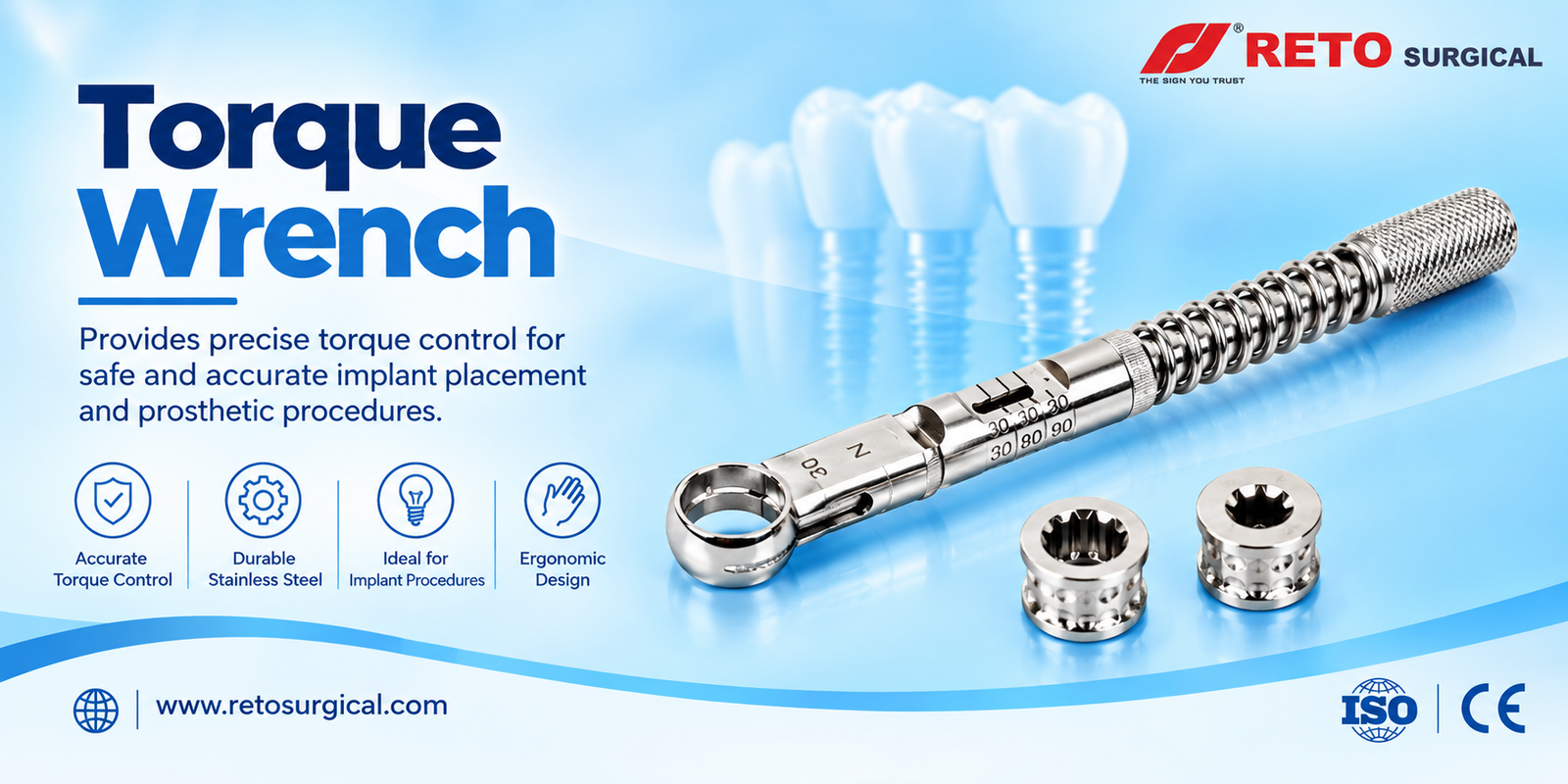
Dental Torque Wrench: Types, Uses & Buying Guide
Dental Torque Wrench: Types, Uses, Torque Settings, and How to Choose the Right One
Precision is essential in modern implant dentistry. Even a small difference in the tightening force applied to an implant screw can affect the stability of a restoration, the performance of its components, and the long-term success of treatment. This is why a dental torque wrench is an important instrument for implantologists, restorative dentists, and dental professionals who perform implant procedures.
A dental torque wrench allows clinicians to apply a controlled amount of rotational force when tightening implant components, abutments, and prosthetic screws. Unlike a conventional screwdriver, which relies mainly on the user’s hand pressure, a torque wrench helps achieve a specified tightening value according to the implant manufacturer’s instructions.
Dental torque wrenches are available in different designs, including manual, adjustable, and dynamometric models. Some feature a ratchet mechanism, interchangeable drivers, and an automatic release system that helps prevent excessive tightening.
For dental clinics, implant centres, and instrument distributors, choosing the right wrench means considering accuracy, compatibility, ease of cleaning, durability, and clinical application.
In this guide, we explain how dental torque wrenches work, the main types available, their essential features, and how to select a suitable instrument for implant procedures.
What Is a Dental Torque Wrench and Why Is It Important?
A dental torque wrench is a precision instrument designed to apply a controlled tightening force to dental implant components and prosthetic screws. It is commonly used during implant placement and restorative procedures where the manufacturer specifies a particular torque value.
Torque is measured in newton centimetres (Ncm). The appropriate setting depends on the implant system, component design, screw specifications, and intended procedure.
The role of torque control in implant dentistry
When a prosthetic screw is tightened, it creates a clamping force that helps hold connected components together. Applying too little torque may contribute to screw loosening, while excessive torque may damage the screw, threads, abutment, or other components.
A suitable torque wrench helps clinicians apply the recommended force more consistently.
For example, when fitting a final implant-supported crown, a dentist may need to tighten an abutment screw to a specified torque. The dentist selects the recommended value and uses a compatible torque wrench to complete the procedure. The exact value must always come from the instructions for the particular implant system and component.
Common applications
Dental torque wrenches are used for several implant-related procedures, including:
- Tightening implant abutment screws.
- Securing prosthetic components.
- Fitting implant-supported crowns and bridges.
- Tightening screws in full-arch restorations.
- Adjusting implant components during designated surgical procedures.
- Supporting controlled screw tightening during restorative treatment.
A dental torque wrench is therefore more than a tightening tool. It is an important part of a controlled clinical workflow that helps reduce avoidable mechanical problems.
Types of Dental Torque Wrenches
Different clinical procedures require different levels of control, compatibility, and accessibility. Understanding the available types helps dental professionals choose an instrument that suits their implant system and working technique.
Adjustable implant torque wrench
An adjustable implant torque wrench allows the user to select from multiple torque settings. Depending on the model, these values may include 15, 20, 25, 30, 35, 40, 45, or 50 Ncm, with some instruments offering additional settings.
These values are examples rather than universal recommendations for every implant system.
The main advantage of an adjustable wrench is versatility. One instrument may support several procedures when its available settings and drivers are appropriate for the components being used.
When evaluating an adjustable model, consider:
- The available torque range and increments.
- How clearly the selected value is displayed.
- Whether the setting locks securely into position.
- The accuracy and repeatability specified by the manufacturer.
- Compatibility with the intended implant drivers.
- The cleaning, sterilisation, and maintenance requirements.
For clinics treating patients with multiple implant systems, adjustability can help simplify instrument selection and reduce the need for separate wrenches.
Manual prosthetic torque wrench
A manual prosthetic torque wrench is designed to help clinicians tighten or adjust prosthetic screws and abutment components using a controlled manual mechanism.
Many models use a lever arm, torque scale, and interchangeable driver. Some are designed for specific torque values, while others provide adjustable settings.
Manual prosthetic torque wrenches are particularly useful during restorative procedures where the correct tightening force is important for maintaining the connection between the implant and the prosthetic restoration.
A well-designed instrument should provide a comfortable grip, clear torque markings, dependable mechanical operation, and convenient access to the working area.
Before selecting a manual model, check whether it is intended for prosthetic procedures, surgical implant placement, or both. These applications are not automatically interchangeable.
Dynamometric dental torque wrench
A dynamometric dental torque wrench is designed to apply a measured or preset tightening force. Depending on its mechanism, it may indicate the applied torque or release, slip, or disengage when the selected torque is reached.
This helps clinicians control the force applied during implant restoration and other specified procedures.
A dynamometric wrench may be especially useful when repeatable tightening is required across multiple components. Its performance, however, depends on the instrument’s design, condition, correct handling, and any calibration or verification requirements specified by its manufacturer.
When comparing products, examine the published accuracy, torque range, release mechanism, and maintenance instructions rather than relying on the product name alone.
Dental torque wrench for surgical and prosthetic applications
A dental implant prosthetic and surgical torque wrench may support more than one type of implant procedure, but its suitability depends on the manufacturer’s stated intended use.
Surgical and prosthetic applications can require different torque ranges, drivers, and handling methods. A wrench intended for tightening an abutment screw should not automatically be assumed suitable for inserting an implant into bone.
For this reason, dental professionals should verify the intended application, supported implant connections, and approved accessories before using an instrument.
Choosing a model designed for the correct clinical task helps maintain a consistent workflow and reduces the risk of using an unsuitable tool.
Essential Features of a High-Quality Dental Torque Wrench
A dental torque wrench should combine precise mechanical performance with practical handling and appropriate reprocessing characteristics. The following features are particularly important when evaluating instruments for professional use.
Precision torque control in Ncm
Precision torque control in Ncm is one of the most important considerations when selecting a dental torque wrench.
A clearly marked scale and a dependable adjustment mechanism help the user select the intended torque value. Consistent performance supports repeatable tightening when the instrument is used correctly and within its specified operating range.
Look for:
- Clearly visible torque markings.
- Secure and repeatable setting selection.
- Published accuracy specifications.
- A suitable range for the intended procedures.
- Instructions for inspection and performance verification.
It is important to remember that a torque wrench does not determine the correct clinical torque by itself. The clinician must follow the implant manufacturer’s instructions for the specific screw or component.
Automatic torque release and ratchet clutch mechanism
An automatic torque release and ratchet clutch mechanism helps control tightening by disengaging, slipping, clicking, or releasing when the selected torque is reached, depending on the design.
This feature can help reduce the likelihood of continuing to tighten a component beyond the selected setting.
A ratchet mechanism also allows controlled rotation without repeatedly removing and repositioning the instrument. This can make work easier in areas where access is limited.
However, the precise operating principle varies between models. Some instruments provide a break-over action, while others use a clutch or declutching mechanism.
Users should learn the correct operating technique for their particular wrench and avoid applying additional force after the specified release or indication occurs.
Autoclavable stainless steel torque wrench
An autoclavable stainless steel torque wrench can be a practical choice for dental environments where reusable instruments must undergo validated cleaning and sterilisation procedures.
Stainless steel is widely used in dental instruments because of its mechanical properties and suitability for appropriate medical-device applications. Nevertheless, not every stainless steel grade, finish, or torque mechanism offers the same resistance to wear, corrosion, or repeated reprocessing.
Before purchasing a reusable instrument, check:
- The specified material and surface finish.
- The manufacturer’s validated cleaning and sterilisation instructions.
- Whether disassembly is required before cleaning.
- Compatibility with the stated autoclave cycle.
- Inspection and maintenance requirements.
- Any restrictions on lubricants or cleaning chemicals.
The word “autoclavable” should always be supported by the manufacturer’s instructions. Reusable instruments must be cleaned, inspected, and sterilised according to the validated process before use.
Universal implant driver and 4 mm square connection
A universal implant driver and 4 mm square connection may be relevant when selecting a torque wrench designed to accept standardised compatible accessories.
For example, some adjustable implant torque wrenches feature a head designed for a standard 4 mm square connection. This can make it easier to use compatible drivers without replacing the complete wrench.
However, a standard connection does not guarantee universal compatibility with every implant system. Driver-tip geometry, engagement depth, screw-head design, and manufacturer-specific requirements must also be considered.
When purchasing a wrench or replacement driver, verify the connection dimensions and compatibility information provided by the instrument manufacturer.
For dental distributors, clearly documented compatibility is also useful when helping customers select instruments for their existing implant systems.
Correct Use, Maintenance, and Safety Considerations
Even a well-manufactured torque wrench must be used and maintained correctly. Following the manufacturer’s instructions helps preserve its performance and supports a reliable clinical workflow.
Implant abutment screw tightening
Implant abutment screw tightening is one of the most common applications of a prosthetic torque wrench.
A general workflow involves identifying the correct screw and driver, confirming the required torque, checking that the components are compatible, and tightening according to the implant manufacturer’s instructions.
The instrument should be positioned and operated as instructed. Applying force at an unintended point on a lever or wrench body may produce an incorrect torque application, particularly on instruments that require force at a designated handle position.
Once the selected torque has been reached and the mechanism indicates release, the user should not continue tightening unless the manufacturer’s procedure specifically requires another step.
Using the correct driver is equally important. A poorly fitting driver can damage the screw head or compromise engagement.
Why the correct torque setting matters
Incorrect tightening can contribute to several mechanical problems.
Insufficient tightening may leave an implant connection vulnerable to screw loosening. Excessive tightening may damage threads, fracture screws, or place unwanted stress on prosthetic components.
Correct torque application helps support the intended screw-joint performance. It does not, by itself, guarantee the long-term success of an implant restoration, which also depends on component design, clinical technique, occlusion, patient factors, and maintenance.
Always use the torque value specified for the actual implant system and component. Values should not be transferred from one manufacturer’s system to another without confirmation.
Cleaning and sterilisation
Reusable dental torque wrenches must be reprocessed according to their validated instructions for use.
Depending on the design, the process may include disassembly, pre-cleaning, cleaning, rinsing, drying, inspection, lubrication where specified, assembly, packaging, and steam sterilisation.
Particular attention should be paid to internal mechanisms, joints, and detachable components where contamination may remain.
Do not assume that all wrenches can be disassembled in the same way or sterilised using identical temperature and cycle settings. Follow the instructions supplied with the specific instrument and the applicable clinical reprocessing procedures.
Inspection, calibration, and storage
Regular inspection helps identify worn drivers, damaged ratchets, corrosion, loose components, or abnormal mechanical movement.
Torque accuracy may also need periodic verification, depending on the instrument design and manufacturer’s recommendations. Some devices require specific servicing or calibration arrangements, while others have different verification requirements.
Store instruments in a clean, dry, protected location according to the manufacturer’s guidance. Avoid impacts, unauthorised adjustments, and practices that could damage the torque mechanism.
If a wrench behaves inconsistently, shows signs of damage, or fails an applicable performance check, remove it from service until it has been assessed appropriately.
How to Choose the Right Dental Torque Wrench for Your Clinic or Business
Selecting a suitable wrench involves more than comparing prices. Dental professionals and distributors should assess the intended application, technical specifications, compatibility, and long-term usability.
Identify the intended clinical application
Start by determining whether the wrench will be used for prosthetic screw tightening, surgical implant procedures, or a specifically approved combination of applications.
Next, establish the required torque range and the types of drivers needed for the intended implant systems.
A product with many torque settings may appear more versatile, but it is only suitable if those settings and its mechanical design meet the requirements of the procedure.
Compare accuracy and mechanical design
Review the stated accuracy, repeatability, torque selection method, and release mechanism.
An instrument with clearly marked settings and an understandable operating method may be easier for a clinical team to use consistently.
Also consider handle ergonomics, head size, access around posterior teeth, and whether the design supports the intended working position.
Check compatibility and accessories
Confirm the connection type, driver dimensions, and supported implant systems before ordering.
For distributors, product documentation should clearly explain which drivers are included, which are optional, and which connections are supported. This reduces confusion and helps buyers choose appropriate accessories.
Evaluate material quality and reprocessing
Consider the instrument’s material, surface finish, mechanical construction, sterilisation instructions, and availability of replacement components.
A reusable wrench should have clear instructions for cleaning, inspection, maintenance, and any necessary performance verification.
For businesses purchasing instruments in quantity, these details can be as important as the initial purchase price.
Consider the supplier and product documentation
Dental instrument buyers should evaluate the manufacturer’s technical information, quality-management arrangements, traceability, and product-specific documentation.
Ask for relevant specifications, instructions for use, material information, and evidence supporting any claimed performance or regulatory status.
Distributors should also confirm that product labelling and documentation meet the requirements applicable to their market.
Why dental instrument distributors should compare carefully
For importers and dental distributors, a reliable supplier relationship can support product consistency, repeat orders, and clearer communication about specifications.
At Reto Surgical, our focus includes dental and surgical instruments, dental implants and accessories, and OEM and custom manufacturing solutions. Dental professionals and distributors evaluating torque wrenches or related instruments should identify their required specifications and confirm the suitability of each product before making a purchasing decision.
When comparing suppliers, prioritise documented quality, fit-for-purpose design, traceability, and dependable communication rather than price alone.
Conclusion
A dental torque wrench is an essential instrument for controlled tightening during many implant-related procedures. The right model helps dental professionals apply the specified torque to implant components and prosthetic screws while supporting a consistent and carefully managed clinical workflow.
Whether you are considering an adjustable implant torque wrench, a manual prosthetic torque wrench, or a dynamometric dental torque wrench, focus on accuracy, appropriate torque settings, compatible drivers, a dependable release mechanism, and validated reprocessing instructions.
Correct implant abutment screw tightening also depends on following the implant manufacturer’s instructions, selecting the right driver, and maintaining the instrument in suitable working condition.
For dental clinics, implant centres, and distributors, careful product evaluation helps identify instruments that meet clinical requirements and purchasing expectations.
Looking for dental instruments or OEM manufacturing solutions? Contact Reto Surgical to discuss your product requirements, technical specifications, and potential supply needs.
Frequently Asked Questions (FAQs)
- What is a dental torque wrench?
A dental torque wrench is a precision instrument used to apply a controlled rotational force when tightening implant components, abutments, and prosthetic screws. It helps clinicians follow the torque specifications provided by the implant manufacturer.
- What is a dental implant torque wrench used for?
It is used for designated implant-related procedures, including tightening abutment screws, securing prosthetic components, and other approved surgical or restorative applications, depending on the instrument’s intended use.
- Why is a torque wrench important in implant dentistry?
A torque wrench helps achieve the specified tightening force. This can reduce the risk of problems associated with insufficient or excessive tightening, including screw loosening and component damage.
- What is an adjustable implant torque wrench?
An adjustable implant torque wrench allows the user to select from a range of torque settings. The available settings vary by model and should match the requirements of the intended implant system.
- What is a manual prosthetic torque wrench?
A manual prosthetic torque wrench is designed to help clinicians tighten or adjust prosthetic screws and implant components using a manual mechanism with specified torque control.
- What is a dynamometric dental torque wrench?
A dynamometric dental torque wrench is designed to apply a measured or preset torque. Depending on its design, it may display the applied force or disengage when the selected torque is reached.
- What does Ncm mean on a dental torque wrench?
Ncm stands for newton centimetre, a unit used to measure torque. The marking indicates the rotational force setting or measurement supported by the instrument.
- What torque setting should be used for an implant abutment screw?
The correct setting depends on the implant system, abutment, and screw. Always follow the implant manufacturer’s instructions for the specific component rather than assuming one torque value applies to every system.
- What happens if an implant screw is overtightened?
Overtightening can damage the screw, threads, or connected components and may contribute to screw fracture. The manufacturer’s specified torque should always be followed.
- Can insufficient torque cause implant screw loosening?
Insufficient tightening may contribute to screw loosening because the intended clamping force may not be achieved. However, loosening can have several causes, including component fit, occlusal forces, and the clinical situation.
- What is an automatic torque release mechanism?
It is a mechanism designed to release, slip, or disengage when the selected torque is reached. Its purpose and operation depend on the specific wrench design.
- What is the function of a ratchet clutch mechanism?
A ratchet clutch mechanism supports controlled rotation and, in torque-limiting designs, can disengage when the selected force is reached. This helps prevent continued tightening beyond the intended setting.
- Are all dental torque wrenches adjustable?
No. Some models provide fixed or limited torque values, while others allow users to select from multiple settings. The appropriate type depends on the intended clinical application.
- Can one torque wrench be used for all dental implant systems?
Not necessarily. Compatibility depends on the torque range, driver connection, tip geometry, and manufacturer’s specifications. Always verify compatibility before use.
- What is a 4 mm square connection on an implant torque wrench?
It is a specified connection interface designed to accept compatible drivers or accessories. A 4 mm square connection does not automatically guarantee compatibility with every implant system.
- Are stainless steel dental torque wrenches suitable for autoclaving?
Some stainless steel torque wrenches are designed for steam sterilisation. Suitability depends on the instrument’s materials, construction, and validated reprocessing instructions.
- How should a reusable dental torque wrench be sterilised?
Follow the manufacturer’s validated instructions, including any requirements for disassembly, cleaning, drying, inspection, packaging, and steam sterilisation. Do not assume every model uses the same cycle.
- How often should a dental torque wrench be calibrated?
Follow the manufacturer’s recommendations for performance verification, servicing, or calibration. Requirements differ between designs, and some instruments may have specific inspection intervals.
- How do you maintain a dental implant torque wrench?
Inspect it regularly, clean and sterilise it according to the instructions, check the ratchet and driver connections, and arrange any required maintenance or performance verification.
- What is the difference between a surgical and a prosthetic torque wrench?
A surgical torque wrench is intended for specified surgical procedures, such as implant insertion or adjustment. A prosthetic torque wrench is intended for designated restorative tasks, such as tightening abutment or prosthetic screws. Their applications should not be assumed interchangeable.
- Can a torque wrench be used to loosen implant screws?
Some models support reverse rotation or loosening. Check the manufacturer’s instructions to confirm the permitted function and correct operating method.
- What features should I look for when buying a dental torque wrench?
Consider torque range, accuracy, adjustment method, release mechanism, driver compatibility, ergonomics, material quality, sterilisation requirements, and technical documentation.
- Is an adjustable torque wrench better than a fixed-setting model?
An adjustable model may offer greater versatility across different approved procedures. A fixed-setting model may suit a narrower application. The best option depends on clinical requirements and verified compatibility.
- Can dental torque wrenches be purchased wholesale?
Many dental instrument suppliers offer products to distributors, importers, and professional buyers. Confirm minimum order quantities, technical specifications, available accessories, documentation, and market-specific regulatory requirements directly with the supplier.
- Where can dental distributors find dental torque wrench suppliers?
Distributors can evaluate specialist dental instrument manufacturers and suppliers by reviewing product specifications, quality documentation, traceability, compatibility information, and commercial terms. Reto Surgical provides dental and surgical instrument manufacturing and OEM solutions; contact the company to discuss relevant product requirements and sourcing needs.
follow us on instagram
follow us on Facebook