
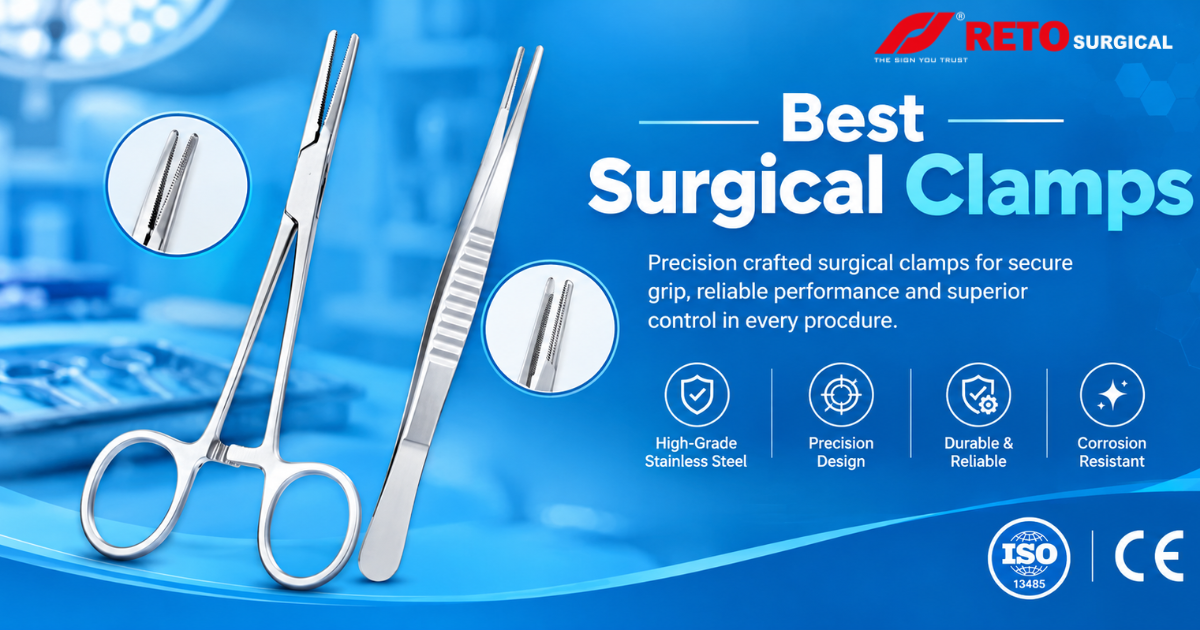
Surgical Forceps: Types, Uses & Applications | Reto Surgical
Surgical Forceps: Types, Uses and Applications in Modern Surgery
Introduction
In modern healthcare, even a small surgical instrument can make a significant difference. Surgical forceps are among the most widely used instruments in operating rooms, clinics, dental practices, and specialist medical environments. They allow healthcare professionals to grasp, hold, manipulate, dissect, or handle tissues and surgical materials with controlled precision.
Although forceps may look simple, their designs vary considerably. Jaw shape, tip configuration, length, teeth, serrations, spring tension, and handle design are all selected according to the intended application. Choosing the right instrument can therefore improve handling and help healthcare professionals work efficiently during procedures.
Understanding the different types of surgical forceps is particularly important for hospitals, clinics, surgical professionals, and medical instrument buyers. From delicate tissue forceps to strong hemostatic forceps, each design has a specific role.
Understanding Surgical Forceps and Their Purpose
At their simplest, forceps are handheld instruments designed to provide a controlled grip. They essentially extend the user’s fingers, allowing precise manipulation in areas where direct hand contact would be impractical or inappropriate.
Surgical forceps can be broadly categorized according to their function. Some are designed to hold tissue gently, while others provide a firmer grip or are used to clamp vessels. There are also specialized instruments designed for delicate procedures where minimizing tissue trauma is important.
One of the most important factors is the working end of the instrument. The jaws may be smooth, serrated, or toothed. Smooth tips can be useful when a gentle grip is required, while serrations can provide additional holding power. Toothed patterns may be selected when a secure grip on particular tissues is needed.
The overall length is another consideration. Short forceps generally provide excellent control for superficial procedures, whereas longer instruments may help surgeons access deeper surgical sites.
The best instrument is therefore not necessarily the largest, strongest, or most expensive one. It is the forceps that match the procedure and provide the appropriate combination of grip, visibility, control, and handling.
Common Types of Surgical Forceps
There are many types of surgical forceps, each developed for a particular purpose. Understanding these differences helps medical professionals and purchasing teams select appropriate instruments.
Hemostatic Forceps
Hemostatic forceps are designed primarily for clamping blood vessels or tissues to assist with controlling bleeding during surgery.
They commonly feature locking handles that allow the instrument to remain clamped without continuous manual pressure. Different sizes and jaw configurations are available depending on the intended application.
Examples include Kelly and other artery forceps. Their serrated jaws help provide a secure hold when clamping tissue or vessels.
Tissue Forceps
Tissue forceps are designed for handling and manipulating tissue during surgical procedures. Their tip configuration varies according to how much grip is required.
Some tissue forceps have smooth or finely serrated tips, while others feature teeth. The selection depends on the tissue and the desired level of grip.
For delicate procedures, controlled handling is especially important because excessive pressure can potentially damage tissue.
Dressing Forceps
Dressing forceps are commonly used to handle dressings, gauze, swabs, and other materials.
They are often lightweight and have relatively narrow working tips. Their design provides the user with control when positioning or removing materials within a surgical or clinical environment.
Because dressing forceps are intended primarily for material handling, they differ from instruments specifically designed for gripping tissue.
Grasping Forceps
Grasping forceps are designed to securely hold tissue or other materials during procedures.
The jaws may have serrations, teeth, or specialized configurations depending on the intended application. Some grasping instruments are designed to provide a firm hold while minimizing unnecessary pressure.
The choice of grasping forceps depends heavily on the tissue type and procedure being performed.
Popular Surgical Forceps and Their Applications
Different surgical specialties use specialized forceps designs. Several well-known instruments have become standard choices for specific applications.
Adson Forceps
Adson forceps are commonly recognized by their relatively broad handle and short working tips. They are frequently used for handling tissue during procedures where precise manipulation is required.
Toothed and non-toothed versions are available. The toothed design can provide a secure grip on certain tissues, while the non-toothed version may be selected when a gentler grip is appropriate.
Their compact design makes them particularly useful when working in relatively small surgical fields.
DeBakey Forceps
DeBakey forceps are known for their delicate, atraumatic design and are commonly associated with vascular and general surgical procedures.
Their distinctive tip configuration is designed to provide controlled tissue handling while helping minimize unnecessary trauma. They are available in different lengths and sizes.
Because precision is particularly important in vascular surgery, instrument design and manufacturing accuracy are critical considerations when selecting DeBakey-style forceps.
Kocher Forceps
Kocher forceps, also called Kocher clamps in some contexts, are recognized by their strong jaws and teeth at the tip.
They provide a firm grip and are commonly associated with procedures where secure tissue holding is required. Their locking mechanism allows the instrument to maintain its grip.
Because their toothed jaws can provide a strong hold, they should be selected according to the intended surgical application and tissue characteristics.
Kelly Forceps
Kelly forceps are commonly used as hemostatic instruments. They feature serrated jaws and a locking mechanism that allows the user to maintain pressure on tissue or vessels.
They are available in straight and curved configurations, providing flexibility for different surgical situations.
The correct size and configuration should be selected according to the procedure, surgical site, and required level of access.
How to Choose the Right Surgical Forceps
Selecting surgical forceps should be based on function rather than appearance alone. A professional buyer or healthcare facility should consider several factors before purchasing instruments.
Consider the Intended Procedure
Start by identifying exactly what the instrument will be used for. A forceps designed for delicate tissue handling may not be suitable for clamping vessels, while a strong toothed instrument may be inappropriate for fragile tissue.
Examine the Tip Design
The tip is one of the most important parts of the instrument.
Ask whether the application requires:
- Smooth tips
- Serrated tips
- Fine teeth
- Larger teeth
- Straight jaws
- Curved jaws
- Fine or broad tips
The appropriate configuration can significantly affect handling and control.
Consider Length and Access
Instrument length should correspond with the depth and location of the surgical site. Longer forceps can provide access to deeper areas, while shorter instruments can provide greater control for superficial work.
Evaluate Material Quality
Reusable surgical instruments are commonly manufactured from stainless steel because it offers durability and corrosion resistance when appropriately selected and processed.
However, material quality alone does not determine instrument performance. Manufacturing accuracy, heat treatment where applicable, finishing, polishing, surface treatment, and quality inspection are also important.
Check Jaw Alignment and Finish
When forceps are closed, the jaws should align appropriately for their intended design. Uneven alignment, damaged tips, rough surfaces, or excessive movement may affect performance.
For professional applications, instruments should undergo appropriate inspection before being supplied or used.
Manufacturing, Maintenance and Quality Considerations
High-quality forceps begin with precise manufacturing. The production process can involve CNC machining, grinding, forming, polishing, finishing, heat treatment, passivation, assembly, and inspection, depending on the instrument design.
For manufacturers and distributors, consistency is particularly important. If a customer orders hundreds or thousands of instruments, each piece should meet the agreed specifications.
Traceability can also be valuable, particularly for medical-device supply chains. Appropriate product identification, batch information, inspection procedures, and documentation can help support quality management.
Cleaning and Reprocessing
Reusable forceps require appropriate cleaning and reprocessing according to the manufacturer’s instructions and the healthcare facility’s validated procedures.
After use, instruments should be handled according to established decontamination protocols. They should be inspected for visible contamination, damage, corrosion, misalignment, or other defects.
Instruments with moving parts should receive appropriate attention during cleaning and inspection. Damaged or poorly functioning instruments should not be returned to service until appropriately evaluated.
Storage
Proper storage helps protect surgical instruments from unnecessary damage. Forceps should be stored in a clean, dry environment and arranged in a manner that prevents excessive contact or impact.
For healthcare facilities, appropriate organization can also make it easier for staff to identify the correct instrument quickly.
Conclusion
Surgical forceps may be simple in appearance, but their design and application are highly specialized. From hemostatic forceps used for clamping to tissue forceps, dressing forceps, and grasping forceps, each instrument serves a particular purpose.
Understanding popular designs such as Adson forceps, DeBakey forceps, Kocher forceps, and Kelly forceps can help healthcare professionals and medical buyers make more informed decisions.
The right forceps should provide appropriate grip, control, access, durability, and handling for the intended procedure. Equally important are material quality, manufacturing precision, inspection, maintenance, and appropriate reprocessing.
For hospitals, clinics, distributors, and OEM customers, selecting an experienced surgical instrument manufacturer can make a significant difference in consistency and long-term supply.
If you are looking for reliable surgical instruments or customized OEM solutions, working with an experienced manufacturer can help you select or develop forceps according to your required specifications.
Frequently Answers Questions:
- What are surgical forceps?
Surgical forceps are handheld instruments used to grasp, hold, manipulate, or handle tissues and surgical materials during procedures. - What are the main types of surgical forceps?
Common types include tissue forceps, dressing forceps, hemostatic forceps, grasping forceps, dissecting forceps, and specialized forceps. - What are hemostatic forceps used for?
They are primarily used to clamp blood vessels or tissue to help control bleeding during surgical procedures. - What are tissue forceps used for?
Tissue forceps are used to grasp and manipulate tissue during surgical procedures. - What are dressing forceps used for?
Dressing forceps are generally used to handle gauze, dressings, swabs, and other materials. - What are grasping forceps?
Grasping forceps are designed to securely hold tissue or materials during surgical procedures. - What are Adson forceps used for?
Adson forceps are commonly used for precise tissue handling, particularly in procedures involving relatively small surgical fields. - What are DeBakey forceps used for?
DeBakey forceps are commonly used for delicate tissue handling and are particularly associated with vascular and general surgery. - What are Kocher forceps used for?
Kocher forceps provide a strong grip and are used when secure tissue holding or clamping is required. - What are Kelly forceps used for?
Kelly forceps are commonly used as hemostatic instruments for clamping vessels or tissue. - What is the difference between toothed and non-toothed forceps?
Toothed forceps provide a stronger mechanical grip, while non-toothed designs may be selected for applications requiring gentler handling. - Are surgical forceps made from stainless steel?
Many reusable surgical forceps are manufactured from stainless steel selected for durability and corrosion resistance. - Are surgical forceps reusable?
Some are designed for repeated use and reprocessing, while others are intended for single-use applications. Always follow the manufacturer’s instructions. - How do you choose surgical forceps?
Consider the procedure, tissue type, tip configuration, jaw design, instrument length, grip, and intended application. - Why is jaw alignment important?
Appropriate jaw alignment helps ensure consistent contact and controlled handling during use. - What are curved surgical forceps used for?
Curved forceps can improve access and visibility when working around anatomical structures or in deeper surgical fields. - What are straight surgical forceps used for?
Straight forceps are commonly selected when direct access and straightforward instrument positioning are appropriate. - How should surgical forceps be maintained?
They should be cleaned, inspected, processed, sterilized where applicable, dried, and stored according to the manufacturer’s instructions and applicable healthcare protocols. - What should you inspect on surgical forceps?
Inspect the tips, jaws, alignment, surface finish, locking mechanism where applicable, corrosion, and overall structural condition. - What makes high-quality surgical forceps?
Material quality, precise manufacturing, appropriate jaw alignment, reliable grip, smooth finishing, durability, and consistent quality inspection are important factors. - Can surgical forceps be customized?
Yes. OEM manufacturers may produce forceps according to customer drawings, dimensions, patterns, materials, finishes, and other specifications. - Can surgical forceps be used in dental surgery?
Specialized surgical and dental forceps are used in oral and dental surgical procedures, depending on the specific application. - What is the difference between forceps and clamps?
Forceps generally refer to instruments used for grasping or manipulating, while clamps often emphasize holding or occluding tissue, vessels, or materials. Terminology can overlap between instruments. - Why is stainless steel commonly used for reusable forceps?
Appropriately selected stainless steel can provide the combination of strength, durability, and corrosion resistance needed for reusable medical instruments. - Where can I buy surgical forceps?
Surgical forceps can be sourced through specialized medical-device manufacturers, surgical instrument suppliers, distributors, and OEM manufacturers. - What should distributors look for in a surgical forceps manufacturer?
Distributors should consider manufacturing capabilities, quality systems, product consistency, inspection processes, customization options, documentation, and supply capacity. - What is OEM surgical forceps manufacturing?
OEM manufacturing involves producing surgical forceps according to another company’s specifications, designs, branding, packaging, or technical requirements.