
Surgical Clamps Types: Complete Guide to Surgical Clamp Uses
Surgical Clamps Types: A Complete Guide to Types, Uses, and Selection
Introduction
In modern surgery, the right instrument can make a significant difference in control, precision, and tissue handling. Among the many instruments found in an operating room, surgical clamps are especially important because they can help control bleeding, temporarily occlude vessels, hold tissue, secure surgical drapes, and support surgeons during delicate procedures.
But “surgical clamp” is not a single instrument. There are many designs, jaw patterns, lengths, curves, locking mechanisms, and applications. A clamp designed for a blood vessel may be completely unsuitable for delicate intestinal tissue, while a towel clamp has an entirely different purpose.
Understanding the different surgical clamps types helps surgeons, hospitals, surgical instrument buyers, distributors, and healthcare professionals select instruments according to the procedure and tissue involved. Surgical clamps are generally designed around a specific function, such as hemostasis, vascular occlusion, tissue handling, or securing materials.
This guide explores the most important types of surgical clamps, their applications, design characteristics, and the factors that should be considered when selecting them.
What Are Surgical Clamps?

A surgical clamp is a hinged medical instrument designed to compress, hold, occlude, or secure tissue, vessels, tubing, or surgical materials. Depending on its design, a clamp may provide temporary vessel occlusion, bleeding control, tissue stabilization, or secure positioning.
Many locking clamps use a ratchet locking mechanism, allowing the instrument to remain closed without continuous hand pressure. Hemostatic clamps commonly use serrated jaws to maintain a secure grip, while many atraumatic vascular clamps are designed to distribute pressure more gently across a vessel.
The correct clamp depends on several factors, including:
- The surgical specialty
- The tissue or vessel being handled
- Required clamping pressure
- Jaw shape and length
- Straight, curved, or angled design
- Atraumatic versus firm-grip requirements
- Depth and accessibility of the surgical field
- Sterilization and reprocessing requirements
Choosing an instrument according to its intended application is essential because excessive pressure or an inappropriate jaw pattern can increase the risk of tissue damage.
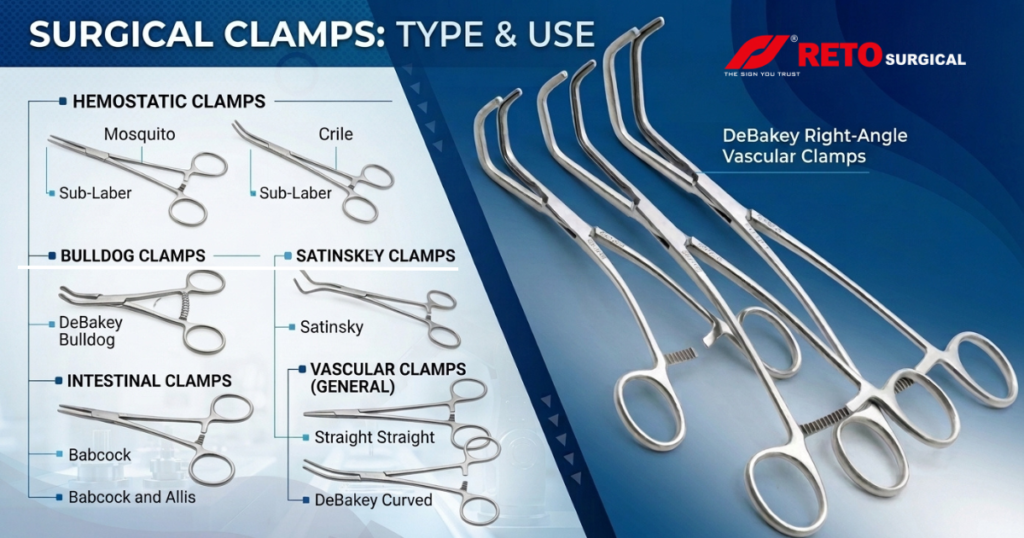
Hemostatic Clamps for Bleeding Control
Hemostatic Clamps are among the most widely recognized surgical clamps. Their primary purpose is to help control bleeding by compressing blood vessels or other vascular structures.
They commonly feature serrated jaws and a ratchet lock. The serrations help maintain grip, while the locking mechanism allows the surgeon to maintain controlled compression. Common hemostatic designs include small, medium, and larger clamps for different vessel sizes.
In practical surgical situations, the appropriate size matters. A small clamp may be useful for fine vessels, whereas larger hemostatic instruments can provide stronger control for larger structures.
Typical applications include:
- Temporary control of bleeding
- Clamping small or medium blood vessels
- General surgery
- Tissue stabilization
- Surgical dissection
- Securing structures before ligation
Hemostatic instruments may have straight or curved jaws depending on the required access and angle. Their design prioritizes secure grip and reliable hemostasis rather than the atraumatic vessel handling associated with specialized vascular clamps.
Vascular Clamps and Atraumatic Vessel Control
Vascular Clamps are specifically designed for controlling blood vessels during vascular and cardiovascular procedures. Their design is often focused on achieving temporary occlusion while minimizing unnecessary trauma to the vessel wall.
Unlike conventional hemostatic clamps, some vascular clamps use smoother or atraumatic jaw surfaces and controlled pressure distribution. This is particularly important when the surgeon needs to preserve vessel integrity during procedures such as vascular reconstruction or anastomosis.
Vascular clamps may be:
- Straight
- Curved
- Angled
- Partial-occlusion
- Full-occlusion
- Spring-loaded
- Ratchet-operated
The selection depends on vessel anatomy, surgical access, required occlusion, and the degree of tissue protection needed. Smooth-jaw vascular and bulldog-style clamps are generally designed around temporary vessel occlusion rather than the stronger gripping action of serrated hemostatic forceps.
Bulldog Clamps
Bulldog Clamps are compact vascular clamps commonly used for temporary occlusion of blood vessels. Their relatively small size makes them particularly useful when the surgical field requires controlled access around individual vessels.
Their spring-loaded design can provide controlled pressure while allowing temporary interruption of blood flow. Bulldog clamps are available in different configurations for vascular and microsurgical applications.
They are especially relevant when the surgeon needs temporary vessel control without applying the same type of aggressive grip associated with conventional serrated hemostats.
Satinsky Vascular Clamps
Satinsky Vascular Clamps are specialized vascular instruments designed for partial occlusion of large blood vessels. Their distinctive curved or angled jaw geometry allows the surgeon to clamp part of a vessel while maintaining blood flow through the remaining portion.
This makes the Satinsky pattern particularly useful in vascular and cardiothoracic procedures where partial vessel occlusion is required.
The design is associated with controlled access and vessel manipulation, making it different from a conventional hemostatic clamp intended primarily for bleeding control. Specialized Satinsky and DeBakey patterns are commonly used when atraumatic vascular control is important.
DeBakey Vascular Clamps
DeBakey Vascular Clamps are another important category of atraumatic vascular instruments. They are designed for handling and controlling blood vessels while reducing unnecessary trauma.
DeBakey-style jaw patterns are widely associated with vascular and cardiovascular surgery. Depending on the model, they may have curved, angled, or specialized jaws designed for specific anatomical locations.
The key considerations when selecting a DeBakey vascular clamp include:
- Vessel diameter
- Jaw configuration
- Overall length
- Degree of curvature
- Required occlusion
- Accessibility of the operative field
- Atraumatic handling requirements
Intestinal Clamps for Gastrointestinal Surgery
Intestinal Clamps are designed for temporary occlusion and manipulation of sections of the gastrointestinal tract.
The intestinal wall is delicate, so clamp design must balance secure control with tissue protection. The purpose is generally not simply to apply maximum pressure, but to provide sufficient control without unnecessarily damaging the bowel wall.
Intestinal clamps may be used during:
- Gastrointestinal resections
- Bowel procedures
- Anastomosis
- Temporary occlusion of intestinal segments
- Isolation of surgical areas
The appropriate design depends on the procedure and the anatomical structure involved. Surgical clamp selection should always consider the tissue characteristics and the required duration of clamping.
Tissue Clamps: Allis and Babcock Designs
Not every surgical clamp is designed for blood vessels. Some are primarily intended to grasp and hold tissue.
Allis Tissue Clamps
Allis Tissue Clamps are designed for firm tissue grasping and traction. Their jaws typically incorporate teeth that help maintain a secure hold.
Because of their relatively firm grip, Allis clamps are commonly associated with tissue that can tolerate stronger grasping forces. They may be used in general, gynecological, and other surgical procedures where secure tissue traction is required.
The key advantage is strong holding capability. However, because the jaws are designed for secure grip, they should not automatically be considered appropriate for delicate or highly fragile tissue.
Babcock Tissue Clamps
Babcock Tissue Clamps are designed for more delicate tissue handling compared with toothed tissue-grasping clamps. Their broader, typically fenestrated jaw design helps distribute pressure over the tissue.
They are commonly associated with structures such as bowel and other delicate tissues where a firm but gentler grip may be required.
This illustrates an important principle in surgical instrument selection: the strongest grip is not always the best grip. The appropriate instrument is the one that provides enough control for the task while respecting the characteristics of the tissue being handled. The distinction between Allis and Babcock designs reflects this difference in intended tissue handling.
Specialized Clamps: Backhaus and Mixter Designs
Some surgical clamps have highly specific functions that are unrelated to direct vessel occlusion.
Backhaus Towel Clamps
Backhaus Towel Clamps are commonly used to secure surgical drapes and towels around the operative field.
Their pointed jaws are designed to grip and hold materials securely. Rather than being used primarily for vascular occlusion or tissue manipulation, their role is to help maintain the organization of the sterile field.
This is a useful reminder that the term “surgical clamp” covers several different instrument categories. Some clamps interact directly with anatomical structures, while others are designed to secure materials used during surgery.
Mixter Right-Angle Clamps
Mixter Right-Angle Clamps, sometimes called right-angle clamps, feature a distinctive angled jaw that allows surgeons to reach structures around corners or through confined anatomical spaces.
The right-angle geometry can make them useful for passing around vessels, ducts, or other structures during dissection and surgical preparation.
Their design provides access where a conventional straight clamp may be difficult to position. This makes the Mixter pattern particularly useful in procedures requiring controlled dissection or passage around anatomical structures.
How to Choose the Right Surgical Clamp
Choosing the correct surgical clamp is more than selecting a familiar instrument name. The instrument should match the procedure, anatomy, and intended function.
Consider the Surgical Application
Start by identifying the purpose of the clamp.
For example:
- Hemostatic Clamps → bleeding control and vessel compression
- Vascular Clamps → temporary vessel occlusion and vascular procedures
- Bulldog Clamps → temporary control of smaller vessels
- Satinsky Vascular Clamps → partial occlusion of larger vessels
- DeBakey Vascular Clamps → atraumatic vascular control
- Intestinal Clamps → temporary bowel occlusion
- Allis Tissue Clamps → firm tissue grasping
- Babcock Tissue Clamps → gentler tissue handling
- Backhaus Towel Clamps → securing surgical drapes
- Mixter Right-Angle Clamps → access around vessels and structures
Consider Jaw Design
Jaw configuration strongly influences instrument performance. Serrated jaws generally provide stronger resistance to slipping, while smoother or atraumatic surfaces can be better suited to delicate vessel handling.
Consider Size and Length
A longer clamp may be advantageous in deeper operative fields, while shorter instruments can provide greater control in more accessible areas. The jaw width and shape should also correspond to the structure being handled.
Consider Material and Reprocessing
High-quality reusable surgical clamps are commonly manufactured from medical-grade stainless steel and must be designed to withstand appropriate cleaning, disinfection, and sterilization processes.
Before reuse, instruments should be inspected for:
- Jaw alignment
- Smooth opening and closing
- Proper ratchet function
- Corrosion or surface damage
- Cracks or deformation
- Secure locking
- Cleanliness and sterilization status
Cleaning and sterilization procedures should always follow the manufacturer’s validated instructions and the healthcare facility’s applicable protocols.
Surgical Clamps vs. Forceps: What Is the Difference?
Surgical clamps and forceps can look remarkably similar, which often causes confusion.
The simplest distinction is their intended function.
Forceps generally prioritize grasping, manipulating, and handling tissue or materials with controlled precision. Clamps are generally designed to provide sustained compression, occlusion, or secure holding, often through a locking mechanism.
However, the terminology can overlap. Locking forceps may be called clamps, and hemostatic forceps are commonly referred to as hemostats. The actual distinction therefore depends heavily on the instrument’s design and intended clinical use.
Why Quality Matters in Surgical Clamps
A surgical clamp may appear to be a relatively simple instrument, but its performance depends on precision manufacturing.
Important quality factors include:
- Accurate jaw alignment
- Consistent jaw pressure
- Reliable locking mechanism
- Smooth articulation
- Appropriate surface finish
- Corrosion resistance
- Consistent dimensions
- Appropriate material selection
- Proper cleaning and sterilization compatibility
For hospitals, distributors, and surgical instrument buyers, supplier evaluation should also consider manufacturing quality systems, traceability, inspection procedures, packaging, documentation, and applicable regulatory requirements.
A high-quality surgical clamp should not only look polished; it should perform consistently when precision matters.
Conclusion
Understanding the different surgical clamps types is essential for selecting the right instrument for each procedure. From Hemostatic Clamps used for bleeding control to Vascular Clamps, Bulldog Clamps, Satinsky Vascular Clamps, and DeBakey Vascular Clamps used for vessel control, each design has a specific purpose.
Similarly, Intestinal Clamps, Allis Tissue Clamps, and Babcock Tissue Clamps address different tissue-handling requirements, while Backhaus Towel Clamps and Mixter Right-Angle Clamps serve specialized functions.
The best surgical clamp is not necessarily the strongest one. It is the instrument whose design, jaw pattern, size, pressure, and geometry are appropriate for the intended application.
For hospitals, distributors, and medical instrument buyers, selecting a reliable manufacturer with consistent quality, appropriate documentation, and a broad range of surgical clamp designs can help ensure dependable instrument performance.
Frequently Asked Questions About Surgical Clamps
- What are surgical clamps?
Surgical clamps are medical instruments used to compress, hold, occlude, or secure blood vessels, tissues, surgical materials, or other structures during a procedure.
- What are the main types of surgical clamps?
Common types include hemostatic clamps, vascular clamps, bulldog clamps, Satinsky clamps, DeBakey vascular clamps, intestinal clamps, tissue clamps, towel clamps, and right-angle clamps.
- What are Hemostatic Clamps used for?
Hemostatic Clamps are primarily used to control bleeding by compressing blood vessels or other structures. They commonly feature serrated jaws and a locking ratchet.
- What are Vascular Clamps used for?
Vascular Clamps are designed to temporarily occlude blood vessels during vascular and cardiovascular procedures while helping the surgeon maintain control of blood flow.
- What is a Bulldog Clamp?
A Bulldog Clamp is a compact vascular clamp used for temporary vessel occlusion. Its design is particularly useful when controlled pressure is required on individual vessels.
- What is a Satinsky Vascular Clamp?
A Satinsky Vascular Clamp is a specialized vascular instrument commonly used for partial occlusion of larger blood vessels. Its curved geometry can allow continued blood flow through an unclamped portion of the vessel.
- What are DeBakey Vascular Clamps?
DeBakey Vascular Clamps are specialized vascular instruments designed for controlled and generally atraumatic handling and occlusion of blood vessels.
- What are Intestinal Clamps used for?
Intestinal Clamps are used to temporarily occlude or control sections of the gastrointestinal tract during procedures such as bowel surgery, resection, and anastomosis.
- What are Allis Tissue Clamps used for?
Allis Tissue Clamps are designed for firm tissue grasping and traction. Their toothed jaws provide a secure grip on appropriate tissue.
- What are Babcock Tissue Clamps used for?
Babcock Tissue Clamps are designed for controlled handling of relatively delicate tissue. Their broader jaw configuration helps distribute pressure during grasping.
- What are Backhaus Towel Clamps?
Backhaus Towel Clamps are used to secure surgical towels and drapes around the operative field. They are not primarily intended for vessel occlusion.
- What is a Mixter Right-Angle Clamp?
A Mixter Right-Angle Clamp has an angled jaw that helps surgeons access structures around corners and within confined surgical spaces.
- What is the difference between a clamp and forceps?
Forceps generally emphasize grasping and manipulation, whereas clamps typically provide sustained compression, occlusion, or secure holding. However, the terminology can overlap between instrument categories.
- Are all surgical clamps locking instruments?
No. Many clamps use a ratchet locking mechanism, but some vascular and bulldog-style clamps use spring mechanisms or other designs to provide controlled pressure.
- Why do surgical clamps have serrated jaws?
Serrations can increase grip and reduce slipping when tissue or vessels need to be held securely. Serrated designs are common in hemostatic instruments.
- Are smooth-jaw clamps used in surgery?
Yes. Smooth or atraumatic jaw designs are commonly associated with vascular instruments where temporary vessel occlusion with controlled pressure distribution is important.
- How do I select the correct surgical clamp?
Consider the procedure, tissue type, vessel size, required pressure, jaw configuration, instrument length, curvature, access requirements, and whether atraumatic handling is necessary.
- What material are surgical clamps made from?
Reusable surgical clamps are commonly manufactured from medical-grade stainless steel because it can provide strength, corrosion resistance, and compatibility with appropriate sterilization processes.
- How should reusable surgical clamps be maintained?
They should be cleaned according to validated manufacturer and healthcare-facility procedures, inspected for damage and jaw alignment, checked for proper locking or spring function, and sterilized using an approved process before reuse.
- Where can hospitals and distributors buy surgical clamps?
Hospitals and distributors should source surgical clamps from established medical instrument manufacturers or qualified suppliers that can provide consistent manufacturing quality, product specifications, traceability, regulatory documentation, and appropriate packaging.