
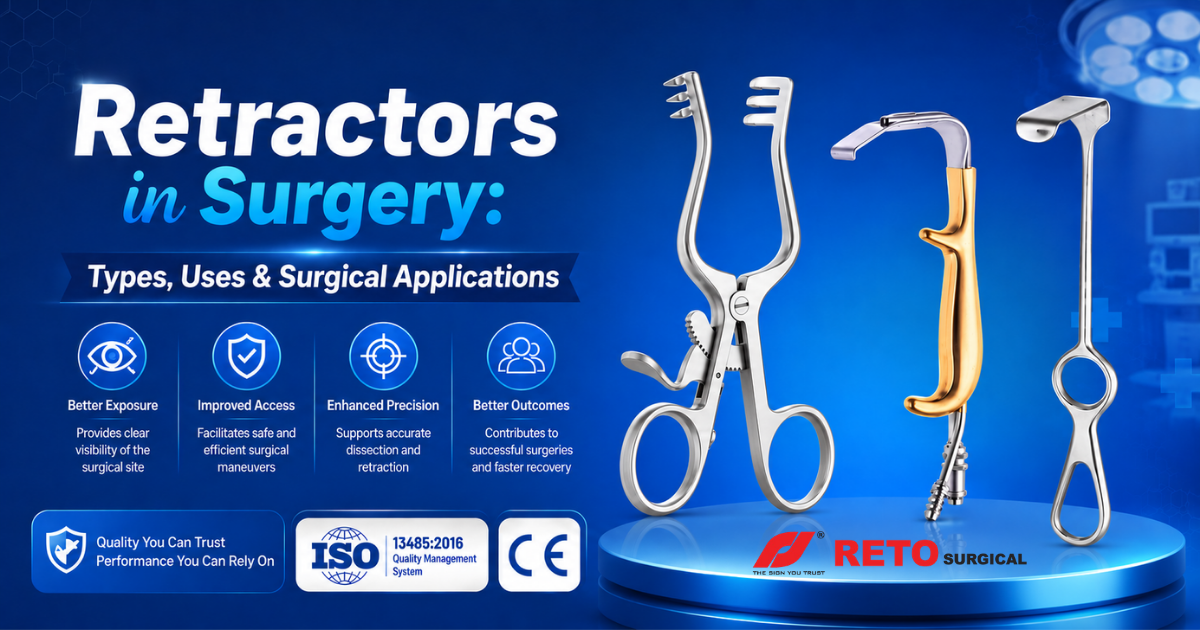
Retractors in Surgery: Types, Uses & Surgical Applications
Retractors in Surgery: Types, Uses, and Their Role in Surgical Site Exposure
Introduction
In surgery, visibility is everything. Even when a surgeon has excellent technical skills and years of experience, working in a deep, narrow, or crowded anatomical area can be challenging without the right instruments. This is where Surgical Retractors play an essential role.
Retractors are surgical instruments designed to hold tissues, organs, skin, or other structures away from the operative field. By maintaining separation, they help surgeons achieve better Surgical Site Exposure, improve visualization, and work with greater precision. Depending on the procedure, retractors may be held manually by an assistant or secured in position so that the surgeon can concentrate on the operation.
From abdominal and thoracic procedures to orthopaedic and minimally invasive operations, retractors are available in many shapes, sizes, and configurations. Choosing the appropriate retractor depends on factors such as the surgical approach, anatomical location, depth of the operative field, tissue characteristics, and the amount of exposure required.
In this guide, we will explore how retractors work, the major types used in modern surgery, and the factors healthcare professionals should consider when selecting them.
What Are Surgical Retractors and Why Are They Important?
The basic purpose of a retractor is straightforward: Tissue Retraction.
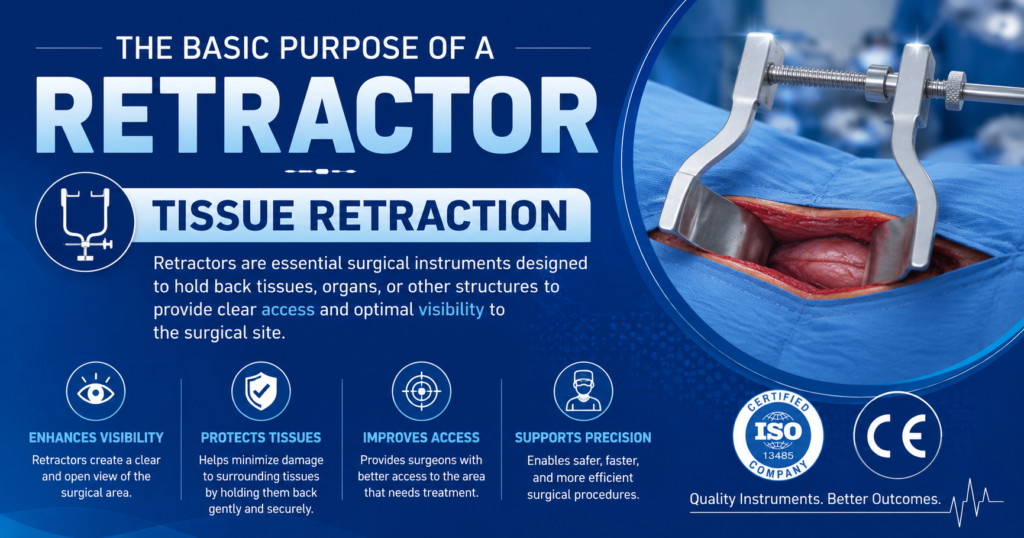
During an operation, tissues naturally move back toward their original position. Blood, muscle, fat, skin, and organs can also obstruct the surgeon’s view. A retractor helps keep these structures away from the surgical field, creating a clearer and more stable working area.
Good Surgical Site Exposure is particularly important when surgeons need to work around delicate anatomical structures. Improved visibility can make it easier to identify vessels, nerves, organs, and other tissues while reducing unnecessary manipulation.
Retractors generally fall into two broad categories:
- Handheld Retractors – held and positioned manually by a surgeon or surgical assistant.
- Self-Retaining Retractors – designed to maintain tissue separation after being positioned, often using a locking or ratcheting mechanism.
Neither type is universally better. The choice depends on the procedure and the surgeon’s preferred technique.
For example, a handheld retractor can be repositioned quickly as the surgical field changes. A self-retaining design, on the other hand, can maintain continuous exposure without requiring an assistant to hold it throughout the procedure.
Handheld and Self-Retaining Retractors: Understanding the Difference
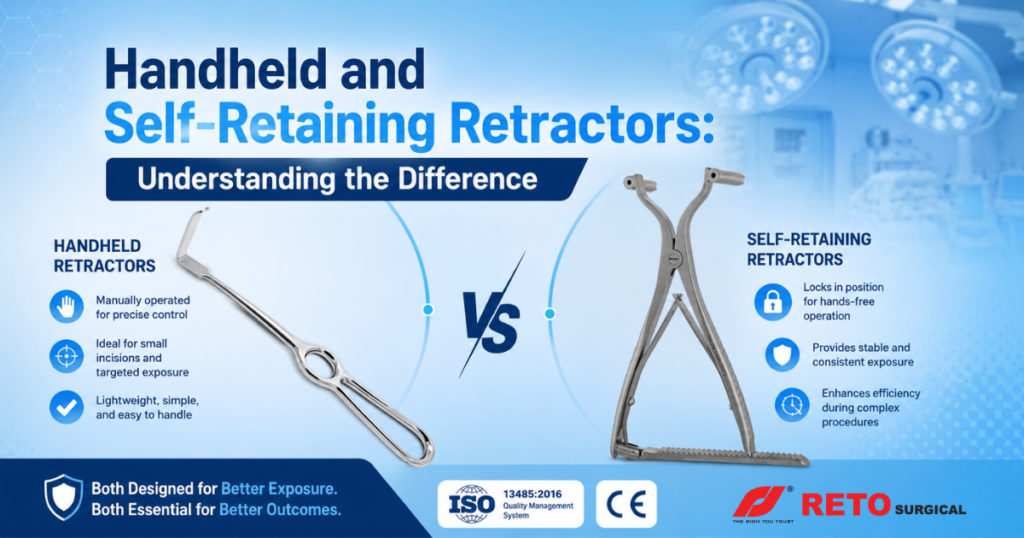
Handheld Retractors
Handheld Retractors are among the simplest and most versatile retraction instruments. They are manually positioned against or beneath tissue and held in place during the operation.
Common examples include various flat, curved, angled, and hook-shaped retractors. Their relatively simple construction makes them useful across numerous surgical specialties.
One major advantage is flexibility. An assistant can adjust the angle or depth immediately when the surgeon requests a different view. This can be particularly useful when operating around changing anatomical structures.
However, handheld retractors require an additional member of the surgical team to maintain their position. Excessive or prolonged pressure must also be avoided because inappropriate retraction can potentially traumatize tissue.
Self-Retaining Retractors
Self-Retaining Retractors use a mechanical mechanism to hold tissue apart once the instrument has been positioned. Many incorporate a ratchet, locking system, frame, or adjustable arms.
Their primary benefit is consistency. Once correctly positioned, they can provide continuous exposure without requiring an assistant to maintain manual pressure.
A familiar example is the Weitlaner Retractor, which is commonly associated with self-retaining retraction. Its pronged blades can help maintain exposure in suitable surgical fields.
Another important example is the Balfour Retractor, widely associated with abdominal surgery. Its frame and adjustable components are designed to help maintain access to the abdominal operative field.
The key point is that self-retaining retractors should not simply be selected because they “hold themselves.” Proper blade placement, tissue protection, and appropriate tension remain essential.
Abdominal Retractors and Surgical Applications
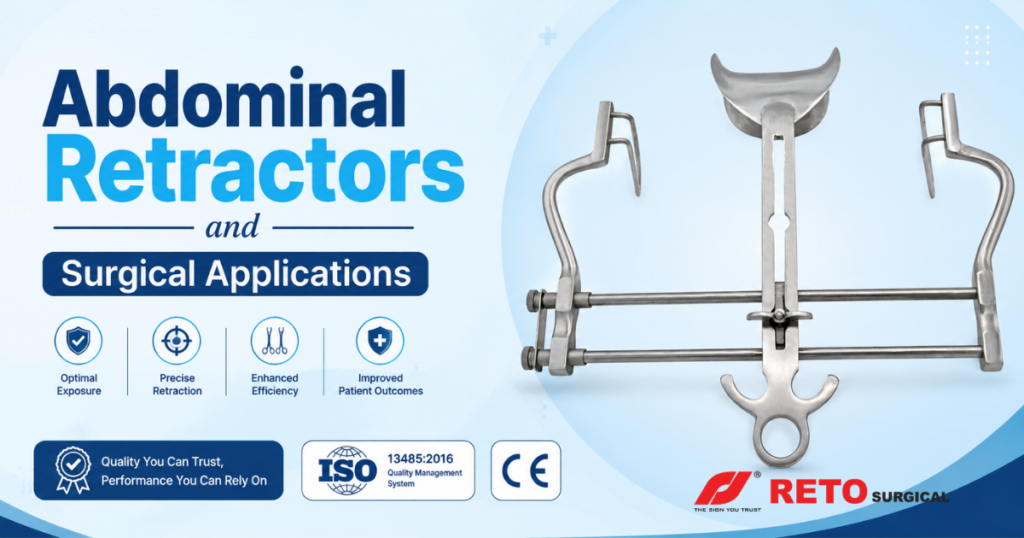
The abdomen presents a unique challenge because surgeons may need access to organs and structures located beneath several layers of tissue. This makes appropriately designed Abdominal Retractors particularly important.
Abdominal retractors are generally designed to provide broad and stable exposure while accommodating the dimensions of the abdominal cavity. Some systems use interchangeable or adjustable blades, allowing the surgical team to adapt the instrument to the procedure.
The Balfour Retractor is a well-known example. Its design allows the surgical team to maintain separation of the abdominal wall and create a relatively unobstructed operative field.
Depending on the operation, abdominal retraction may be needed during procedures involving the stomach, intestines, liver, gallbladder, urinary system, reproductive organs, or other abdominal structures.
Consider a situation in which a surgeon needs to work deep within the abdominal cavity. Simply pulling the skin aside may not provide adequate visibility. Deeper layers may continue to obstruct the field. An appropriate abdominal retractor can maintain the required exposure while leaving the surgeon’s hands available for other tasks.
This illustrates an important principle: retraction is not just about pulling tissue away. It is about creating controlled, stable, and appropriate exposure.
Retractor Blades, Minimally Invasive Retractors, and Modern Surgical Needs
One of the most important components of many retraction systems is the Retractor Blades. Blade design directly influences how tissue is contacted and how much exposure can be achieved.
Blades may differ in:
- Width and length
- Shape and curvature
- Depth
- Number of prongs
- Edge profile
- Surface design
- Attachment method
A broad blade may be useful when wider tissue displacement is required, while a narrower blade can provide more localized access. Curved or angled blades may also help surgeons reach anatomical areas that would otherwise be difficult to expose.
Selecting the right blade is therefore more than a matter of size. Surgeons and operating-room professionals need to consider the anatomy, procedure, depth, tissue characteristics, and desired field of view.
Minimally Invasive Retractors
Modern surgery has also increased the demand for Minimally Invasive Retractors.
Minimally invasive procedures typically use smaller incisions and specialized access routes compared with traditional open surgery. Consequently, retraction must often be achieved within a restricted space.
Specialized minimally invasive retraction systems can help create and maintain the necessary working corridor without requiring the large exposure associated with conventional open procedures.
This reflects a broader development in surgical instrumentation: instruments are increasingly designed around the specific requirements of the procedure rather than being one-size-fits-all solutions.
At the same time, smaller access does not eliminate the need for careful tissue handling. The principles of controlled pressure, stable positioning, adequate visualization, and protection of surrounding structures remain just as important.
How to Choose the Right Surgical Retractor
Choosing a retractor should begin with the surgical objective rather than the instrument catalogue. The most appropriate instrument is the one that provides sufficient exposure while allowing the surgical team to work safely and efficiently.
Several factors deserve attention.
- Surgical Procedure
The first consideration is the type of operation. An abdominal procedure may require a different retraction system from a superficial soft-tissue operation or minimally invasive procedure.
- Anatomical Location
The location and depth of the surgical site influence the required blade shape, length, and angle. Deep surgical fields often require longer or specially angled components.
- Tissue Characteristics
Different tissues respond differently to pressure. The retractor should provide the required exposure without unnecessary force or prolonged compression.
- Required Exposure
Some procedures require broad exposure, while others require highly localized access. A retractor with adjustable or interchangeable blades may provide greater versatility.
- Retraction Method
The surgical team should consider whether continuous manual control is preferable or whether a self-retaining system would be more practical.
- Instrument Quality and Construction
Because retractors are repeatedly exposed to cleaning, sterilization, handling, and mechanical stress, manufacturing quality matters. Medical-grade stainless steel and appropriate finishing can contribute to durability, corrosion resistance, and reliable performance.
The locking mechanism is also important for self-retaining designs. It should operate smoothly and maintain the selected position reliably.
- Sterilization and Maintenance
Reusable retractors should be compatible with the healthcare facility’s validated cleaning, disinfection, and sterilization processes. Hinges, joints, ratchets, and other moving components require particular attention during cleaning and inspection.
Safe and Effective Use of Retractors
Even a high-quality retractor can be inappropriate if it is incorrectly positioned or used with excessive force.
The objective should always be adequate exposure with the least unnecessary tissue pressure. Surgical teams should inspect instruments before use and confirm that locking mechanisms, blades, handles, and other components are functioning correctly.
During a procedure, the surgical team may need to adjust the retractor as the operative field changes. What provides excellent exposure at the beginning of an operation may not be ideal several minutes later.
This is particularly relevant when using self-retaining systems. Although they reduce the need for continuous manual assistance, they still require thoughtful positioning and monitoring.
Instrument selection and handling should always follow the surgeon’s technique, the healthcare facility’s protocols, and the manufacturer’s instructions for use.
Conclusion
Surgical Retractors may appear simple compared with more complex surgical devices, but their contribution to successful procedures is significant. By providing controlled Tissue Retraction, they help create the visibility and working space surgeons need.
From versatile Handheld Retractors to mechanically supported Self-Retaining Retractors, different designs serve different surgical requirements. Specialized Abdominal Retractors, the Weitlaner Retractor, and Balfour Retractor demonstrate how retractor designs can be adapted to specific anatomical and procedural needs. Meanwhile, advanced Minimally Invasive Retractors continue to support the evolving requirements of modern surgery.
Ultimately, selecting the right retractor is about more than choosing an instrument with the correct dimensions. It requires consideration of anatomy, exposure, tissue handling, surgical technique, instrument quality, and sterilization requirements.
For hospitals, surgical centres, distributors, and healthcare professionals sourcing surgical instruments, investing in well-designed, reliable retractors can make a meaningful difference in surgical workflow and instrument performance. The right retractor does its job quietly—but when surgical exposure matters, that job is essential.
FAQs About Retractors in Surgery
- What are retractors in surgery?
Retractors are surgical instruments used to hold tissues, organs, skin, or other structures away from the operative field to improve visibility and provide better access.
- What is the main purpose of a surgical retractor?
The main purpose of a surgical retractor is to provide controlled tissue retraction and improve surgical site exposure during an operation.
- What are the main types of surgical retractors?
The main types include handheld retractors, self-retaining retractors, abdominal retractors, and specialized retractors designed for minimally invasive procedures.
- What are handheld retractors?
Handheld retractors are manually operated instruments that are positioned and held by a surgeon or surgical assistant to retract tissue during a procedure.
- What are self-retaining retractors?
Self-retaining retractors use a locking, ratcheting, or mechanical mechanism to maintain tissue separation without requiring continuous manual holding.
- What is a Weitlaner retractor used for?
A Weitlaner retractor is a self-retaining instrument commonly used to maintain exposure in suitable surgical fields, particularly where controlled retraction of soft tissue is required.
- What is a Balfour retractor used for?
A Balfour retractor is primarily associated with abdominal surgery and is designed to help maintain exposure of the abdominal operative field.
- What are abdominal retractors?
Abdominal retractors are designed specifically to provide access and exposure during abdominal surgical procedures by holding the abdominal wall and surrounding tissues apart.
- What are retractor blades?
Retractor blades are the working components that contact and move tissue away from the surgical field. They are available in different shapes, sizes, depths, and configurations.
- How do surgeons choose the right retractor?
Selection depends on the surgical procedure, anatomical location, required exposure, tissue characteristics, surgical approach, and the depth and size of the operative field.
- What is tissue retraction in surgery?
Tissue retraction is the controlled movement or holding of tissues away from the surgical site to create adequate visibility and working space for the surgical team.
- Why is surgical site exposure important?
Good surgical site exposure helps surgeons clearly visualize the operative area and access anatomical structures while performing the procedure.
- What are minimally invasive retractors?
Minimally invasive retractors are specialized instruments designed to provide tissue retraction through smaller surgical access points and restricted operative spaces.
- What is the difference between handheld and self-retaining retractors?
Handheld retractors require continuous manual positioning, while self-retaining retractors use a mechanical mechanism to maintain their position after placement.
- What materials are surgical retractors commonly made from?
Reusable surgical retractors are commonly manufactured from medical-grade stainless steel because of its strength, durability, corrosion resistance, and suitability for sterilization.
- Can surgical retractors be reused?
Many surgical retractors are reusable and designed to undergo validated cleaning and sterilization processes. Always follow the manufacturer’s instructions for use and the healthcare facility’s protocols.
- What factors should be considered when selecting retractor blades?
Important factors include blade length, width, depth, curvature, angle, number of prongs, tissue-contact design, and the specific requirements of the procedure.
- Are surgical retractors used in minimally invasive surgery?
Yes. Specialized minimally invasive retractors can help create and maintain the necessary working space when surgeons operate through smaller access points.
- How should surgical retractors be maintained?
Retractors should be cleaned, inspected, sterilized, and stored according to the manufacturer’s instructions and applicable healthcare-facility procedures. Moving parts and locking mechanisms should be checked regularly.
- Why is the quality of surgical retractors important?
High-quality retractors can provide reliable mechanical performance, durability, appropriate tissue handling, and consistent surgical exposure when manufactured and maintained according to applicable requirements.