
Best Quality Atraumatic Forceps Supplier | DeBakey Surgical Forceps
Best Quality Atraumatic Forceps Supplier: Complete Guide to Choosing the Right Surgical Instrument
Introduction
When surgical precision matters, the quality of the instrument in a surgeon’s hand can make a meaningful difference. Atraumatic forceps are designed to provide a secure grip while helping minimise unnecessary trauma to delicate tissue. For hospitals, surgical centres, dental practices, veterinary clinics, distributors and medical-device buyers, choosing the best atraumatic forceps supplier is therefore about much more than comparing prices.
A good supplier should offer consistent manufacturing quality, appropriate materials, accurate jaw design, multiple sizes, reliable documentation and dependable after-sales support. This is particularly important when purchasing DeBakey Atraumatic Forceps, which are widely associated with delicate tissue handling and controlled manipulation.
Modern suppliers offer several configurations, including straight and angled forceps, different jaw widths and multiple working lengths. For example, current UK listings include DeBakey atraumatic forceps in several lengths and angled configurations, while specialist cardiothoracic suppliers offer reusable thoracic versions.
This guide explains what to look for when selecting a supplier, the main types available, their applications, sterilisation considerations and how different options compare.
What Are Atraumatic Forceps?

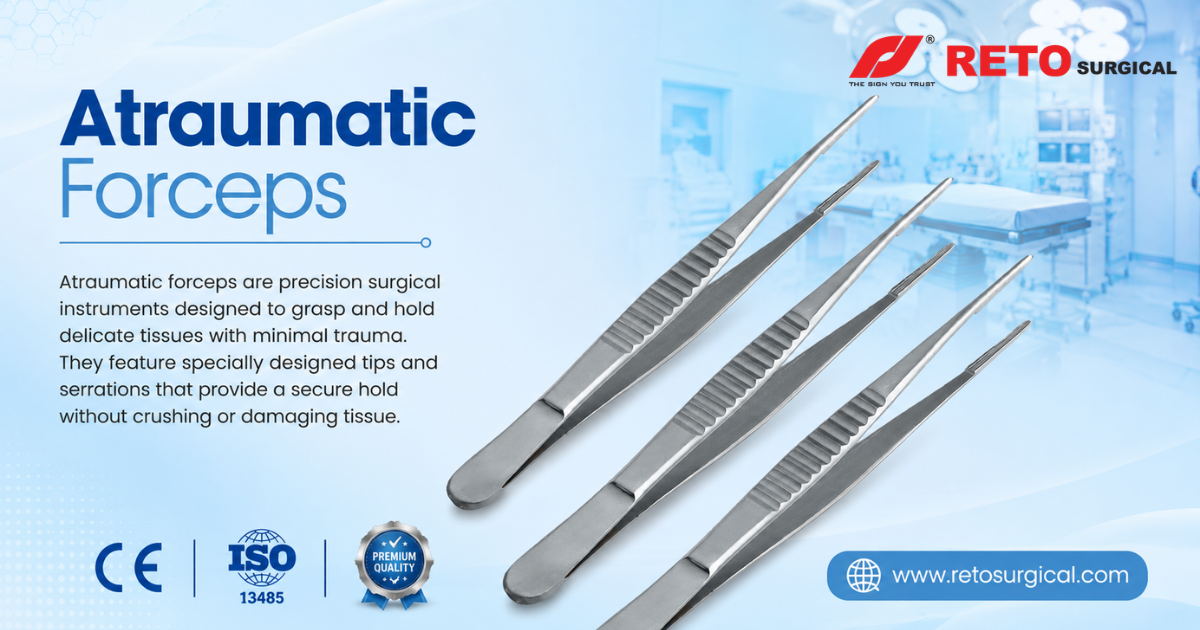
Atraumatic Tissue Forceps are surgical instruments designed to grasp, hold and manipulate tissue while reducing unnecessary mechanical injury. Unlike toothed tissue forceps that use pronounced teeth to obtain a firm grip, atraumatic designs generally use fine serrations or specially shaped working surfaces to provide controlled handling.
One recognised example is the DeBakey Tissue Forceps. Their fine atraumatic jaws are designed for controlled manipulation of delicate structures. Depending on the configuration, they can be used for vascular, cardiac, general, plastic and other surgical procedures.
The fundamental objective of atraumatic instrumentation is simple: provide enough grip for the surgeon to control the tissue without applying excessive pressure.
This makes them especially valuable where tissue preservation and precision are important.
What makes DeBakey forceps different?
A DeBakey-style forceps typically has:
- Fine atraumatic serrated jaws
- A long, slender working profile
- Controlled tissue grip
- Different jaw widths and lengths
- Straight or angled configurations
- Reusable designs in many professional ranges
For example, UK suppliers list DeBakey instruments with different lengths and jaw configurations, giving users the ability to select an instrument according to the procedure and working area.
Types of Atraumatic Forceps
Selecting the right forceps starts with understanding the different designs available. A supplier with a broad range can make it easier for hospitals and distributors to standardise their instrumentation.
DeBakey Atraumatic Forceps
DeBakey Atraumatic Forceps are among the best-known instruments for delicate tissue handling. They are designed to provide a secure but gentle grip and are available in multiple lengths and configurations.
Some models are particularly suited to vascular and cardiothoracic applications, while others can be used in general or specialist surgery.
Movora UK, for example, lists DeBakey atraumatic forceps in 15 cm, 18 cm and 20 cm configurations, as well as an angled 15 cm version.
Thoracic Atraumatic Tissue Forceps
Thoracic Atraumatic Tissue Forceps are designed for procedures where access to deeper structures requires a longer working instrument.
They are commonly associated with cardiothoracic surgery, where careful tissue manipulation is essential. Specialist UK listings describe reusable thoracic atraumatic tissue forceps for cardiothoracic surgery and include DeBakey and Gerald DeBakey patterns.
Cardiothoracic Surgical Forceps
Cardiothoracic Surgical Forceps are designed for procedures involving the heart, vessels and structures within the thoracic cavity. Length, jaw geometry and handling characteristics can be particularly important in these applications.
A professional supplier should therefore be able to provide appropriate instrument specifications rather than offering a single generic forceps for every procedure.
Gerald DeBakey Tissue Forceps
Gerald DeBakey Tissue Forceps are another specialised option within atraumatic tissue instrumentation. They can be selected when the surgeon requires a particular jaw pattern or handling characteristic.
A comprehensive supplier catalogue may include both DeBakey and Gerald DeBakey patterns so that users can select the design most appropriate to their technique.
Key Features to Look for in the Best Atraumatic Forceps Supplier
Not every supplier provides the same level of quality or technical support. Before placing a purchase order, consider the following characteristics.
- High-quality material
Medical Grade Steel Forceps should be manufactured from suitable stainless steel with appropriate mechanical and corrosion-resistance characteristics.
Material quality is particularly important for reusable instruments because they may undergo repeated cleaning and sterilisation cycles.
Some specialist UK surgical instrument manufacturers specify stainless steel grades and British-standard manufacturing requirements for their DeBakey instruments.
- Consistent jaw alignment
The jaws should meet accurately and provide a predictable grip. Poor alignment can affect surgical control and may increase the risk of tissue damage.
- Fine atraumatic serrations
The working surface should provide sufficient grip without requiring excessive pressure. Fine serrations are a characteristic feature of many DeBakey-style instruments.
- Multiple sizes
A professional supplier should ideally provide different lengths and jaw dimensions. One size is rarely suitable for every procedure.
Examples of commercially available DeBakey forceps include approximately 15 cm, 18 cm, 19.5 cm and 24 cm configurations.
- Straight and angled options
Angled instruments can provide improved access in certain surgical fields. Movora UK, for example, lists both straight and angled configurations.
- Reusable construction
Reusable Surgical Forceps can be an economical option for hospitals and clinics when the instruments are designed for validated cleaning and sterilisation processes.
Judd Medical describes its thoracic atraumatic tissue forceps as reusable and supplied non-sterile, meaning the instruments require appropriate processing before clinical use.
- Quality documentation
For professional procurement, ask the supplier for relevant documentation, such as:
- Material specifications
- Product codes
- Manufacturing information
- Quality-management documentation
- Instructions for use, where applicable
- Sterilisation/reprocessing instructions
- Regulatory information appropriate to the market
Uses of Atraumatic Forceps
The primary advantage of atraumatic instruments is controlled delicate tissue grasping & manipulation.
Cardiovascular and vascular surgery
DeBakey-pattern forceps are commonly associated with handling delicate vascular structures. The fine jaw design can provide controlled manipulation without the aggressive grip associated with heavily toothed forceps.
Thoracic surgery
Longer Thoracic Atraumatic Tissue Forceps can assist surgeons when working within deeper operative fields.
Specialist cardiothoracic ranges specifically identify these instruments for delicate tissue handling during cardiothoracic procedures.
General surgery
DeBakey-style forceps can also be useful for soft-tissue manipulation in selected general surgical procedures. Some UK product descriptions identify applications involving the bowel and urogenital system.
Plastic and reconstructive surgery
Fine atraumatic forceps can be useful where controlled manipulation of delicate tissue is required.
Ophthalmic and other delicate procedures
Certain DeBakey atraumatic dissecting forceps are marketed for use across cardiac, vascular, plastic and reconstructive, ophthalmic and general surgery.
The correct instrument should always be selected according to the procedure, tissue type, surgical technique and manufacturer’s intended use.
Sterilization and Care of Reusable Atraumatic Forceps
One of the most important considerations when purchasing reusable instruments is how they will be cleaned, inspected, sterilised and stored.
Many reusable forceps are supplied non-sterile. For example, Judd Medical specifies that its reusable thoracic atraumatic tissue forceps are supplied non-sterile.
A typical reprocessing workflow should follow the instrument manufacturer’s validated instructions and the healthcare facility’s infection-control procedures.
Recommended considerations
Cleaning: Remove biological contamination as soon as practicable after use, following the manufacturer’s instructions.
Inspection: Check the jaws, tips, alignment and surface finish for damage or corrosion.
Lubrication: Where specified by the manufacturer, use an appropriate surgical-instrument lubricant on moving components.
Sterilisation: Use the validated sterilisation method specified by the manufacturer and healthcare facility.
Storage: Store clean and sterilised instruments in a manner that protects the fine working tips from damage.
Fine atraumatic jaws require particular care. Dropping instruments, forcing misaligned jaws or using them for purposes for which they were not designed can affect performance.
Product Comparison: Choosing the Right Atraumatic Forceps
Forceps Type | Typical Design | Main Advantage | Common Applications |
DeBakey Atraumatic Forceps | Fine atraumatic serrated jaws | Controlled tissue grip | Vascular, cardiac, general surgery |
Gerald DeBakey Tissue Forceps | Fine tissue-handling pattern | Precise delicate manipulation | Cardiothoracic and specialist surgery |
Thoracic Atraumatic Tissue Forceps | Longer working profile | Access to deeper fields | Thoracic and cardiothoracic surgery |
Angled DeBakey Forceps | Angled working end | Improved access and visibility | Vascular and deep operative fields |
Atraumatic Tissue Forceps | Fine atraumatic tips | Reduced tissue trauma | General delicate tissue handling |
Reusable Surgical Forceps | Reusable stainless-steel construction | Suitable for repeated reprocessing | Hospitals, clinics and theatres |
Available commercial specifications demonstrate why comparison should go beyond the instrument name. DeBakey products can vary by length, jaw size and straight/angled configuration. Surgical Holdings, for example, lists DeBakey atraumatic dissecting forceps in several lengths and jaw sizes, including 1.5 mm, 2 mm, 2.5 mm and 2.8 mm options.
For buyers, this means the “best” forceps is not necessarily the cheapest or most expensive model. It is the model that provides the appropriate combination of jaw design, length, material, handling characteristics, quality and intended application.
How to Choose the Best Atraumatic Forceps Supplier
If you are purchasing for a hospital, distributor, surgical centre or medical-device business, consider these questions before selecting a supplier:
Does the supplier offer the required range?
Look for suppliers that can provide multiple lengths, jaw sizes and configurations. This is particularly useful if you are building complete surgical instrument sets.
Can they provide consistent quality?
For repeat orders, consistency is critical. A supplier should be able to maintain the same specifications and performance across production batches.
Are the instruments properly documented?
Professional buyers should request appropriate technical and regulatory documentation before purchase.
Can they support bulk orders?
If you are a distributor or importer, ask about:
- MOQ
- Lead time
- Private labelling
- Custom engraving
- Packaging
- Product codes
- Export documentation
- Quality certificates
- Sample availability
Do they understand your market?
A supplier serving NHS, private hospitals, distributors or international markets may have different documentation and commercial requirements. Choose a supplier that understands your intended market rather than simply offering a low unit price.
Conclusion
Finding the best atraumatic forceps supplier requires looking beyond a product photograph or advertised price. The right supplier should combine reliable manufacturing, appropriate medical-grade materials, accurate jaw geometry, multiple sizes, consistent quality and strong customer support.
DeBakey Atraumatic Forceps, Atraumatic Tissue Forceps, Thoracic Atraumatic Tissue Forceps and Gerald DeBakey Tissue Forceps are valuable options when controlled handling of delicate tissue is required. The most appropriate choice depends on the surgical application, instrument dimensions, jaw configuration and reprocessing requirements.
For distributors and healthcare procurement teams, it is also worth evaluating the supplier’s manufacturing capabilities, documentation, quality systems, customisation options and ability to maintain consistent supply.
If you are looking for a long-term surgical-instrument partner rather than a one-off purchase, request samples, technical specifications and quality documentation before committing to a larger order. A reliable supplier should be able to demonstrate not only what the instrument looks like, but also how it is manufactured and why it is suitable for its intended application.
Frequently Asked Questions About Atraumatic Forceps
- What are atraumatic forceps?
Atraumatic forceps are surgical instruments designed to grasp and manipulate tissue while helping minimise unnecessary tissue trauma.
- What are DeBakey atraumatic forceps used for?
DeBakey atraumatic forceps are commonly used for delicate tissue handling, including selected vascular, cardiovascular, thoracic and general surgical applications.
- Why are DeBakey forceps called atraumatic?
They use a fine jaw design, commonly with delicate serrations, intended to provide a secure grip while reducing unnecessary tissue compression.
- What are Thoracic Atraumatic Tissue Forceps?
They are longer atraumatic tissue forceps designed for tissue handling in thoracic and cardiothoracic surgical procedures.
- What are Gerald DeBakey Tissue Forceps?
Gerald DeBakey Tissue Forceps are a specialised tissue-forceps pattern designed for controlled manipulation of delicate tissue.
- Are DeBakey forceps reusable?
Many DeBakey forceps are manufactured as reusable surgical instruments, but the buyer should always verify the specific product’s reprocessing instructions.
- What material are surgical atraumatic forceps made from?
Professional reusable instruments are commonly manufactured from stainless steel suitable for surgical instrumentation. Specific grades should be confirmed with the manufacturer.
- What sizes are available for DeBakey forceps?
Sizes vary by manufacturer and model. Commercial ranges include approximately 15 cm, 18 cm, 19.5 cm, 20 cm and 24 cm configurations.
- Are angled DeBakey forceps available?
Yes. Angled versions are available from some suppliers and can provide improved access in selected operative fields.
- What is the difference between straight and angled atraumatic forceps?
Straight forceps provide a direct working axis, while angled forceps can improve access or visibility when approaching tissue from a different angle.
- Can atraumatic forceps be used in vascular surgery?
Yes, DeBakey-style atraumatic forceps are commonly associated with delicate vascular tissue handling.
- Can DeBakey forceps be used in cardiothoracic surgery?
Yes. Specialist suppliers offer DeBakey and Gerald DeBakey patterns specifically within cardiothoracic instrumentation ranges.
- Are atraumatic forceps supplied sterile?
Not necessarily. Some reusable models are supplied non-sterile and must be appropriately processed before clinical use.
- How should reusable atraumatic forceps be sterilised?
They should be cleaned and sterilised according to the manufacturer’s validated instructions and the healthcare facility’s approved reprocessing procedures.
- What should I check before buying atraumatic forceps?
Check the material, jaw design, jaw size, length, alignment, finish, intended use, quality documentation and reprocessing instructions.
- What makes a good atraumatic forceps supplier?
A good supplier should offer consistent quality, suitable materials, multiple configurations, technical documentation, reliable delivery and responsive customer support.
- Can atraumatic forceps be customised?
Depending on the manufacturer, options may include custom lengths, jaw configurations, engraving, branding and packaging. These options should be confirmed before ordering.
- Are DeBakey forceps suitable for delicate tissue?
Yes. Their atraumatic jaw configuration is specifically intended for controlled handling of delicate tissue.
- Should I buy atraumatic forceps from a manufacturer or distributor?
Both can be suitable. Manufacturers may provide greater customisation and bulk-order flexibility, while established distributors can offer convenient stock availability and established logistics.
- How can I find the best atraumatic forceps supplier?
Compare suppliers based on product quality, material specifications, jaw precision, available sizes, certifications and documentation, manufacturing consistency, lead times, pricing and after-sales support rather than price alone.