
Dental Root Elevators: Types, Uses & Selection Guide
Dental Root Elevators: Types, Uses, and How to Choose the Right Instrument
Introduction
Dental extractions can range from straightforward procedures to technically demanding cases where a tooth has fractured, a root has separated, or access to the remaining root is limited. In these situations, having the appropriate instruments can make a significant difference to the efficiency and control of the procedure.
Among the most important instruments used for controlled tooth and root removal are dental root elevators. These specialized dental instruments are designed to help loosen teeth, mobilize roots, and assist in removing root fragments from the socket. Unlike extraction forceps, which primarily grip and remove a tooth, elevators work by applying controlled leverage and rotational forces around the tooth or root.
There are many different elevator designs available, and each has characteristics that make it suitable for particular clinical situations. Common examples include Bein root elevators, Kopp root elevator, Cryer root elevators, Heidbrink root tip elevator, Coupland root elevator, Warwick James root elevator, and Flohr root elevator.
Understanding the differences between these instruments is useful for dentists, oral surgeons, dental assistants, purchasing teams, and dental instrument distributors. The right instrument should provide appropriate access, handling, visibility, and control for the intended procedure.
In this guide, we will explore the main types of dental root elevators, their applications, design characteristics, and important considerations when selecting quality dental elevators.
What Are Dental Root Elevators?
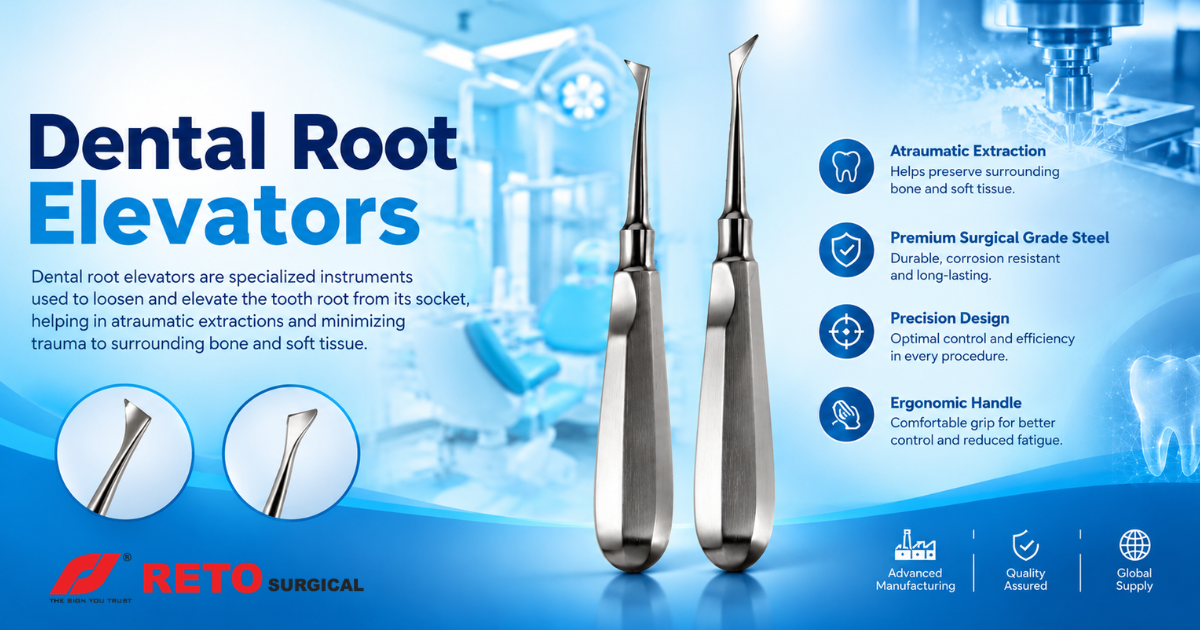
Dental root elevators are hand-operated instruments used primarily during tooth extraction and minor oral surgical procedures. Their main purpose is to loosen or mobilize a tooth or remaining root before or during extraction.
An elevator typically consists of a handle, shank, and working end. The working end may be straight, angled, pointed, triangular, or blade-shaped depending on the instrument design.
During an extraction, an elevator may be used to:
- Luxate a tooth before forceps application
- Loosen a retained root
- Remove fractured root fragments
- Create initial mobility in a tooth
- Assist with difficult extractions
- Reach areas where forceps cannot obtain a secure grip
- Separate or mobilize root segments
The design of the working tip is particularly important. A narrow tip may provide access to a small space around a root, while a broader blade can provide greater surface contact.
It is important to remember that elevators are precision surgical instruments. They should be used with controlled technique and appropriate clinical judgment rather than excessive force.
Common Types of Dental Root Elevators
Different extraction situations require different instrument designs. This is why dental practices often maintain a selection of dental elevators rather than relying on one universal pattern.
- Bein Root Elevators
Bein root elevators are commonly associated with straight elevator designs and are used for loosening teeth or roots during extraction procedures.
Their working end allows the clinician to gain access around the root and apply controlled pressure. Depending on the specific pattern and size, Bein elevators may be selected for different tooth and root positions.
For dental practices, having multiple sizes available can be useful because root morphology and accessibility vary considerably between patients.
The ergonomic design of the handle is also important because it allows the clinician to maintain controlled positioning while working around the extraction site.
- Kopp Root Elevator
The Kopp root elevator is another specialized pattern used for root and tooth removal procedures.
Its design provides the clinician with an instrument intended for controlled elevation and mobilization. Kopp-style elevators may be particularly useful when working with remaining roots where conventional extraction forceps cannot obtain adequate access.
As with other elevators, the working end should be carefully matched to the clinical situation. A suitable tip geometry can improve access while helping the clinician maintain control.
- Cryer Root Elevators
Cryer root elevators are among the well-known patterns used in dental extraction procedures.
They commonly feature an angled or triangular working end designed to engage areas around roots. Different left and right patterns are available, making them particularly useful when access and root position require a specific orientation.
Cryer elevators may be selected when a fractured root or remaining root segment needs to be mobilized.
Their distinctive working-end geometry is one reason they remain an important part of many dental extraction instrument sets.
Root Tip and Root Fragment Elevators
Root Tip and Root Fragment Elevators
Not every extraction involves removing an intact tooth. In some cases, a root can fracture during extraction, leaving a small section inside the socket.
This is where specialized instruments can become particularly valuable.
- Heidbrink Root Tip Elevator
The Heidbrink root tip elevator is designed for situations involving small root fragments and root tips.
Its relatively fine working end can provide access to restricted areas where a larger elevator may be difficult to position.
Root-tip procedures require careful handling because the remaining fragment may be small, deep, or surrounded by delicate tissues. The clinician needs an instrument that provides adequate access without unnecessarily traumatizing the surrounding area.
A properly selected Heidbrink-style elevator can therefore be useful as part of a dedicated root-tip extraction set.
- Root Fragment Elevator
A root fragment elevator is designed specifically to assist with the mobilization and removal of retained root fragments.
Root fragments can present different challenges depending on their size, depth, shape, and position. A narrow working end can sometimes provide access to a confined area, while different blade configurations may be selected depending on the extraction technique.
For this reason, dental practices often benefit from having several elevator patterns and sizes available rather than treating all root fragments in the same way.
Coupland, Warwick James, and Flohr Elevators
Beyond the commonly recognized patterns, there are several other elevator designs used in dental extraction procedures.
- Coupland Root Elevator
The Coupland root elevator is commonly associated with straight elevator designs and is available in different sizes.
Different sizes allow the clinician to select an appropriate working end according to the tooth or root being treated. Smaller versions may be useful for more restricted access, while larger patterns can provide a broader working surface.
A major advantage of having different Coupland sizes available is versatility. The clinician can choose an instrument based on the anatomy and extraction requirements rather than attempting to use one size for every procedure.
- Warwick James Root Elevator
The Warwick James root elevator is another recognized pattern within dental extraction instruments.
Warwick James elevators are available in different configurations, including angled designs that can help provide access around particular root positions.
Their geometry makes them useful when a straight instrument does not provide the desired access or working angle.
For dental professionals, the ability to select different elevator configurations can be especially valuable during surgical extractions where visibility and access are more restricted.
- Flohr Root Elevator
The Flohr root elevator is another specialized instrument used for dental extraction procedures.
Like other root elevators, its purpose is to assist with the controlled mobilization of roots or tooth structures. The specific design of the working end determines how the instrument interacts with the tooth or root.
When purchasing Flohr elevators, dental practices and distributors should consider the precise pattern, dimensions, handle design, material, and finish rather than selecting an instrument based solely on its name.
How to Choose the Right Dental Root Elevator
Selecting the appropriate elevator is about more than simply choosing a familiar instrument name.
A good selection should take several factors into consideration.
Working-End Design
The working end is one of the most important characteristics.
Different designs can provide different levels of access, contact, and control. Pointed, triangular, straight, and angled tips may each have a place within a dental extraction instrument set.
Size
Root and tooth dimensions vary significantly. Smaller elevators can be useful when working around small root fragments, while larger instruments may be more appropriate for larger structures.
A dental practice should ideally maintain a range of sizes to accommodate different clinical situations.
Handle Ergonomics
An elevator needs to be comfortable and controllable.
A well-designed handle can help provide a secure grip while reducing unnecessary hand fatigue during procedures. For professionals using instruments regularly, handle ergonomics should therefore be considered alongside the working-end design.
Material and Manufacturing Quality
High-quality dental elevators are typically manufactured from medical-grade stainless steel appropriate for reusable dental instruments.
Material selection affects important properties such as corrosion resistance, durability, surface finish, and resistance to repeated cleaning and sterilization processes.
Manufacturing quality is equally important. Precision machining, grinding, finishing, polishing, and quality inspection can influence the consistency of the finished instrument.
Surface Finish
A smooth and properly finished surface is important for reusable dental instruments.
A quality finish can make the instrument easier to clean and inspect while contributing to corrosion resistance when the instrument is properly processed and maintained.
Maintenance and Care of Dental Elevators
Even a high-quality dental elevator requires appropriate maintenance.
After clinical use, reusable instruments should be processed according to the dental practice’s validated cleaning, disinfection, sterilization, and manufacturer instructions.
Important considerations include:
- Remove contamination as soon as practical after use.
- Follow the instrument manufacturer’s cleaning instructions.
- Use an appropriate washer-disinfector where applicable.
- Inspect the working end for damage or deformation.
- Check the handle and shank for defects.
- Look for corrosion, staining, or surface damage.
- Ensure instruments are properly dried before storage.
- Follow the validated sterilization procedure.
- Store instruments in a clean and appropriate environment.
Particular attention should be paid to the working tip. A damaged or excessively worn elevator may not provide the intended performance and should be assessed according to the manufacturer’s recommendations.
Good instrument maintenance can also help dental practices protect their investment and maintain consistent instrument performance.
What Makes a Quality Dental Root Elevator?
When purchasing dental root elevators, quality should be evaluated across the entire manufacturing process rather than based only on appearance.
A reliable manufacturer should have appropriate quality controls covering raw materials, machining, grinding, finishing, polishing, assembly where applicable, inspection, and final packaging.
For distributors and dental equipment suppliers, other factors can also be important, including:
- Consistent dimensions
- Accurate working-end geometry
- Appropriate stainless-steel material
- Corrosion-resistant finish
- Ergonomic handles
- Reliable production consistency
- Traceability
- Quality inspection
- Suitable packaging
- Availability of different patterns and sizes
- OEM and customization capabilities
For larger purchasing programs, consistency between batches is particularly important. A distributor supplying dental professionals needs instruments that maintain the same specifications and expected characteristics across repeat orders.
This is where experienced dental instrument manufacturers can provide additional value through documented manufacturing processes and quality management systems.
Dental Root Elevators for Professional Dental Instrument Sets
A well-organized dental extraction set may include several elevator patterns because no two extraction procedures are exactly the same.
For example, a dentist may use a general straight elevator during initial luxation and then select a more specialized instrument if a root fractures. A narrow root-tip instrument may subsequently be required to access a retained fragment.
This illustrates why instruments such as Bein root elevators, Cryer root elevators, Heidbrink root tip elevator, Coupland root elevator, Warwick James root elevator, and Flohr root elevator can complement one another.
For dental instrument distributors, offering these patterns as individual instruments or as part of customized extraction sets can also make it easier to meet different customer requirements.
Manufacturers may additionally provide OEM services, custom instrument patterns, laser marking, customized packaging, and product identification depending on the customer’s requirements.
Conclusion
Dental root elevators are important instruments in tooth extraction and oral surgical procedures, particularly when a tooth or root requires controlled mobilization or when retained root fragments need to be accessed.
From Bein root elevators and the Kopp root elevator to Cryer root elevators, the Heidbrink root tip elevator, Coupland root elevator, Warwick James root elevator, and Flohr root elevator, each pattern offers specific design characteristics that can support different extraction situations.
Choosing the right instrument involves considering the working-end design, size, access, handle ergonomics, material, surface finish, manufacturing quality, and intended clinical application.
For dental professionals and distributors, investing in appropriately manufactured and properly maintained dental elevators can help create a versatile and dependable extraction instrument set.
Looking for professionally manufactured dental root elevators or customized dental extraction instruments? Choose a manufacturer that can provide consistent specifications, quality-controlled production, reliable finishing, and OEM/customization support to meet your specific requirements.
Frequently Answers Questions
- What are dental root elevators?
Dental root elevators are hand instruments used during tooth extraction procedures to help loosen, mobilize, or remove teeth, roots, and retained root fragments.
- What are dental elevators used for?
Dental elevators are primarily used to luxate teeth, loosen roots, mobilize fractured roots, and assist with the removal of root fragments during extraction procedures.
- What is a root elevator?
A root elevator is a dental instrument designed to provide controlled leverage and access around a tooth root or root fragment during extraction.
- What are Bein root elevators used for?
Bein root elevators are commonly used to assist with loosening and elevating teeth or roots during dental extraction procedures.
- What is a Kopp root elevator?
A Kopp root elevator is a specialized dental elevator pattern used to help mobilize teeth or remaining roots during extraction.
- What are Cryer root elevators?
Cryer root elevators are specialized elevators with distinctive working-end designs used to assist with the mobilization and removal of roots and root fragments.
- What is a Heidbrink root tip elevator?
A Heidbrink root tip elevator is a fine dental instrument designed to provide access for the mobilization and removal of small root tips or fragments.
- What is a Coupland root elevator?
A Coupland root elevator is a straight elevator pattern available in different sizes for assisting with tooth and root mobilization during extraction.
- What is a Warwick James root elevator?
A Warwick James root elevator is a specialized dental elevator available in different configurations to provide access around teeth and roots during extraction procedures.
- What is a Flohr root elevator?
A Flohr root elevator is a dental extraction instrument designed to assist in the controlled mobilization of teeth or roots.
- What is a root fragment elevator?
A root fragment elevator is designed to help access and mobilize retained or fractured root pieces during extraction procedures.
- Are dental root elevators reusable?
Many dental root elevators are manufactured as reusable instruments. Reusable instruments must be cleaned, disinfected, inspected, and sterilized according to the manufacturer’s validated instructions.
- What material are dental root elevators made from?
Dental root elevators are commonly manufactured from stainless steel suitable for reusable dental instruments, with material selection depending on the manufacturer’s specifications and intended use.
- How do you maintain dental root elevators?
Proper maintenance generally includes prompt cleaning, appropriate disinfection, thorough inspection, drying, sterilization, and correct storage according to the manufacturer’s instructions.
- How do I choose the right dental root elevator?
Selection depends on the tooth or root anatomy, required access, working-end geometry, instrument size, clinical technique, and the specific extraction situation.
- What is the difference between a dental elevator and an extraction forceps?
An elevator is generally used to loosen or mobilize a tooth or root, while extraction forceps are designed to grasp and remove the tooth. Both may be used during an extraction procedure.
- Why are different sizes of dental elevators available?
Different sizes provide different levels of access and working surface, allowing clinicians to select an instrument appropriate for the particular tooth or root.
- What should I look for when buying dental root elevators?
Consider material, working-end accuracy, dimensions, surface finish, handle design, manufacturing consistency, quality inspection, traceability, and the manufacturer’s documentation.
- Can dental root elevators be customized?
Depending on the manufacturer, dental elevators can potentially be customized in areas such as dimensions, patterns, handles, markings, finishes, packaging, and other OEM specifications.
- What is the importance of the working tip on a root elevator?
The working tip determines how the instrument contacts and accesses the tooth or root. Its shape, size, and finish are therefore important considerations when selecting an elevator.