
How to Maintain Dental Instruments: Complete Guide
How to Maintain Dental Instruments: A Complete Guide
Introduction
Dental instruments are essential to almost every clinical procedure, from routine examinations and cleanings to extractions, restorative treatments, and oral surgery. These instruments are designed for precision, but even high-quality instruments can lose their performance, appearance, and service life if they are not cleaned, reprocessed, inspected, and stored correctly.
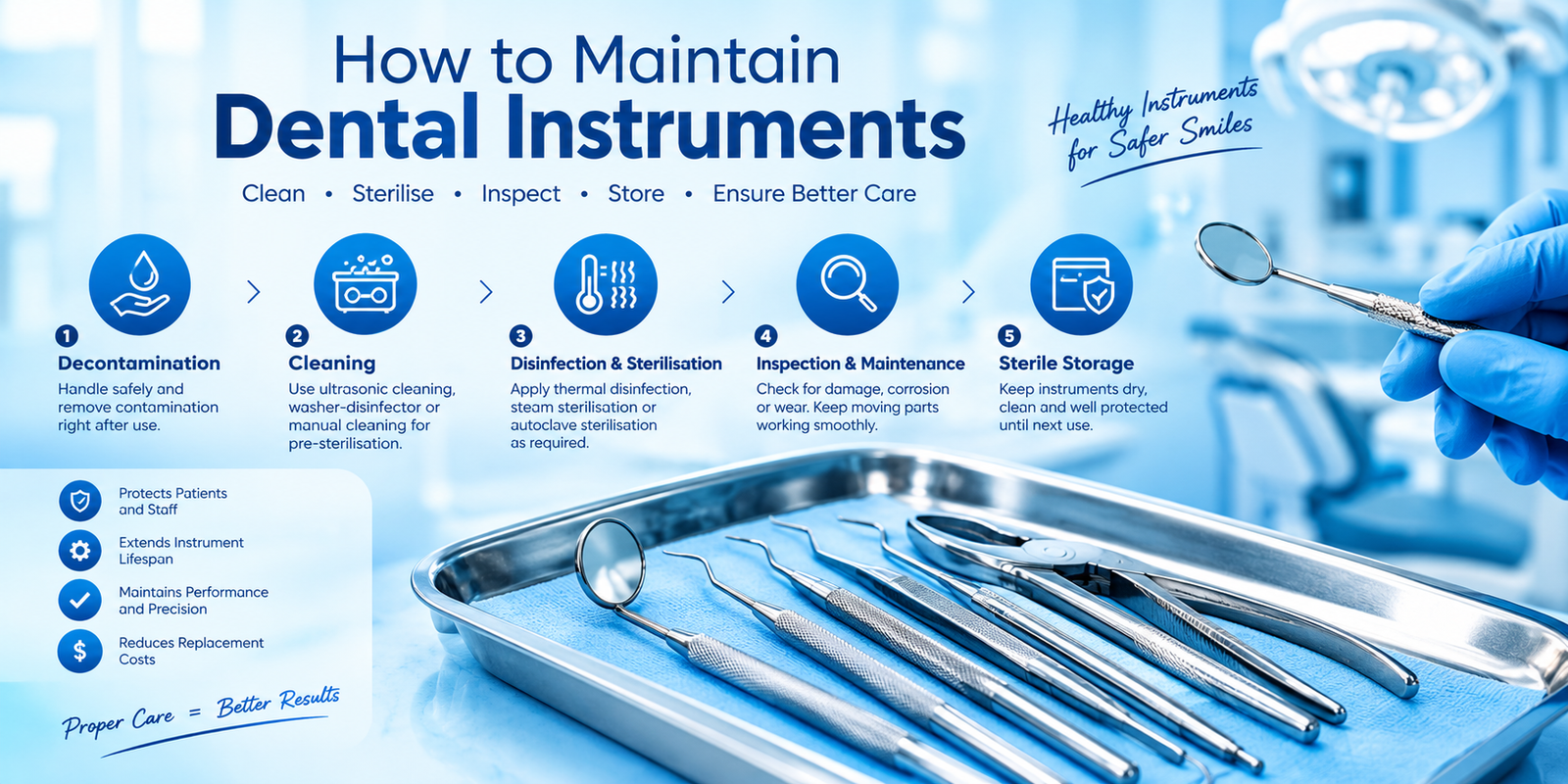
Proper instrument care is about much more than simply washing instruments after use. Effective dental instrument reprocessing involves a systematic process that includes cleaning, instrument decontamination, disinfection or sterilisation where required, inspection, maintenance, and appropriate storage. Each stage helps protect patients and dental professionals while preserving the condition and functionality of the instruments.
For dental practices, good maintenance can also reduce unnecessary replacement costs. An instrument that is cleaned correctly, inspected regularly, and handled according to the manufacturer’s instructions is less likely to develop corrosion, staining, stiffness, or mechanical problems.
Whether you are managing a busy dental practice, purchasing instruments for a clinic, or responsible for infection prevention and control, understanding how to maintain dental instruments properly is an important part of quality dental care.
Start With Proper Dental Instrument Reprocessing
The first step in maintaining dental instruments is establishing a consistent dental instrument reprocessing workflow. Instruments should not simply be cleaned whenever someone has time. Reprocessing should follow a defined procedure based on the instrument manufacturer’s instructions and the dental practice’s infection-control requirements.
After an instrument has been used, it should be handled carefully to prevent contamination and avoid unnecessary damage. Used instruments should be transported to the designated reprocessing area using appropriate procedures.
Instrument decontamination
Instrument decontamination is an important part of the reprocessing process. Its purpose is to reduce contamination and make instruments safer to handle before subsequent cleaning and sterilisation steps.
Dental instruments should be handled using appropriate personal protective equipment, and staff should follow established procedures for the safe transportation and processing of contaminated instruments.
One common mistake is allowing blood, tissue, saliva, or other organic material to dry onto instruments. Dried contamination can become more difficult to remove and may increase the amount of cleaning required.
For this reason, instruments should be processed as soon as reasonably practical after use. Where immediate cleaning is not possible, practices should follow their validated procedures and the instrument manufacturer’s recommendations.
Pre-sterilisation cleaning
Effective pre-sterilisation cleaning is critical because sterilisation cannot compensate for inadequate cleaning. Organic debris and other residues can interfere with the sterilisation process and may remain on an instrument if the cleaning stage is poorly performed.
Depending on the practice’s procedures and the type of instrument, cleaning may involve manual methods, ultrasonic equipment, or an automated washer-disinfector.
The exact process should always take into account the manufacturer’s instructions because different instruments may have different requirements.
Use Ultrasonic Cleaning and Washer-Disinfectors Correctly
Modern dental practices often use equipment to make instrument cleaning more consistent and efficient. Two commonly encountered technologies are ultrasonic cleaning and washer-disinfectors.
Ultrasonic cleaning
Ultrasonic cleaning uses high-frequency sound waves to create microscopic bubbles in a cleaning solution. The collapse of these bubbles helps loosen debris from instrument surfaces and difficult-to-reach areas.
This can be particularly useful for instruments with grooves, serrations, joints, or complex surfaces.
However, ultrasonic cleaning should not be treated as a substitute for the complete reprocessing procedure. Instruments should be loaded appropriately, the correct cleaning solution should be used, and the equipment should be operated according to the manufacturer’s instructions.
Overloading an ultrasonic cleaner can reduce cleaning effectiveness because the solution may not reach all instrument surfaces adequately.
It is also important to remember that not every instrument or component is necessarily suitable for ultrasonic cleaning. Always check the manufacturer’s instructions before placing instruments into an ultrasonic bath.
Washer-disinfector
A washer-disinfector can automate important stages of instrument processing. These systems are designed to clean and thermally disinfect instruments under controlled conditions.
One advantage of automated processing is consistency. When correctly loaded and operated, a washer-disinfector can provide a repeatable process while reducing staff exposure to contaminated instruments compared with extensive manual cleaning.
However, automated equipment still requires proper loading, suitable detergents, routine maintenance, monitoring, and validation according to applicable requirements.
Instruments should not be packed into trays in a way that prevents water or cleaning solution from reaching their surfaces. Hinged instruments should generally be positioned appropriately so that joints and working surfaces can be effectively cleaned.
Disinfection and Sterilisation: Protecting Patients and Instruments
Cleaning, disinfection, and sterilisation are related but distinct processes. Understanding the difference is important when developing a safe instrument-reprocessing workflow.
Thermal disinfection
Thermal disinfection uses heat to reduce microorganisms to an appropriate level as part of an automated reprocessing cycle. It is commonly associated with washer-disinfectors.
The effectiveness of thermal disinfection depends on factors such as temperature, exposure time, equipment performance, and the specific validated cycle.
Dental practices should never assume that simply exposing an instrument to hot water is sufficient. The equipment and cycle must be appropriate for the intended purpose and operated according to validated instructions.
Steam sterilisation
For reusable heat-resistant dental instruments that require sterilisation, steam sterilisation is widely used.
Steam sterilisation uses saturated steam under pressure to achieve the required sterilising conditions. Properly performed steam sterilisation can provide an effective method for processing compatible reusable dental instruments.
However, successful sterilisation depends on the entire reprocessing chain. Instruments need to be properly cleaned, prepared, packaged when appropriate, loaded correctly, and processed using a suitable sterilisation cycle.
Autoclave sterilisation
Autoclave sterilisation is the practical application of steam sterilisation using an autoclave. Dental practices should select and operate equipment according to the manufacturer’s instructions and applicable infection-control requirements.
An autoclave should never be overloaded. Instruments need adequate exposure to the sterilising conditions, and packaging or instrument arrangement should not prevent steam from reaching the relevant surfaces.
It is equally important to monitor sterilisation cycles and maintain appropriate records as required by the practice’s procedures and applicable regulations.
Good sterilisation practice protects patients, but it also helps protect instruments. Poor cleaning, inappropriate chemicals, excessive heat outside specified parameters, or incorrect processing can contribute to corrosion, staining, or premature deterioration.
Inspect, Maintain, and Handle Instruments Carefully
Cleaning and sterilisation are only part of instrument maintenance. Dental instruments should also be inspected regularly to ensure they remain functional and suitable for use.
Instrument inspection and maintenance
Instrument inspection and maintenance should take place after cleaning and before instruments are returned to service.
Staff should look for visible contamination, staining, corrosion, cracks, damaged tips, misalignment, loose components, or other signs of deterioration.
For hinged instruments, check that the jaws open and close smoothly. Forceps should operate correctly without excessive stiffness or looseness. Scissors should maintain appropriate cutting performance, while elevators and other instruments should be checked for damaged working ends.
Small problems are easier to address when they are identified early.
For example, imagine a dental practice notices that a group of extraction forceps is becoming increasingly difficult to open and close. Continuing to use them without investigation may lead to further deterioration. A routine inspection can identify the problem and allow the instruments to be serviced, repaired, or replaced when appropriate.
Lubrication of hinged instruments
Some hinged or moving instruments may require maintenance with a suitable lubricant. If lubrication is required, the product should be compatible with the instrument and subsequent reprocessing procedures.
Using unsuitable oils or excessive lubricant can interfere with cleaning and sterilisation. Always follow the instrument manufacturer’s recommendations.
Avoid aggressive chemicals
Strong or inappropriate chemicals can damage instrument surfaces. Depending on the instrument material, exposure may contribute to staining, corrosion, pitting, or deterioration.
Dental practices should therefore use cleaning and maintenance products that are recommended or compatible with the instruments being processed.
Stainless steel does not mean an instrument is completely immune to corrosion. Water quality, chemical residues, prolonged exposure to contaminants, incorrect cleaning products, and processing conditions can all affect instrument surfaces.
Store Sterile Instruments Properly
Even perfectly cleaned and sterilised instruments can be compromised by poor storage.
Sterile instrument storage should protect processed instruments from contamination, moisture, physical damage, and unnecessary handling.
Sterile instruments should be stored in a clean, dry, appropriate environment and handled in a way that maintains the integrity of their packaging or protective systems.
Keep instruments dry
Moisture can contribute to corrosion and can compromise the condition of packaging or storage systems. Instruments should therefore be properly dried during the reprocessing process before storage.
Wet instruments should not simply be placed into storage because residual moisture can create problems over time.
Avoid unnecessary handling
Once instruments have been sterilised and packaged, unnecessary handling should be avoided. Frequent handling increases the opportunity for packaging damage or contamination.
Dental teams should also arrange instruments logically so that frequently used items can be accessed without repeatedly disturbing other sterile packs.
Inspect packaging
Before using a sterilised instrument, staff should check its packaging or protective barrier for signs of damage, moisture, tears, punctures, or other problems.
If packaging integrity has been compromised, the instrument should be processed again according to the practice’s established procedures rather than assuming that it remains sterile.
A Practical Dental Instrument Maintenance Routine
A Practical Dental Instrument Maintenance Routine
A simple routine can help dental practices maintain consistency:
After use:
Handle contaminated instruments safely and transfer them to the designated reprocessing area.
During cleaning:
Carry out appropriate pre-sterilisation cleaning using the validated manual or automated method.
During automated processing:
Use the washer-disinfector or ultrasonic cleaning equipment correctly where appropriate.
Before sterilisation:
Inspect instruments and ensure they are visibly clean, functional, and appropriately prepared.
During sterilisation:
Use the appropriate steam sterilisation or autoclave sterilisation cycle for compatible instruments.
After sterilisation:
Check packaging and store instruments using appropriate sterile instrument storage procedures.
During routine maintenance:
Monitor instruments for corrosion, staining, damage, stiffness, dull edges, and other signs of deterioration.
This systematic approach can make instrument care easier for staff and reduce the risk of inconsistent processing.
Conclusion
Maintaining dental instruments properly requires more than simply putting them through an autoclave. Effective care begins with safe instrument decontamination and thorough cleaning, followed by appropriate disinfection or sterilisation, careful inspection, routine maintenance, and suitable storage.
Processes such as ultrasonic cleaning, washer-disinfector processing, thermal disinfection, steam sterilisation, and autoclave sterilisation can all play important roles when they are used correctly and according to applicable instructions and requirements.
Regular instrument inspection and maintenance can also help dental practices identify problems before they become more serious, while appropriate sterile instrument storage helps preserve the condition of processed instruments until they are needed.
For dental practices and instrument buyers, investing in quality reusable instruments is only the beginning. Proper reprocessing and maintenance are what help those instruments deliver reliable performance over their working life.
Frequently Questions Answers:
- How should dental instruments be maintained?
Dental instruments should be cleaned, decontaminated, appropriately disinfected or sterilised, inspected, maintained, and stored according to the manufacturer’s instructions and applicable infection-control procedures. - Why is dental instrument reprocessing important?
Dental instrument reprocessing helps ensure reusable instruments are appropriately cleaned and processed before they are used again. - What is instrument decontamination?
Instrument decontamination is the process of reducing contamination on used instruments so they can be handled and subsequently reprocessed safely. - What is pre-sterilisation cleaning?
Pre-sterilisation cleaning removes visible contamination and organic material from instruments before the sterilisation process. - What is ultrasonic cleaning for dental instruments?
Ultrasonic cleaning uses high-frequency sound waves in a cleaning solution to help remove debris from instrument surfaces and difficult-to-reach areas. - What is a washer-disinfector?
A washer-disinfector is automated equipment designed to clean and thermally disinfect compatible reusable instruments. - What is thermal disinfection?
Thermal disinfection uses controlled heat during an appropriate validated process to reduce microorganisms on compatible instruments. - What is steam sterilisation?
Steam sterilisation uses saturated steam under pressure to sterilise compatible reusable instruments. - Is autoclave sterilisation the same as steam sterilisation?
Autoclave sterilisation is a method of achieving steam sterilisation using an autoclave under controlled conditions. - How often should dental instruments be cleaned?
Reusable dental instruments should be appropriately processed after each use before being returned to service. - Can ultrasonic cleaning replace sterilisation?
No. Ultrasonic cleaning is a cleaning method and should not be considered a replacement for sterilisation when sterilisation is required. - How can corrosion of dental instruments be prevented?
Following the manufacturer’s processing instructions, using compatible cleaning products, removing contamination promptly, ensuring adequate drying, and inspecting instruments regularly can help reduce corrosion risks. - Why should dental instruments be dried before storage?
Proper drying helps prevent moisture-related problems, including corrosion, and supports the integrity of storage or packaging systems. - What should be checked during instrument inspection and maintenance?
Staff should look for visible contamination, corrosion, cracks, damaged tips, loose components, stiffness, misalignment, and other signs of deterioration. - How should hinged dental instruments be maintained?
Hinged instruments should be cleaned thoroughly, inspected for smooth movement, and maintained using compatible products where lubrication is recommended by the manufacturer. - How should sterilised dental instruments be stored?
Sterilised instruments should be kept in a clean, dry, appropriate storage environment that protects them from contamination and physical damage. - Can stainless steel dental instruments rust?
Yes. Stainless steel can corrode under certain conditions, particularly when exposed to unsuitable chemicals, contamination, moisture, or inappropriate processing conditions. - Why is regular dental instrument inspection important?
Regular inspection can identify damaged, corroded, contaminated, or poorly functioning instruments before they are returned to clinical use. - How can dental practices extend instrument service life?
Consistent cleaning, appropriate reprocessing, correct sterilisation, careful handling, regular inspection, suitable maintenance, and proper storage can help preserve reusable instruments. - What should dental practices consider when buying reusable instruments?
Practices should consider instrument quality, materials, design, compatibility with their reprocessing procedures, manufacturer instructions, traceability, intended use, and applicable regulatory requirements.