
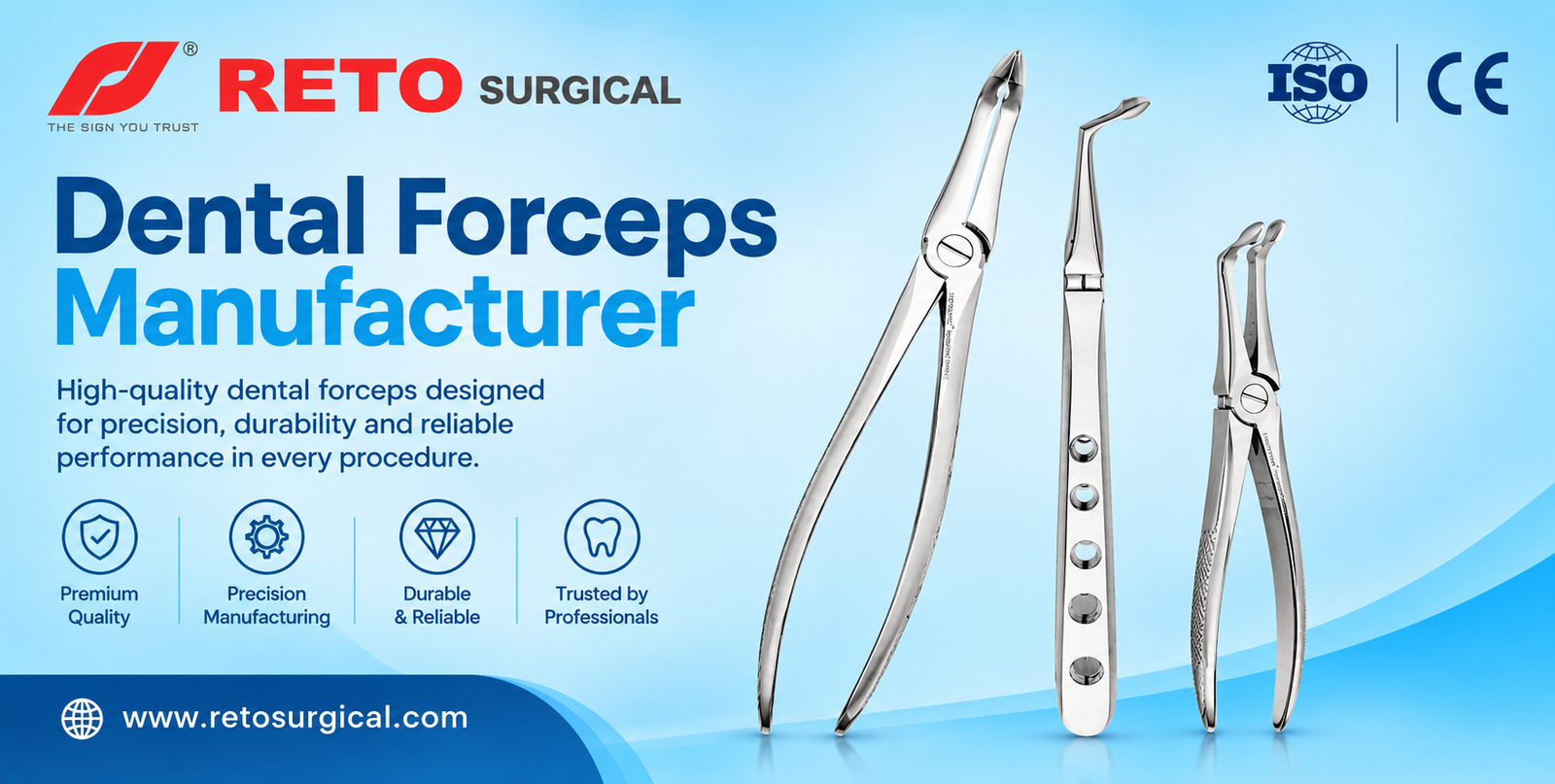
Dental Extracting Forceps: Types, Uses & Selection Guide
Dental Extracting Forceps: Types, Uses, and How to Choose the Right Instrument
Dental extractions are a common part of clinical dentistry, but achieving a controlled and efficient extraction requires the right instruments, sound clinical judgement, and an understanding of tooth anatomy. Among the essential instruments used in oral surgery, dental extraction forceps play an important role in grasping teeth and applying controlled forces during the removal process.
Although extraction forceps may appear similar at first glance, different designs serve specific clinical purposes. The shape of the beaks, the length of the handles, the position of the hinge, and the overall geometry influence how an instrument engages a tooth. Selecting an appropriate design helps dental professionals work more precisely and manage different extraction situations.
From upper and lower molar extraction forceps to specialised root extraction forceps, each instrument is designed to accommodate differences in tooth position, root structure, and accessibility. Other designs, including cowhorn extraction forceps and eagle-beak extraction forceps, have distinctive beak shapes intended for particular tooth and root configurations.
For dental clinics, oral surgeons, purchasing managers, and instrument distributors, understanding these differences is valuable when selecting instruments for clinical use or building a comprehensive product range.
In this guide, we explore the main types of dental extracting forceps, their applications, the anatomy of the instrument, material considerations, and practical factors to consider when choosing high-quality dental extraction instruments.
What Are Dental Extraction Forceps?
Dental extraction forceps are specialised dental instruments used by trained dental professionals to grasp a tooth and apply controlled movements during extraction. Their design allows the clinician to engage the tooth securely while working according to the tooth’s anatomy and the surrounding supporting structures.
The appropriate forceps depend on several factors, including the tooth being removed, the number and shape of its roots, its position in the mouth, and the clinical circumstances.
For example, extracting an upper incisor presents different access and anatomical considerations from removing a lower molar with multiple roots. As a result, a single universal forceps design is not suitable for every extraction.
Why are different forceps designs necessary?
Dental extraction instruments are designed to accommodate variations in tooth anatomy and access. Their principal differences include:
- Beak shape: Determines how the working ends engage the tooth crown or accessible root structure.
- Beak width and curvature: Affect access and adaptation to different tooth shapes.
- Handle length and design: Influence grip, access, and instrument control.
- Hinge construction: Connects the handles and beaks, allowing the instrument to open and close.
- Overall geometry: Helps determine whether the instrument is suitable for anterior teeth, posterior teeth, or particular root configurations.
Choosing a suitable instrument is not simply about matching a product name to a tooth. The clinician must consider the tooth’s condition, access, and the intended technique.
For dental practices, maintaining a carefully selected range of dental extraction forceps can support instrument availability across routine extraction procedures and more specialised clinical requirements.
Types of Dental Extracting Forceps and Their Uses
Types of Dental Extracting Forceps and Their Uses
There are several categories of extraction forceps, each with specific design features. Understanding these differences helps dental professionals select appropriate instruments and helps distributors organise their product catalogues more effectively.
Upper and Lower Molar Extraction Forceps
Upper and lower molar extraction forceps are designed for posterior teeth, where access can be more challenging and tooth anatomy differs between the upper and lower jaws.
Upper molars commonly have three roots, while lower molars commonly have two. However, root number and configuration can vary, and the clinician must assess the individual tooth before selecting an instrument.
Upper molar forceps are designed around the anatomy and accessibility of maxillary molars. Depending on the design, the beaks may differ to accommodate the buccal and palatal aspects of the tooth.
Lower molar forceps are designed for mandibular molars. Their angulation and beak configuration help accommodate the position of the lower posterior teeth and the available working space.
Important selection considerations include:
- Whether the instrument is intended for upper or lower molars.
- The shape and spacing of the beaks.
- Access to the posterior region of the mouth.
- The tooth’s crown condition and root anatomy.
- Compatibility with the clinician’s preferred technique.
For dental instrument buyers, checking the manufacturer’s stated indication and design details is more reliable than selecting an instrument based on appearance alone.
Cowhorn Extraction Forceps
Cowhorn extraction forceps are recognised by their distinctive, pointed or curved beak design, which resembles the shape of a cow’s horns. Certain designs are intended to engage the furcation region of suitable molar teeth.
The furcation is the area where a multirooted tooth divides into its separate roots. Depending on the instrument design and clinical circumstances, the beaks may engage this area to assist with controlled tooth mobilisation.
Cowhorn forceps are commonly associated with particular lower molar extraction applications, although the exact indication depends on the model.
Their distinctive shape makes them different from conventional molar forceps with broader, more closely adapted beaks.
When selecting cowhorn forceps, consider:
- The intended tooth and jaw.
- Beak shape, width, and symmetry.
- The condition of the crown and accessible furcation.
- The manufacturer’s intended clinical application.
- The clinician’s experience and preferred extraction technique.
These instruments are not suitable for every molar. If the crown is severely damaged or the root configuration is unsuitable, another approach may be necessary.
Eagle-Beak Extraction Forceps
Eagle-beak extraction forceps feature a distinctive beak profile designed for particular tooth-engagement requirements. The term generally describes the shape of the working ends rather than one universal instrument specification.
Their exact indication can vary between manufacturers and product designs. For this reason, dental professionals should confirm the intended tooth type and clinical application from the product documentation before use.
When evaluating eagle-beak forceps, buyers should pay attention to the following features:
- The profile and sharpness of the beak tips.
- The working-end curvature and alignment.
- The opening range and handle ergonomics.
- The finish of the working surfaces.
- The manufacturer’s identification and product specifications.
For dental distributors, accurate product descriptions and clear photographs are especially important because similarly named forceps may differ in geometry and intended application.
Root Extraction Forceps
Root extraction forceps are designed for situations in which a tooth root or accessible remaining root structure must be grasped. They typically have narrower working ends than many conventional crown-gripping forceps, allowing access to restricted areas when the clinical situation permits.
These instruments may be considered when a tooth has fractured, the crown is substantially damaged, or residual root structure remains following an earlier procedure.
However, not every retained root can be safely removed with forceps. Root depth, curvature, bone coverage, fracture risk, and proximity to important anatomical structures influence the clinical approach.
Root forceps should therefore be selected according to the specific case rather than treated as a universal solution for difficult extractions.
Key features to evaluate include:
- Narrowness and precision of the beaks.
- Secure closure and working-end alignment.
- Access to the intended root structure.
- Handle control and overall balance.
- Suitability for the intended clinical procedure.
A well-designed root forceps can form a useful part of an oral surgery instrument range, provided its limitations and indications are clearly understood.
Upper Root and Lower Root Forceps
Upper root and lower root forceps are differentiated by their intended use in the maxilla and mandible. Their shapes may vary to accommodate differences in tooth position, root anatomy, and access.
Upper root forceps may feature angulation intended to improve access to the upper arch. Lower root forceps may have a geometry suited to working within the lower arch.
The exact differences are model-dependent. Some instruments are designed for particular root types, while others have broader indications.
When comparing these products, consider:
- Jaw compatibility: Confirm whether the instrument is designed for upper or lower use.
- Beak geometry: Examine the working-end shape and access requirements.
- Handle design: Look for a comfortable, controlled grip.
- Construction quality: Inspect alignment, joint movement, and surface finish.
- Product identification: Verify the manufacturer’s catalogue number and intended indication.
For procurement teams, these checks help reduce confusion between similar-looking instruments and support more accurate ordering.
Incisor and Canine Extraction Forceps
Incisor and canine extraction forceps are intended for anterior teeth. Incisors generally have relatively narrow crowns, while canines have a different crown shape and often long roots.
The working ends of anterior forceps are designed to accommodate the relevant tooth anatomy while allowing access to the front of the mouth.
Depending on the model, the beaks may be relatively narrow and shaped for the crown contours of anterior teeth. The instrument’s curvature and handle design can also influence access and visibility.
When choosing anterior extraction forceps, dental professionals should consider the specific tooth, crown condition, root anatomy, and the manufacturer’s stated indication.
For clinics, having suitable anterior forceps alongside molar and root forceps helps maintain a more complete extraction instrument set.
Pediatric Dental Extraction Forceps
Pediatric dental extraction forceps are designed for extraction procedures involving children. They may have smaller working ends and dimensions suited to the smaller teeth and oral cavity encountered in pediatric dentistry.
Primary teeth differ from permanent teeth in crown dimensions, root morphology, and their relationship with developing permanent successors. These differences require careful clinical assessment before an instrument and extraction technique are selected.
Pediatric forceps should not be chosen on size alone. The clinician must confirm that the instrument is suitable for the specific primary or permanent tooth and the intended procedure.
For pediatric dental practices, useful selection factors include:
- Appropriate working-end dimensions.
- Access and visibility in the child’s mouth.
- Comfortable handling and precise control.
- Suitable construction and cleaning compatibility.
- Clear manufacturer guidance on intended use.
The priority is to select an appropriate instrument and technique for the individual patient, not simply to use a smaller version of an adult instrument.
Understanding Dental Forceps Anatomy: Beaks, Handles and Hinges
Understanding dental forceps anatomy: beaks, handles and hinges is essential when evaluating instrument quality. These three main components work together to provide grip, movement, and control.
Beaks: The Working Ends
The beaks are the parts of the forceps that contact the tooth or accessible root structure. Their shape varies according to the intended application.
Some beaks are broad and contoured for particular crowns, while others are narrow or pointed to accommodate specific root or molar configurations.
When inspecting beaks, look for:
- Appropriate geometry for the intended tooth.
- Consistent alignment between the two working ends.
- Smooth, well-finished surfaces where required by the design.
- No visible cracks, burrs, or manufacturing defects.
- Reliable closure without unwanted misalignment.
Beak geometry is one of the most important differences between forceps models. A visually attractive instrument is not necessarily suitable for a particular clinical application.
Handles: Grip and Control
The handles provide the gripping surfaces used by the clinician to operate the forceps. Their length, shape, texture, and balance affect handling and accessibility.
Some handles feature smooth surfaces, while others incorporate textured areas to improve grip. The appropriate design depends on the instrument type and intended clinical use.
Good handle construction should support controlled operation without unnecessary discomfort. Surfaces should be appropriately finished, and the handles should not show visible defects that could interfere with use or cleaning.
For buyers assessing several models, comparing handle dimensions and grip characteristics can help identify instruments suited to different clinical preferences.
Hinges: Movement and Alignment
The hinge connects the two halves of the instrument and enables the beaks to open and close. Its construction is important to the overall function of the forceps.
A suitable hinge should allow smooth, consistent movement without excessive looseness, binding, or unwanted lateral play.
During inspection, check whether:
- The handles move smoothly throughout their intended range.
- The beaks align correctly when closed.
- The joint has no obvious damage or excessive looseness.
- The instrument opens and closes without irregular resistance.
- The hinge design is compatible with the manufacturer’s cleaning and maintenance instructions.
Poor hinge performance can affect control and may indicate wear or a manufacturing defect. Instruments that are damaged, misaligned, or difficult to operate should be removed from service until assessed by an appropriate professional.
Stainless Steel Dental Forceps: Quality, Manufacturing and Maintenance
Stainless steel dental forceps are widely used because appropriately selected stainless steel grades can offer corrosion resistance, strength, and suitability for reusable instrument applications.
However, stainless steel is not a single material specification. Different grades have different mechanical and corrosion-resistance properties, so the appropriate material depends on the instrument’s design, manufacturing process, and intended use.
For dental practices and distributors, the material designation should be supported by reliable product documentation rather than assumed from the instrument’s appearance.
What determines instrument quality?
Material selection is only one part of quality. Manufacturing consistency, finishing, joint construction, inspection, and validation of reprocessing instructions also matter.
Important evaluation criteria include:
Material specification: Confirm the grade and relevant material documentation supplied by the manufacturer.
Manufacturing precision: Beaks, handles, and hinges should meet the applicable design specifications.
Surface finishing: The surface should be appropriately finished, free from visible defects, and suitable for the instrument’s intended use.
Joint performance: The hinge should operate smoothly and maintain appropriate alignment.
Corrosion resistance: The finished instrument should meet applicable requirements for its intended reusable use when properly processed and maintained.
Traceability: Product identification and batch or lot records can help support quality management and investigation of product issues.
Cleaning, inspection and sterilisation
Reusable extraction forceps must be cleaned, inspected, and sterilised according to the manufacturer’s validated instructions and applicable clinical requirements.
Organic material and residues should be removed using the specified cleaning process before sterilisation. Instruments should be inspected for damage, corrosion, wear, and hinge problems, and any required maintenance should follow the manufacturer’s instructions.
The sterilisation method, cycle parameters, packaging requirements, and compatibility of cleaning agents should be established by the manufacturer for the specific instrument.
Do not assume that every instrument can be processed using the same cycle or cleaning products. Following the applicable instructions helps maintain instrument condition and supports appropriate infection prevention practices.
Why manufacturing consistency matters
For distributors and dental equipment suppliers, consistent manufacturing is particularly important when sourcing products in larger quantities.
A structured quality management system, documented inspections, material traceability, and clear product specifications can make supplier evaluation more straightforward.
At Reto Surgical, dental instrument buyers can explore product options for different extraction applications and discuss requirements for OEM manufacturing, custom specifications, product identification, and wholesale supply. Product-specific material and compliance documentation should be confirmed for the instrument being considered.
How to Choose the Right Dental Extraction Forceps
Choosing extraction forceps involves more than comparing prices or selecting the most familiar design. The instrument must be suitable for the intended tooth, clinical circumstances, and the professional using it.
Match the instrument to the intended application
Begin by identifying the tooth type and jaw. Determine whether the requirement is for anterior teeth, upper or lower molars, accessible root structures, or pediatric applications.
Then review the manufacturer’s stated indication and product specifications. This is especially important for specialised models such as cowhorn and eagle-beak forceps, where similar product names may describe different geometries.
Evaluate ergonomics and construction
The instrument should open and close smoothly, maintain appropriate beak alignment, and provide a comfortable, controlled grip.
Check the working ends for visible defects and confirm that the hinge operates as intended. Where possible, review samples before committing to a large order, particularly when sourcing a new model or developing an OEM product range.
Consider the complete cost of ownership
Purchase price matters, but it should not be the only selection criterion. Instrument durability, reprocessing compatibility, maintenance requirements, traceability, and supplier support may also affect long-term value.
For distributors, consistency across repeat orders is another important consideration. Ask suppliers how they control specifications, inspect finished instruments, and manage product identification.
Review supplier documentation
Before purchasing, request relevant information, including:
- Product catalogue and model identification.
- Intended use and applicable product specifications.
- Material grade and supporting documentation.
- Cleaning, inspection, and sterilisation instructions.
- Applicable regulatory and conformity documentation.
- Traceability and quality management information.
- OEM branding and packaging options, where required.
Documentation requirements vary by product, intended market, and regulatory classification. Claims relating to certification or conformity should be verified against the actual product and supporting records.
Choose a supplier that understands your requirements
Dental practices often need instruments for specific clinical applications, while distributors may require a broader portfolio covering multiple tooth types and extraction techniques.
A capable manufacturing partner should be able to explain available models, clarify product differences, discuss customisation where feasible, and provide accurate technical information.
For international buyers, clear communication about specifications, quantities, lead times, packaging, and quality requirements can help establish a more dependable supply relationship.
Conclusion
Dental extracting forceps are essential instruments in many extraction procedures, but selecting the right design requires an understanding of tooth anatomy, instrument geometry, and clinical requirements.
From upper and lower molar extraction forceps and cowhorn extraction forceps to eagle-beak extraction forceps, root extraction forceps, and pediatric dental extraction forceps, each category serves a particular purpose. The beaks, handles, and hinges all contribute to the instrument’s function, while material selection, manufacturing precision, and appropriate reprocessing support long-term performance.
For dental professionals, the priority is to choose instruments appropriate for the individual case and follow established clinical procedures. For distributors and procurement teams, reviewing specifications, material documentation, manufacturing consistency, and supplier support can help make purchasing decisions more effective.
Looking for dental extraction forceps for your clinic or distribution business?
Explore Reto Surgical’s dental instrument range at https://retosurgical.com to discuss available models, wholesale requirements, and OEM manufacturing options. Contact the team to request product information and identify suitable instruments for your business needs.
Follow us
Frequently Asked Questions
- What are dental extracting forceps?
Dental extracting forceps are specialised instruments used by trained dental professionals to grasp teeth or accessible root structures during extraction procedures.
- What are dental extraction forceps used for?
They are used to engage a tooth and apply controlled movements during removal, with the appropriate instrument selected according to the tooth’s anatomy and clinical circumstances.
- What are the main types of dental extraction forceps?
Common categories include upper and lower molar forceps, anterior forceps, root forceps, cowhorn forceps, and pediatric extraction forceps.
- What is the difference between upper and lower molar extraction forceps?
They differ in their working-end geometry and intended application to accommodate anatomical differences between maxillary and mandibular molars.
- What are cowhorn extraction forceps used for?
Cowhorn forceps have distinctive pointed beaks that may engage the furcation of suitable molar teeth. Their precise indications depend on the instrument design and clinical situation.
- What are eagle-beak extraction forceps?
Eagle-beak forceps are instruments with a distinctive beak profile. Their intended application varies by model, so the manufacturer’s product specifications should be checked.
- What are root extraction forceps?
Root extraction forceps are designed to grasp accessible root structures in appropriate clinical situations, particularly when the tooth crown is damaged or residual roots remain.
- What is the difference between upper root and lower root forceps?
These instruments are designed for different jaw locations. Their curvature and working-end geometry may vary to accommodate access and anatomical requirements.
- Which forceps are used for incisor and canine extractions?
Anterior extraction forceps are designed for incisors and canines. The specific model should be selected according to the tooth, its anatomy, and the manufacturer’s stated indication.
- What are pediatric dental extraction forceps?
Pediatric extraction forceps are designed for use in appropriate extraction procedures involving children. Their dimensions and indications should match the tooth and clinical requirements.
- What material is commonly used to manufacture dental extraction forceps?
Stainless steel is widely used because suitable grades can provide strength and corrosion resistance. The exact grade should be verified through manufacturer documentation.
- What are the main parts of dental extraction forceps?
The main components are the beaks, handles, and hinge. Each contributes to tooth engagement, handling, and opening-and-closing movement.
- Why is beak design important in dental forceps?
Beak geometry determines how the working ends engage the intended tooth or root structure and helps distinguish one forceps design from another.
- What should a good dental forceps hinge be like?
A hinge should move smoothly, close appropriately, and maintain correct beak alignment without excessive looseness or binding.
- Are all dental extraction forceps suitable for every tooth?
No. Different tooth types and anatomical circumstances require different instrument designs. The clinician must select a suitable instrument for the individual case.
- How should reusable dental extraction forceps be cleaned?
They should be cleaned and inspected according to the manufacturer’s instructions, using compatible processes that have been established for the specific instrument.
- Can stainless steel dental forceps be sterilised?
Reusable stainless steel forceps can be sterilised when the particular instrument is designed and validated for the specified sterilisation process. Always follow the manufacturer’s instructions.
- How can dental professionals assess the quality of extraction forceps?
Assess the material documentation, beak alignment, hinge movement, surface finish, handle design, product traceability, and supporting technical documentation.
- How should dental distributors select a dental forceps supplier?
Distributors should review product specifications, manufacturing consistency, quality management, traceability, regulatory documentation, supply capacity, and communication.
- What documentation should buyers request when purchasing dental extraction forceps?
Depending on the product and market, buyers may request material specifications, intended-use information, instructions for reprocessing, traceability records, and applicable conformity documentation.
- What is the difference between extraction forceps and dental elevators?
Extraction forceps are designed to grasp teeth or accessible root structures. Dental elevators are used to mobilise teeth or roots and assist with luxation as part of an appropriate extraction technique.
- Are dental extraction forceps available for wholesale purchase?
Yes. Dental instrument manufacturers and distributors may offer extraction forceps for wholesale supply. Buyers should confirm available models, minimum order quantities, lead times, and product specifications.
- Can dental extraction forceps be manufactured under a private label?
Some manufacturers offer OEM or private-label manufacturing. Availability depends on the manufacturer’s capabilities, the requested design, branding requirements, and applicable regulatory obligations.
- What should buyers consider when ordering custom dental forceps?
Buyers should define the intended application, dimensions, material, working-end geometry, finish, identification, packaging, quality requirements, and any applicable regulatory documentation.
- Where can dental professionals and distributors source dental extraction forceps?
Dental professionals and distributors can contact specialist dental instrument manufacturers and suppliers, including Reto Surgical at https://retosurgical.com, to enquire about available models, wholesale supply, and OEM options. Product specifications and availability should be confirmed directly with the supplier.