
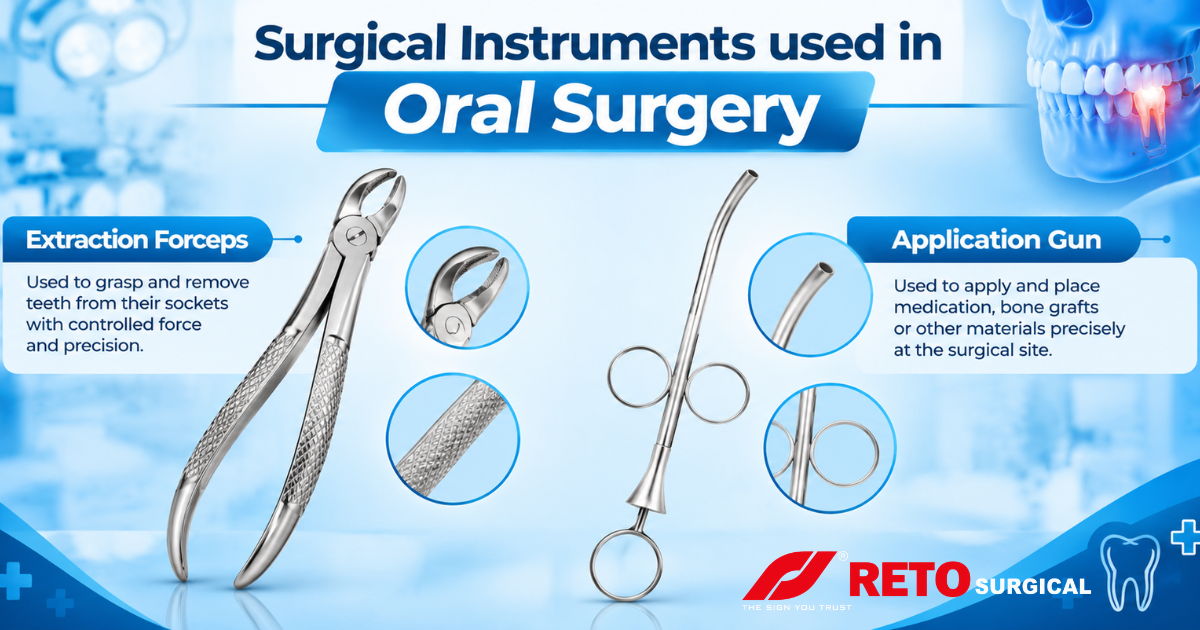
Surgical Instruments Used in Oral Surgery: Complete Guide
Surgical Instruments Used in Oral Surgery: A Complete Guide
Oral surgery requires more than clinical skill alone. The right instruments help dental professionals work with greater control, precision, and efficiency while supporting patient comfort and predictable treatment outcomes. From routine tooth extractions to more complex procedures involving soft tissue, bone, and suturing, every instrument has a specific purpose.
A well-organized oral surgery setup may include Extraction Forceps, Dental Elevators, Luxating Instruments, Surgical Retractors, Surgical Curettes, Periosteal Elevators, Bone Cutting Forceps, Surgical Chisels, Hemostatic Forceps, and Needle Holders. Understanding what each instrument does—and when to use it—helps clinicians select the appropriate tools for each procedure.
This guide explores the most important surgical instruments used in oral surgery, their applications, and the characteristics that dental professionals should consider when choosing them.
- Instruments for Tooth Extraction and Tooth Removal
Tooth extraction is one of the most common procedures in oral surgery. Although it may appear straightforward, successful extraction depends on controlled movement, appropriate instrument selection, and careful handling of surrounding tissues.
Extraction Forceps
Extraction Forceps are designed to grasp and remove teeth from the socket. Different forceps patterns are available for different teeth and anatomical locations.
For example, upper and lower teeth often require different jaw designs, while specialized forceps may be used for roots or difficult-to-access teeth. The shape of the beaks, handle design, working angle, and overall balance can influence how effectively the instrument performs.
A good extraction forceps should provide:
- Secure and controlled tooth grip
- Appropriate jaw geometry
- Smooth opening and closing
- Comfortable handling
- Adequate strength and durability
- Precise alignment of the working ends
In clinical practice, selecting the correct forceps can make a significant difference. A forceps designed for a particular tooth or root allows the clinician to apply controlled movement rather than unnecessary force.
Dental Elevators
Dental Elevators are commonly used to loosen teeth or roots before extraction. They work by applying controlled leverage and helping separate the tooth from the surrounding periodontal structures.
Common designs include straight elevators, root elevators, and other specialized patterns intended for different clinical situations.
The instrument should have a comfortable handle and a strong, precisely finished working end. The clinician must also use appropriate technique to avoid placing excessive pressure on adjacent teeth or tissues.
Luxating Instruments
Luxating Instruments are designed to help sever periodontal ligament attachments and facilitate tooth mobilization. They are generally slimmer than traditional elevators and are available in different tip shapes and sizes.
Luxators are particularly useful when controlled periodontal ligament separation is required before using extraction forceps.
Because the working tip enters a confined area, precision in manufacturing is especially important. The tip should have the intended geometry, while the handle should provide adequate control during use.
- Instruments for Access, Visibility, and Soft-Tissue Management
Oral surgery often involves working within a relatively small operating field. Clear visibility and careful soft-tissue management are therefore essential.
Surgical Retractors
Surgical Retractors are used to hold soft tissue, cheeks, lips, or flaps away from the surgical site. By maintaining a clear field of view, retractors can help the clinician work more efficiently.
Common designs include retractors intended for different areas of the oral cavity and different surgical approaches.
A well-designed retractor should have:
- Smooth, rounded working surfaces where appropriate
- Adequate strength
- Comfortable handling
- Proper working angles
- A surface that can be effectively cleaned and reprocessed
For example, during a surgical extraction, a retractor can help maintain visibility while protecting surrounding soft tissue from instruments being used in the operative area.
Periosteal Elevators
Periosteal Elevators are used to separate and reflect the periosteum from bone during procedures involving surgical flaps.
Different patterns are available depending on the procedure and clinician preference. The working end may be designed for controlled tissue elevation, while the handle provides the leverage required for precise manipulation.
Because these instruments come into direct contact with delicate tissue, smooth finishing and appropriate edge geometry are particularly important.
A poorly finished instrument may make tissue handling more difficult, whereas a properly manufactured instrument provides the clinician with better control.
- Instruments for Bone Management and Surgical Site Preparation
Some oral surgical procedures require modification or removal of bone. This can occur during complex extractions, impacted tooth procedures, implant-related surgery, and other surgical interventions.
Bone Cutting Forceps
Bone Cutting Forceps are used for cutting or removing small sections of bone. Their strong construction allows controlled manipulation when bone needs to be trimmed or removed.
The design of the jaws, cutting edges, hinge mechanism, and handles all contribute to instrument performance.
For manufacturers, maintaining accurate jaw alignment and cutting-edge geometry is particularly important. Even small dimensional variations can influence the way an instrument performs.
Surgical Chisels
Surgical Chisels are used in procedures where bone needs to be cut, shaped, or removed. Depending on the design, chisels can be used for procedures involving osteotomy, bone modification, or other surgical applications.
They may be available in different widths, shapes, and working-end configurations.
A high-quality surgical chisel should combine:
- Appropriate hardness
- Strong construction
- Accurate working geometry
- Smooth finishing
- Resistance to repeated sterilization
- Reliable dimensional consistency
The instrument’s material and heat-treatment process are also important because the working end must maintain its intended performance during repeated clinical use.
- Instruments for Tissue Removal, Bleeding Control, and Suturing
Once the surgical site has been accessed and the required procedure performed, clinicians may need specialized instruments for tissue management, bleeding control, and closure.
Surgical Curettes
Surgical Curettes are used for removing tissue, debris, granulation tissue, or other material from a surgical site, depending on the specific procedure.
Different curette designs are available for different applications. The shape and size of the working end allow clinicians to access specific areas while maintaining controlled movement.
A properly manufactured curette should have a smooth surface, accurate working-end geometry, and a comfortable grip.
Hemostatic Forceps
Hemostatic Forceps are used to grasp blood vessels or tissue and assist with bleeding control during surgical procedures.
Common patterns include mosquito-type and other hemostatic designs. The locking mechanism allows the instrument to maintain a controlled grip when required.
For this type of instrument, the ratchet mechanism is especially important. It should engage consistently while allowing the clinician to release it smoothly when necessary.
Manufacturing accuracy therefore matters not only for appearance but also for functionality. Proper alignment of the jaws and reliable operation of the locking mechanism are key quality considerations.
Needle Holders
Needle Holders are essential during the suturing stage of oral surgery. They allow the clinician to securely hold and manipulate a surgical needle while placing sutures.
Different needle holder designs are available, including patterns suited to general surgical applications and others intended for more delicate procedures.
A good needle holder should provide:
- Secure needle grip
- Accurate jaw alignment
- Smooth ratchet operation
- Comfortable handling
- Appropriate surface finish
- Consistent performance
For example, when closing a surgical flap, precise needle control can help the clinician place sutures accurately without unnecessarily manipulating the surrounding tissue.
- What to Look for When Choosing Oral Surgery Instruments
Choosing surgical instruments should involve more than simply selecting the correct instrument name. Dental professionals and purchasing teams should consider the instrument’s design, materials, manufacturing quality, usability, and suitability for repeated clinical use.
Material and Durability
Stainless steel is widely used for reusable dental and surgical instruments because it can provide a useful combination of strength, corrosion resistance, and cleanability when the appropriate grade and processing are selected.
However, material selection alone does not determine instrument quality. Manufacturing processes, heat treatment, finishing, polishing, and passivation can also influence the final product.
Precision Manufacturing
The dimensions and geometry of surgical instruments can directly affect their functionality. This is particularly important for instruments such as extraction forceps, elevators, luxating instruments, scissors, and bone-cutting instruments.
Modern manufacturing technologies, including CNC machining, can support consistent dimensions and repeatable production when properly controlled.
Finishing and Polishing
Surface finishing is another important consideration. Smooth, properly finished surfaces can support cleaning and reprocessing while contributing to the overall appearance and handling of the instrument.
For instruments with moving parts, appropriate finishing can also support smooth operation.
Inspection and Quality Control
Quality control should not be limited to the final inspection. Ideally, manufacturing controls should be applied throughout the production process.
Depending on the instrument, inspections may include:
- Dimensional checks
- Jaw alignment
- Cutting-edge inspection
- Functional testing
- Surface-finish inspection
- Ratchet and hinge operation
- Marking and identification
- Final visual inspection
This approach helps manufacturers identify problems earlier and maintain consistency from batch to batch.
Traceability
Traceability is increasingly important for professional dental instrument supply. Product codes, batch or lot information, production records, and customer-specific information can help manufacturers investigate quality concerns and manage products more effectively.
For distributors and dental organizations, clear identification can also simplify inventory management and product selection.
Conclusion
The range of surgical instruments used in oral surgery reflects the variety of procedures performed in modern dentistry. From Extraction Forceps, Dental Elevators, and Luxating Instruments used during tooth removal to Surgical Retractors, Periosteal Elevators, and Surgical Curettes used for tissue and surgical-site management, each instrument has a specific role.
Likewise, Bone Cutting Forceps and Surgical Chisels support procedures involving bone, while Hemostatic Forceps and Needle Holders assist with bleeding control and surgical closure.
For dental professionals, the goal should not simply be to have a large collection of instruments. The focus should be on selecting instruments that are appropriate for the procedure, accurately manufactured, comfortable to handle, durable, and suitable for the required cleaning and sterilization processes.
For manufacturers and distributors, consistent quality, precise manufacturing, reliable inspection, and traceability are equally important. Ultimately, the right combination of instrument design and manufacturing quality can help dental professionals perform oral surgical procedures with greater control and confidence.
Looking for reliable oral surgery instruments? Explore a professionally manufactured range of dental and surgical instruments, and consider working with a supplier that can provide consistent quality, OEM/custom manufacturing, and long-term supply support.
Frequently Answer Questions:
- What are surgical instruments used in oral surgery?
Surgical instruments used in oral surgery are specialized tools designed for procedures such as tooth extraction, implant placement, bone surgery, tissue management, and other oral surgical treatments.
- What are the most common oral surgery instruments?
Common oral surgery instruments include extraction forceps, dental elevators, luxating instruments, surgical retractors, periosteal elevators, surgical curettes, bone cutting forceps, surgical chisels, hemostatic forceps, and needle holders.
- What instruments are used for tooth extraction?
Tooth extraction commonly involves dental elevators, luxators, extraction forceps, surgical curettes, retractors, and other instruments depending on the type and complexity of the procedure.
- What are extraction forceps used for?
Extraction forceps are designed to grasp and remove teeth during dental extraction procedures. Different forceps patterns are available for different teeth and clinical applications.
- What are dental elevators used for?
Dental elevators are used to loosen and mobilize teeth or tooth roots before extraction. They can also assist in gaining access to difficult areas during surgical extraction.
- What are luxating instruments used for in oral surgery?
Luxating instruments are used to carefully sever periodontal ligament fibers and help loosen a tooth before extraction.
- What are surgical retractors used for?
Surgical retractors are used to hold soft tissues, cheeks, lips, or other tissues away from the surgical field, improving visibility and access.
- What is a periosteal elevator?
A periosteal elevator is a surgical instrument used to separate and reflect the periosteum from the surface of bone during oral and maxillofacial procedures.
- What are surgical curettes used for?
Surgical curettes can be used to remove tissue, debris, granulation tissue, or other material from a surgical site, depending on the procedure.
- What are bone cutting forceps used for?
Bone cutting forceps are designed for cutting or removing small sections of bone during selected oral surgical procedures.
- What are surgical chisels used for?
Surgical chisels can be used for controlled bone cutting, shaping, or removal during certain oral and maxillofacial surgical procedures.
- What are hemostatic forceps used for?
Hemostatic forceps are used to grasp blood vessels or tissue and assist with controlling bleeding during surgical procedures.
- What are needle holders used for in oral surgery?
Needle holders are designed to securely hold and control surgical needles during suturing and wound closure.
- What instruments are used in oral and maxillofacial surgery?
Oral and maxillofacial surgery may require extraction forceps, elevators, retractors, periosteal elevators, curettes, bone instruments, hemostatic forceps, needle holders, and specialized surgical instruments.
- What is included in an oral surgery instrument set?
An oral surgery instrument set may include instruments such as extraction forceps, elevators, retractors, periosteal elevators, curettes, hemostatic forceps, scissors, and needle holders, depending on the intended procedure.
- What instruments are used for surgical tooth extraction?
Surgical tooth extraction may involve elevators, luxators, extraction forceps, retractors, periosteal elevators, surgical curettes, bone-cutting instruments, and suturing instruments.
- How are oral surgery instruments sterilized?
Reusable oral surgery instruments are generally cleaned, inspected, packaged, and sterilized according to the manufacturer’s instructions and applicable infection-control requirements.
- What materials are oral surgery instruments made from?
Many reusable oral surgery instruments are manufactured from medical-grade stainless steel. Specific material grades vary according to the instrument design, intended use, and manufacturer.
- How should oral surgical instruments be maintained?
Oral surgical instruments should be cleaned promptly after use, inspected for damage or corrosion, properly lubricated where applicable, and sterilized according to validated procedures and manufacturer instructions.
- What is the difference between dental instruments and surgical instruments?
Dental instruments are used for a broad range of examinations and treatments, while surgical instruments are specifically designed for procedures involving tissue, bone, extraction, incision, suturing, or other surgical intervention.