
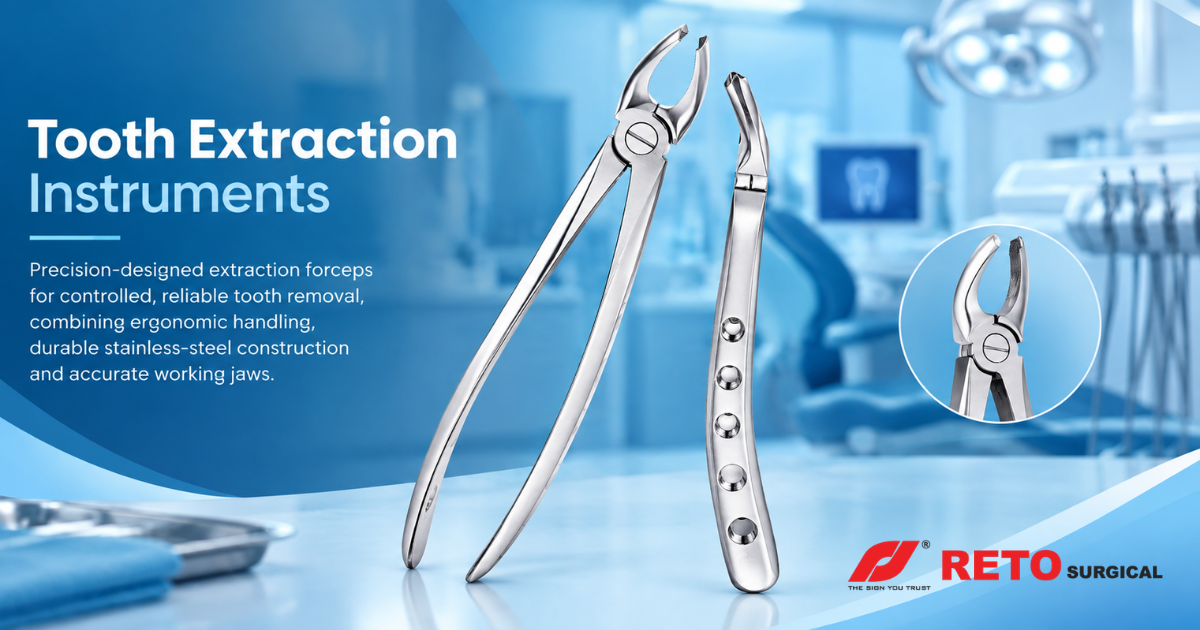
Tooth Extraction Instruments: Types, Uses & Dental Guide
Tooth Extraction Instruments: Types, Uses, and How to Choose the Right Dental Tools
Tooth extraction is one of the most common procedures performed in dental practice, but successful extraction involves much more than simply removing a tooth. The right instruments can make a significant difference in visibility, control, efficiency, tissue preservation, and patient comfort.
From routine extractions to complex surgical cases, dentists rely on a carefully selected range of Tooth Extraction Instruments. These include Extraction Forceps, Dental Elevators, Dental Luxators, Root Forceps, Periosteal Elevators, Root Tip Picks, Cowhorn Forceps, Surgical Curettes, and other specialized Surgical Extraction Instruments.
Each instrument has a particular design and purpose. Choosing the appropriate tool depends on factors such as the tooth’s position, root anatomy, surrounding bone, periodontal condition, and whether the procedure is a simple or surgical extraction.
For dental professionals, clinics, distributors, and instrument buyers, understanding these differences is important when selecting reliable dental extraction instruments. Quality instruments should provide precise handling, appropriate strength, smooth operation, and dependable performance throughout repeated clinical use.
This guide explores the major types of tooth extraction instruments, their applications, and the factors that should be considered when selecting them for a modern dental practice.
Understanding Tooth Extraction Instruments
Tooth extraction instruments are designed to help dental professionals loosen, mobilize, grasp, section, and remove teeth while minimizing unnecessary trauma to surrounding tissues.
Although a basic extraction may appear straightforward, every case is different. A fully erupted tooth with strong crown structure may require a different instrument combination from a fractured molar, retained root, impacted tooth, or tooth surrounded by dense bone.
A typical extraction procedure may involve several stages:
- Assessing the tooth and surrounding structures.
- Separating soft tissue where necessary.
- Mobilizing the tooth or root.
- Expanding or preparing the socket.
- Grasping and removing the tooth.
- Inspecting and cleaning the extraction site.
- Managing the socket after removal.
Different instruments are designed for specific stages of this process.
For example, elevators can help create initial mobility, while extraction forceps are generally used to grasp and remove the tooth. In more complicated cases, luxators, root tip instruments, surgical curettes, and other specialized instruments may be required.
This is why a complete extraction instrument set should contain a variety of instruments rather than relying on a single type of forceps.
Essential Extraction Forceps and Root Instruments
Extraction Forceps are among the most recognizable dental instruments. They are designed to grasp the tooth securely and allow the dentist to apply controlled movements during extraction.
Different forceps patterns are designed for different teeth and anatomical situations. Their beaks, angles, handles, and overall geometry can vary depending on whether they are intended for anterior teeth, premolars, molars, or other applications.
A well-designed forceps should provide:
- Secure tooth engagement
- Comfortable handling
- Appropriate mechanical strength
- Smooth opening and closing
- Accurate control during extraction
- Resistance to repeated sterilization
Instrument selection should always be based on the clinical situation rather than simply choosing the largest or strongest instrument available.
Root Forceps
When the crown of a tooth has fractured or is no longer suitable for conventional grasping, Root Forceps can be particularly useful.
These instruments are designed for controlled access to remaining root structures. Their narrower working ends allow the clinician to engage root fragments where conventional extraction forceps may not provide sufficient access.
Root forceps are commonly included in extraction kits because fractured teeth and retained roots can occur unexpectedly during routine procedures.
Cowhorn Forceps
Cowhorn Forceps are specialized extraction forceps commonly associated with mandibular molars. Their distinctive beak design can engage the furcation area of a molar and assist with controlled elevation and removal.
The design is particularly useful when the anatomy of the tooth allows the beaks to engage beneath the crown in the furcation region.
As with any extraction instrument, the dentist must select the appropriate technique and instrument according to the tooth’s anatomy and clinical circumstances.
Dental Elevators, Luxators, and Periosteal Instruments
Forceps are only part of the extraction process. Instruments designed to loosen or separate the tooth from surrounding structures are equally important.
Dental Elevators
Dental Elevators are commonly used to luxate teeth or roots before forceps are applied. They can help create controlled movement and provide access in situations where direct forceps engagement is difficult.
Elevators are available in different patterns and sizes, with variations in working-end shape, thickness, length, and handle configuration.
The choice of elevator depends on the tooth, available access, root anatomy, and the desired direction of controlled movement.
For dental instrument manufacturers and distributors, offering multiple elevator patterns can make a product range more useful to general dental practices and oral surgery professionals.
Dental Luxators
Dental Luxators are designed with thin working ends that can be inserted into the periodontal ligament space to assist with tooth mobilization.
Their narrow profiles make them useful where precise access is required. Compared with broader instruments, a thin luxator can provide access in restricted areas, although the appropriate instrument and technique should always be determined by the clinician.
A quality luxator should have a carefully finished working end and a handle that provides secure control. Precision is particularly important because excessive force or inappropriate use can damage the instrument or surrounding structures.
Periosteal Elevators
Periosteal Elevators are commonly used when soft tissue or the periosteum needs to be reflected from the underlying bone.
They are especially relevant in surgical extraction procedures where access to the tooth or bone is necessary.
The working end of a periosteal elevator should be appropriately finished and sufficiently durable for repeated clinical use. A comfortable handle can also improve control during longer procedures.
For practices performing a combination of routine and surgical extractions, periosteal elevators can form an important part of a comprehensive surgical instrument collection.
Root Tip Picks
Small retained root fragments can present a particular challenge. Root Tip Picks are specialized instruments designed to assist with the management of small root fragments during appropriate extraction procedures.
Their fine working ends allow access to confined areas where larger instruments may not be suitable.
Because these instruments are relatively delicate compared with heavy-duty elevators, proper handling, cleaning, sterilization, and storage are particularly important.
Surgical Extraction Instruments and Supporting Tools
Not every extraction can be completed using conventional forceps and elevators. Impacted teeth, fractured roots, heavily restored teeth, dense bone, and difficult anatomical situations may require a surgical approach.
This is where Surgical Extraction Instruments become particularly important.
A surgical extraction set may contain instruments such as:
- Periosteal elevators
- Surgical elevators
- Root tip instruments
- Bone instruments
- Surgical curettes
- Retractors
- Extraction forceps
- Luxators
- Other specialized hand instruments
The precise combination depends on the procedure and the clinician’s preferred technique.
Surgical Curettes
Surgical Curettes may be used to inspect, clean, or manage the extraction socket where clinically indicated.
They are available in different shapes and working-end configurations. The appropriate curette should provide sufficient access while allowing the clinician to maintain control.
For instrument buyers, the quality of the working edge and the overall finish should be considered carefully. Smooth surfaces and appropriate finishing can make cleaning and maintenance easier.
Alveolar Bone Expansion
In some extraction and oral surgery situations, preservation and controlled management of the surrounding bone are important considerations.
Alveolar Bone Expansion refers to techniques and instrumentation intended to manage or gradually expand the alveolar bone in appropriate clinical situations. This concept is particularly relevant to implant-related procedures and selected surgical applications.
The instruments used for bone management can differ substantially from conventional extraction instruments. Therefore, dental professionals should select instruments according to the specific surgical procedure rather than treating all extraction tools as interchangeable.
How to Choose High-Quality Tooth Extraction Instruments
Whether you are a dentist purchasing instruments for a clinic, a distributor building a product portfolio, or an importer sourcing OEM dental instruments, product quality should be considered from several perspectives.
Material Quality
Dental extraction instruments need to withstand repeated clinical use, cleaning, disinfection, and sterilization.
Common stainless-steel grades may be selected according to the intended application and required mechanical properties. The material should provide an appropriate balance of strength, corrosion resistance, durability, and finish.
Working-End Precision
The working end is one of the most important parts of any extraction instrument.
For forceps, the beaks should align appropriately and provide secure engagement. For elevators and luxators, the working end should have suitable geometry and finishing for its intended application.
Even small manufacturing inconsistencies can affect handling and performance.
Handle Design
A dental professional may use an extraction instrument repeatedly throughout the day. The handle should therefore provide a secure and comfortable grip.
Ergonomic considerations include:
- Grip security
- Instrument balance
- Appropriate weight
- Smooth edges
- Controlled movement
- Easy cleaning
A well-designed handle can contribute to better instrument control and reduce unnecessary hand fatigue.
Manufacturing and Finishing
The manufacturing process is also important.
Precision machining, forging, grinding, polishing, passivation, and quality inspection can all contribute to the final performance of a dental instrument.
For distributors and OEM buyers, it is useful to work with manufacturers capable of maintaining consistent dimensions and finishes across production batches.
Traceability and Quality Documentation
For professional dental instrument sourcing, product documentation can be just as important as physical quality.
Depending on the market and product classification, buyers may need relevant technical documentation, declarations, material information, quality-system documentation, labeling information, and traceability records.
When sourcing instruments internationally, distributors should establish the regulatory and documentation requirements applicable to their particular market before placing an order.
Building a Complete Dental Extraction Instrument Set
A dental practice does not necessarily need every possible instrument pattern. Instead, the objective should be to create a practical selection that matches the procedures routinely performed.
A general extraction collection might include several types of:
- Extraction Forceps
- Root Forceps
- Cowhorn Forceps
- Dental Elevators
- Dental Luxators
- Periosteal Elevators
- Root Tip Picks
- Surgical Curettes
A practice that performs more complex oral surgery may require a broader range of Surgical Extraction Instruments and supporting surgical tools.
Instrument selection can also vary between general dentistry, oral surgery, dental hospitals, teaching institutions, and specialist clinics.
For distributors, another consideration is product range flexibility. Dental professionals often have different preferences regarding handle styles, working-end patterns, lengths, finishes, and instrument configurations.
This makes OEM and custom manufacturing particularly useful for businesses that want to develop their own dental instrument range.
The Importance of Reliable Dental Instrument Manufacturing
The quality of an extraction instrument begins long before it reaches the dental clinic.
Manufacturing precision, raw-material control, skilled finishing, inspection procedures, and quality management all contribute to the final product.
For international distributors and importers, choosing a manufacturer with established production capabilities can help maintain consistency across repeat orders.
A capable manufacturer may also provide customization options such as:
- Customer-specific instrument patterns
- Custom dimensions
- Laser marking
- Private labeling
- Product coding
- Packaging customization
- OEM manufacturing
- Custom instrument development
For example, a distributor may already have a preferred instrument design but require its own branding and product identification. An OEM manufacturer can potentially produce the requested design while following agreed specifications and quality requirements.
The relationship between manufacturer and distributor is therefore more than simply buying and selling instruments. Clear specifications, communication, inspection, documentation, packaging requirements, and long-term quality consistency all contribute to a successful supply relationship.
Conclusion
The right Tooth Extraction Instruments can play an important role in supporting controlled and efficient dental procedures. From everyday Extraction Forceps and Dental Elevators to specialized Dental Luxators, Root Forceps, Cowhorn Forceps, Root Tip Picks, and Periosteal Elevators, each instrument has a specific purpose.
For more complex procedures, Surgical Curettes and other Surgical Extraction Instruments can provide additional support, while techniques involving Alveolar Bone Expansion require appropriately designed surgical instrumentation.
For dentists, clinics, distributors, and importers, selecting instruments should involve more than comparing prices. Material quality, precision, ergonomics, manufacturing consistency, finishing, documentation, and traceability should all be considered.
A reliable dental instrument supplier should be able to provide consistent quality and, where required, support customization and OEM requirements.
Whether you are expanding a dental practice instrument set or developing a professional dental product portfolio, choosing the right extraction instruments is an investment in precision, reliability, and long-term performance.
Frequently Asked Questions
- What are tooth extraction instruments?
Tooth extraction instruments are specialized dental tools used to loosen, grasp, remove, and manage teeth or tooth roots during extraction procedures. Common examples include extraction forceps, dental elevators, luxators, root forceps, and surgical curettes. - What are the most common tooth extraction instruments?
Common tooth extraction instruments include Extraction Forceps, Dental Elevators, Dental Luxators, Root Forceps, Periosteal Elevators, Root Tip Picks, Cowhorn Forceps, and Surgical Curettes. - What are extraction forceps used for?
Extraction Forceps are designed to grasp and remove teeth after the tooth has been sufficiently loosened. Different forceps patterns are designed for different teeth and anatomical situations. - What are dental elevators used for?
Dental Elevators are generally used to loosen or mobilize teeth and roots before or during extraction. Their design allows the clinician to apply controlled forces in appropriate clinical situations. - What is the difference between dental elevators and dental luxators?
Dental Elevators and Dental Luxators both assist with tooth mobilization, but their working-end designs differ. Luxators typically have a thinner working end intended to access the periodontal ligament space, while elevators are available in various shapes and are commonly used for controlled elevation. - What are dental luxators used for?
Dental Luxators are designed to assist with separating the periodontal ligament and mobilizing teeth before extraction. Their narrow working ends can provide access in areas where broader instruments may be less suitable. - What are root forceps used for?
Root Forceps are specialized instruments used to grasp and remove accessible tooth roots or root fragments, particularly when the remaining tooth structure cannot be securely grasped with conventional forceps. - What are cowhorn forceps used for?
Cowhorn Forceps are commonly associated with the extraction of mandibular molars. Their distinctive beaks can engage the furcation area of suitable molars and assist with controlled tooth mobilization. - What are periosteal elevators used for in dental surgery?
Periosteal Elevators are used to reflect or separate soft tissue and periosteum from underlying bone when surgical access is required, including in certain surgical extraction procedures. - What are root tip picks?
Root Tip Picks are fine dental instruments designed to assist with the management of small or retained root fragments in appropriate clinical situations. Their narrow working ends allow access to confined areas. - What are surgical extraction instruments?
Surgical Extraction Instruments are specialized dental tools used when a tooth cannot be removed effectively through a routine extraction approach. They may include surgical elevators, luxators, periosteal elevators, curettes, retractors, and other instruments. - What are surgical curettes used for?
Surgical Curettes may be used to inspect and manage the extraction socket or remove appropriate tissue or debris during selected surgical procedures. The specific application depends on the clinical situation. - What instruments are needed for a simple tooth extraction?
A simple extraction may require appropriate extraction forceps and elevators, with additional instruments selected according to the tooth, root anatomy, and clinical circumstances. - What instruments are used for surgical tooth extraction?
Surgical extraction may involve Dental Elevators, Dental Luxators, Periosteal Elevators, Root Tip Picks, Surgical Curettes, surgical forceps, and other supporting instruments depending on the procedure. - How do I choose the right tooth extraction instrument?
Instrument selection depends on factors such as tooth type, crown condition, root anatomy, access, surrounding bone, and whether the extraction is routine or surgical. The clinician should select instruments appropriate for the specific procedure. - What should I look for when buying dental extraction instruments?
Important considerations include material quality, working-end precision, instrument balance, handle design, surface finish, corrosion resistance, manufacturing consistency, sterilization compatibility, and applicable documentation. - Which material is commonly used for dental extraction instruments?
Stainless steel is widely used for dental extraction instruments because suitable grades can provide a combination of strength, corrosion resistance, durability, and compatibility with cleaning and sterilization processes. - Why is instrument precision important in tooth extraction?
Precision helps the clinician maintain appropriate control over the instrument. Properly manufactured working ends can provide consistent engagement and handling during the intended procedure. - What is included in a dental extraction instrument set?
A dental extraction set can include different Extraction Forceps, Dental Elevators, Dental Luxators, Root Forceps, Root Tip Picks, Periosteal Elevators, and other instruments selected according to the procedures performed by the dental practice. - Are dental extraction instruments reusable?
Many professional dental extraction instruments are designed for repeated use and sterilization when their labeling and manufacturer instructions permit it. They should be cleaned, inspected, maintained, and sterilized according to the manufacturer’s instructions and applicable clinical protocols. - How should tooth extraction instruments be maintained?
Instruments should be appropriately cleaned and inspected after use, followed by the sterilization process specified by the manufacturer. Working ends, joints, surfaces, and handles should be checked regularly for damage or deterioration. - What is the difference between extraction forceps and root forceps?
Extraction forceps are available in many designs for grasping and removing teeth, while Root Forceps generally have narrower working ends designed to provide access to and grasp suitable root structures or fragments. - Are cowhorn forceps suitable for every tooth?
No. Cowhorn Forceps are designed for particular extraction applications, commonly involving suitable mandibular molars. The appropriate instrument should be selected according to tooth anatomy and the clinical procedure. - What are OEM tooth extraction instruments?
OEM tooth extraction instruments are dental extraction tools manufactured according to specifications, designs, branding, packaging, or other requirements provided by a dental company, distributor, or importer. - Can dental extraction instruments be customized?
Yes. Depending on the manufacturer, customization may include instrument patterns, dimensions, handles, finishes, laser marking, product identification, packaging, branding, and other OEM requirements. Customization should be agreed upon with the manufacturer before production. - What are instruments used for alveolar bone expansion?
Instruments used for Alveolar Bone Expansion are specialized tools designed for selected surgical procedures involving controlled management or expansion of alveolar bone. The instruments required depend on the specific technique and clinical application. - Why should dental clinics use high-quality extraction instruments?
High-quality instruments can provide consistent handling, appropriate mechanical performance, durability, and reliable operation when properly maintained and used according to their intended purpose. - Can tooth extraction instruments be used for implant procedures?
Some extraction instruments may also be relevant to procedures associated with implant treatment, but implant surgery requires instruments specifically designed and indicated for the particular procedure. Extraction and implant instruments should not automatically be considered interchangeable. - Where can distributors buy tooth extraction instruments in bulk?
Dental distributors and importers can source tooth extraction instruments directly from professional dental instrument manufacturers or established OEM suppliers. Buyers should evaluate product specifications, quality systems, documentation, production capability, and applicable regulatory requirements before purchasing. - What types of tooth extraction instruments should a dental instrument manufacturer offer?
A comprehensive product range can include Extraction Forceps, Root Forceps, Cowhorn Forceps, Dental Elevators, Dental Luxators, Periosteal Elevators, Root Tip Picks, Surgical Curettes, and other surgical extraction instruments to serve different clinical and professional requirements.